Showing posts with label Boromir. Show all posts

Sunday, February 28, 2021

Thrusting the Snow Aside: February 2021 Inklings

It's still February, so I still have time to join this month's Inklings link-up hosted by Heidi here at Along the Brandywine.  This month, the prompt is a snow scene in book or film.

I'm choosing the attempt to pass through the Redhorn Gate in the White Mountains of Middle-earth in The Lord of the Rings: The Fellowship of the Ring by J.R.R. Tolkien.  The fellowship is trying to make their way through the mountains, but a mysterious and evil snowstorm falls upon them and forces them to halt.  They realize they must turn back, but they've become cut off by vast mounts of snow, both before them and behind them.  The snow is so deep, it's far over the heads of the hobbits, and they'll never be able to struggle through it.  So Aragorn and Boromir decide to force a path through it for the others to follow.

Aragorn was the tallest of the Company, but Boromir, little less in height, was broader and heavier in build.  He led the way, and Aragorn followed him.  Slowly they moved off, and were soon toiling heavily.  In places the snow was breast-high, and often Boromir seemed to be swimming or burrowing with his great arms rather than walking (p. 284).

I love that image of the two mighty warriors and leaders of men turning themselves into snowplows to make a path for the smaller members of their company.  And that's not all they do!  When they return, the hobbits worry that still the snow will be too deep underfoot for them to get through.

"Have hope!" said Boromir.  "I am weary, but I still have some strength left, and Aragorn too.  We will bear the little folk.  The others no doubt will make shift to tread the path behind us.  Come, Master Peregrin!  I will begin with you."

He lifted up the hobbit.  "Cling to my back! I shall need my arms," he said and strode forward.  Aragorn and Merry came behind.  Pippin marvelled at his strength, seeing the passage that he had already forced with no other tool than his great limbs.  Even now, burdened as he was, he was widening the track for those who followed, thrusting the snow aside as he went (p. 285-86).

Again, what an amazing example of true leadership!  The heir to the stewardship of Gondor and the rightful king of all Middle-earth use their strength to serve others.  They're not too proud or too busy or too filled with their own self-importance to serve even the smallest person.  What mighty leaders!

(Mine from my Instagram account.)

I'm eager to see what Heidi's prompt for next month is!  Here's hoping I don't wait to participate until the very last day next time ;-)

Saturday, November 16, 2019

The Seven Question Book Tag


I'm in the mood to fill out blog tags.  And Eva tagged me with this a while back, so I'm going to seize this mood and fill this out!

RULES

  • thank the person who tagged you (thanks, Eva!)
  • answer the questions given
  • create new questions
  • tag bloggers to answer your questions

(All pics are mine from my Bookstagramming adventures.)

EVA'S QUESTIONS

What’s the first book you can remember reading?

By myself?  Um.  I have memories of reading this little paperback version of "The Little Red Hen" when I was very small.  Probably some sort of early-reader book, and I was about five.  I also have memories of a comic book someone gave me before I could actually read -- I remember lying in my bed counting squiggles of particular shapes in the speech bubbles, which I didn't recognize as letters yet.  I would've been like three then.

First person or third person POV?

I like both :-)  For years, I only wrote in third person, and some books just require that distance, but I've become better at writing first person with practice.  For reading, though, I like both.

What’s the longest series you’ve ever read? (It can be in terms of page numbers, amount of books in the series, or any other method of calculating.)

For adult novels, the Aubrey-Maturin books by Patrick O'Brian.  There are twenty of those.  (I mean, I've read way more Hardy Boys and Trixie Beldens and Mandie books, but those are not adult books.)


What book world would you least like to enter?

Great Expectations by Charles Dickens depressed me a lot.  Nobody there I want to hang out with.  No desire to travel there.

Do you own any autographed-by-the-author books?

I do!  Several, in fact.  I got my copy of Fahrenheit 451 autographed by Ray Bradbury when I was in college, and I got my copy of The Beekeeper's Apprentice autographed by Laurie R. King about ten years ago.  I also have a couple others that I bought that were signed, and some written by friends who signed them for me.


What is your favorite place at which to buy books?

The 2nd and Charles here in our city is really fun because I can often sell back a bunch of books and movies there in exchange for store credit, and then the new ones I buy don't cost very much.  And I love Mermaid Books down in Williamsburg, VA, and Royal Oak Books up in Front Royal, VA.  So, yeah, used book stores are my jam, but I like new books too.  I love Barnes & Noble -- we have two that are less than an hour away, so I get to them three or four times a year.  If we had a Barnes & Noble here in our city, it would be my favorite, but since they're farther away, they're a special treat instead of a regular place to visit.

Who is your favorite sibling duo/trio/etc in literature?

Boromir and Faramir from The Lord of the Rings.  We never get to see them on page together, but their brotherly bond shines clear even so.


MY QUESTIONS

1.  Villain you wish would turn good so you could like him in good conscience.
2.  Hero you don't think is worthy of the title hero.
3.  Heroine who deserved a better ending.
4.  Sidekick who ought to get a spin-off.
5.  Series that you wish could have gone on for just one more book.
6.  Author you'd like to thank for a book that is meaningful to you.
7.  Dream cast for your favorite book.

I TAG the following bloggers:


Play if you want to!


Thursday, September 26, 2019

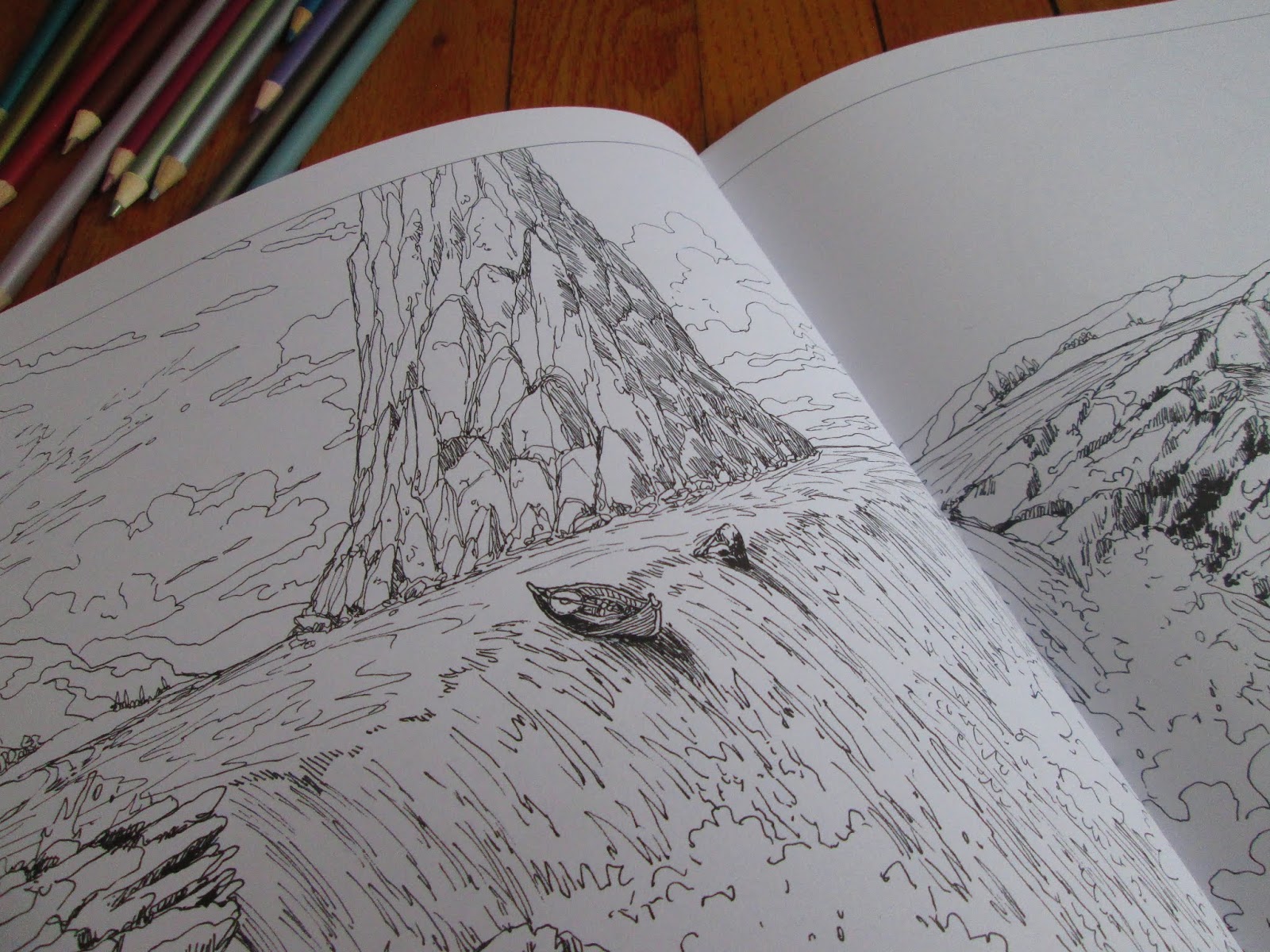
"Tolkien's World" Coloring Book

Do you enjoy adult coloring books?  I'm kind of addicted to them.  Especially the ones related to some fandom or other that I love.  So it's no surprise that I own several Tolkien-inspired coloring books.  Today, I'm going to take you on a tour of Tolkien's World.  The coloring book version, anyway.

You can actually color the slipcover if you want.  There's a different picture underneath.


The first picture I colored in this was the one I totally bought it for, a portrait of Boromir.  I had so much fun layering different colors on to get his hair and cloak to please me.


The artwork in this book is from several different artists with very different styles.  For some reason, this Smaug picture makes me think of the 1970s.


Here's a lovely Rider of Rohan I colored last month.


There are quite a few two-page panoramic pictures in this, which are a total treat.  I love all the little details!


This slice of the Shire was incredibly fun.


And here are a few pictures I haven't gotten to yet, but am looking forward to.


Have you been enjoying my Tolkien Blog Party this year?  I hope so!  I've only read a smidgen of other people's posts so far, but they've been wonderful, and I'm looking forward to reading the rest!  If you haven't joined yet... what're you waiting for?


Saturday, October 27, 2018

"The Lion, the Witch, and the Wardrobe" by C. S. Lewis

Is it weird that I liked this book WAY BETTER when I read it now, as an adult, than I did as a kid?  I'm thinking that maybe I'm old enough to read fairy tales again, like the dedication to this book says.  I read the series when I was in my early teens and just didn't care for them.  I've never been a huge fan of allegory, so that was part of it.  But I think I was just in the wrong time of life for them, like I was for The Hobbit.  

Anyway, I totally dug this book this time through!  I think I spent less time trying to "solve" the allegory and figure out who represented what, and so on, which I remember getting hung up on as a teen.  Instead, I enjoyed the characters and their arcs, and appreciated the artistry of Lewis' storytelling.  I didn't expect to say this, but I intend to reread the rest of the series over the next few months.  


I did read this one and The Horse and His Boy at least twice when I was younger, and when I was in my twenties, I went to see the movies.  So it's not like I was anti-Narnia so much as just not into Narnia.  But maybe I'm finally ready to be into it.


I was interested to discover that, as an adult, I still like Edmund best of the Pevensies.  I like Lucy too, but she's almost too good to be realistic, you know?  And so is Peter.  Susan is okay, but not someone I want to be friends with, really.  But Edmund... I understand Edmund.  I love his character arc, how he stumbles and falls and repents and finds forgiveness -- which is also a big part of why I love Boromir in The Lord of the Rings, actually.  I love how both of them are so relatable -- we all are tempted, we all sin, we all need forgiveness.  (I also love Boromir because he's wonderful, but that's another post from another time.)


If This was a Movie, I Would Rate It:  PG for some violence and scary moments.  Squeaky clean in all other respects.


This is my 22nd book read and reviewed for my second go-round with the Classics Club, and my 8th book for the OldSchool Kidlit Reading Challenge.


And this is my second book read for the Reams of Rereads event!

Tuesday, April 10, 2018

Another LOTR Read-Along: The Tower of Cirith Ungol (ROTK 6, 1)


Sam. Oh, Sam. Loyal, brave, wonderful Sam.

I've got "aww" written in the sidebar from the second time I read this (first time I underlined or made notes, back in 2005), right where Sam "no longer had any doubt about his duty: he must rescue his master or perish in the attempt." Sam tells himself, "The perishing is more likely, and will be a lot easier anyway" (p. 878), and doesn't that say so much about him? He figures he's going to die, but he's going to try anyway, and while he's at it, he's going to be as cheerful as possible!

As he prepares to enter Mordor, Sam has a moment where he figures if he does, "[h]e could never come back" (p. 878). That one little line really makes me think of the very end of the book. And that, to me, is Sam's bravest moment -- he believes he'll never get home again if he makes one step into Mordor, and he does it anyway. He gives up all hope of going home in order to save Frodo.

My favorite moment of this chapter is when Sam gets inside the stronghold and yells, "Tell Captain Shagrat that the great Elf-warrior has called, with his elf-sword too!" (p. 882). Even in great peril, he still has his sense of humor.

On a rather different subject, here is something I noticed for the very first time just today. My seventh time reading this, and I'd never picked up on it before. Frodo freaks out and snatches the ring back from Sam, and is sort of "possessed" by the ring, for lack of a better term. And when his "possession" ends and he's himself again, he says, "What have I said? What have I done?" (p. 891). That is exactly what Boromir said after he tried to take the ring from Frodo, after its control over him had ended. Check it out, page 390, right at the bottom. Exactly those same eight words. Whoa.

Favorite Lines:

He was in a land of darkness where the days of the world seemed forgotten, and where all who entered were forgotten too (p. 878).

"The whole thing is quite hopeless, so it's no good worrying about tomorrow. It probably won't come" (p. 893).

Discussion Questions:

Frodo talks to Sam about the orcs, and says: "[t]he Shadow that bred them can only mock, it cannot make: not real new things of its own. I don't think it gave life to the orcs, it only ruined them and twisted them" (p. 893). What do you think of that, and how it might apply to the creative process? When we humans create things, are we actually "creating" new things of our own? Or are we taking what God made and sort of... twisting them around? Especially if we're trying to create things to please or honor ourselves, rather than to honor God? What do you think -- am I reading too much into that?

Monday, April 2, 2018

Another LOTR Read-Along: The Siege of Gondor (ROTK 5, 4)


Isn't Denethor hideous? That description of him at the beginning of this chapter is so perfect and awful: "an old patient spider" (p. 788). Blech. It's amazing Boromir and Faramir turned out so well, with a creep like that for a dad. Probably he neglected them a lot when they were kids. Lucky them.

Should I quick mention how sweet it is that Pippin remembers liking Boromir "from the first, admiring the great man's lordly but kindly manner" (p. 792)? Yes, it seems I should. It's the fondest, nicest thing anyone says about Boromir, I think.

Gandalf continues to make me smile at odd moments. When he's explaining things to Pippin again, for instance, and says, "But what?... Only one but will I allow tonight" (p. 796). I need to remember that line and use it with my kids.

Plus, Gandalf gets one of the most chilling lines in the book. He calls the Lord of the Nazgul "a spear of terror in the hand of Sauron" (p. 800). Ooooh. Isn't that brilliant? Makes my hair stand on end even now as I flip through the chapter.

And is there any chapter in any book that ends so magnificently? With Gandalf squaring off with the Lord of the Nazgul, telling him in effect that he Shall. Not. Pass. The Black Rider laughs, Gandalf stands firm, and then... oh my goodness, I'm choking up as I re-read it. I had tears rolling down my face when I read this ending yesterday. I still get chills racing up and down me. "Horns, horns, horns. In dark Mindolluin's sides they dimly echoed. Great horns of the North wildly blowing. Rohan had come at last" (p. 811).

Wow.

Favorite Lines:

"Stir not the bitterness in the cup that I mixed for myself," said Denethor (p. 795).

"Comfort me not with wizards!" said Denethor (p. 805).

Discussion Questions:

Gandalf describes Aragorn a "able to take his own counsel" (p. 797). Hasn't Denethor been taking his own counsel? What's the difference between the two of them?

Gandalf healed Theoden of his dispair. Why hasn't he been able to help Denethor stop being so gloom-and-doom?

Monday, March 26, 2018

Another LOTR Read-Along: The Passing of the Grey Company (ROTK 5, 2)

Another looooooong chapter. Good thing there are some shorter ones ahead.

I love when Halbarad and the other Rangers arrive -- it's such a bright spot of joy for Aragorn amidst all this Very Important Stuff that's been going on. And it's so cool that Elrond's sons, Elladan and Elrohir, come too. They're quiet, but intriguing. And have grey eyes. You knew I was going to mention that, of course. And I did.

Interestingly, Aragorn says that the Men of the Mountains "had worshipped Sauron in the Dark Years" (p. 765). As far as I can remember, that's the only time the word "worship" gets used in this whole trilogy. They talk about power, they talk about Sauron having control of places and people, but I do not recall any other place where someone is said to have worshiped him. Hmm.

Poor Eowyn. She yearns for Aragorn so much, and he keeps trying to tell her that his heart is not available. He even tells her, "Were I go to where my heart dwells, far in the North I would now be wandering in the fair valley of Rivendell" (p. 766). And yet, she still keeps hoping. She really makes me so very sad here.  Still, maybe Aragorn could have been a little more direct?  You know, said, "I'm in love with someone else." Stopped paying her compliments like, "I walked in this land ere you were born to grace it" (p. 766). I mean, it's one thing to be gentlemanly, Aragorn, but it's totally another to say nice things to someone you obviously know liiiiiiiiiiiiiiiikes you.

Anyway, I love the way Theoden treats Merry, don't you? With kindness and respect and interest. It's so completely the reverse of how Denethor treats Pippin. And both Merry and Pippin swear fealty to a powerful ruler, but for totally different reasons. Pippin does it out of obligation, honoring not Denethor, but Boromir. Merry does so out of love and respect for Theoden. I've talked before about how there are a lot of mirror-image things going on in these books, events in one book being repeated in a different way in another book. This is the clearest instance of that, I think. As Jane Chance pointed out in The Lord of the Rings: The Mythology of Power, Theoden and Denethor's names even kind of reflect each other. The-o-den. Den-e-thor. One is a kind and loving leader who "commands through respect and love," and the other is a "tyrant [who] commands his followers by edict, rule, law" (p. 90 in TLOTR: The Mythology of Power). I find comparing the two of them so fascinating.

But moving right along, there's one thing about the whole Paths of the Dead section that has always bugged me. Legolas says he will go with Aragorn because he "[does] not fear the Dead" (p. 764). And when they reach the Dark Door, it says "there was not a heart among them that did not quail, unless it were the heart of Legolas of the Elves, for whom the ghosts of Men have no terror" (p. 769). But what about Elladan and Elrohir? They're Elves too! Has Tolkien totally forgotten about them for a while? I kind of feel like he has, because a few paragraphs later, Gimli says, "Here is a thing unheard of... An Elf will go underground and a Dwarf dare not!" (p. 769). Shouldn't he say, "Elves will go underground" instead? And then at the end of the chapter, it says, "No other mortal Men could have endured it, none but the Dunedain of the North, and with them Gimli the Dwarf and Legolas of the Elves" (p. 772). Um... AND Elrohir and Elladan! (I actually have that written in my copy.)

One last thing: I so sympathize with Gimli. As they walk the Paths of the Dead, "he was ever hindmost, pursued by a groping horror that seemed always just about to seize him" (p. 770). That is exactly what chases me up the stairs if I have to be the last one going to bed at night.

Favorite Lines:

"He was tall, a dark standing shadow" (p. 757).

More than ever he missed the unquenchable cheerfulness of Pippin (p. 762).

And she answered: "All your words are but to say: you are a woman, and your part is in the house. But when the men have died in battle and honour, you have leave to be burned in the house, for the men will need it no more. But I am of the House of Eorl and not a serving-woman. I can ride and wield blade, and I do not fear either pain or death" (p. 767).

Discussion Questions:

Do you think Tolkien forgot about Elrohir and Elladan?

Eowyn is very upset that she has to stay with her people and be their leader instead of riding to danger and glory with Aragorn. Do you think being leader of all Rohan in the king's absence is unglorious? Why does Eowyn?

Saturday, March 24, 2018

Another LOTR Read-Along: Minas Tirith (ROTK 5, 1)


Here we are at Minas Tirith at last. This chapter makes me a little melancholy. First, because Boromir isn't here, returning to aid the city he loves. And second, because Minas Tirith is a very sad place. It's half empty, even before the women and children leave, a withering place filled with long grief.

Anyway, we get to learn about about one of my favorite minor characters: Prince Imrahil of Dol Amroth. Tolkien says that his folk are "tall men and proud with sea-grey eyes" (p. 734). How sea-grey eyes are different from just grey eyes is beyond me, but maybe they're got a bit of blue to them? Cowboy and our youngest child have grey-blue eyes, so maybe they're descendants of the people of Belfalas :-D  Later on in the chapter, Prince Imrahil arrives, and we also learn he's a kinsman of Denethor. In fact, if I recall correctly, he had a claim to the stewardship of Gondor if Denethor's line failed.  Denethor married his sister?  Or aunt?  Phooey, I don't remember.

But getting back to Boromir. Gandalf says that Denethor "loved him greatly: too much perhaps; and the more so because they were unlike" (p. 737). That's such a relief to me! Denethor is this dreadful, lurking spider sort of person and I really can't stand him, so I'm very relieved that we get an explicit report here that Boromir was unlike him.

We get some cool insight into Gandalf and his purpose in Middle Earth here too. He tells Denethor that "the rule of no realm is mine, neither of Gondor nor any other, great or small. But all worthy things that are in peril as the world now stands, those are my care. And for my part, I shall not wholly fail of my task, though Gondor should perish, if anything passes through this night that can still grow fair or bear fruit and flower again in days to come. For I also am a steward" (p. 742). I love that idea of Gandalf as the steward and caretaker of all Middle Earth.

Also, I think my favorite moment in this book is when Gandalf laughs suddenly, and Pippin looks up at him and sees that "under all there was a great joy: a fountain of mirth enough to set a kingdom laughing, were it to gush forth" (p. 742). I think that might be the moment where Gandalf first became one of my favorites. I love happy people, being overall quite cheerful myself, and that joy lurking under his solemnity is so delightful.

And here we learn a bit more about Faramir's seeming ability to "read" Gollum's mind back in the last book! Gandalf says that "the blood of Westernesse runs nearly true" in both Denethor and Faramir, and that Denethor "has long sight. He can perceive, if he bends his will thither, much of what is passing in the minds of men" (p. 742-43). I assume since Faramir has an equal amount of Westernesse-ness with Denethor, he can do the same.

Goodness, this is getting long! And I haven't even mentioned Beregond and his splendid son Bergil. Such a meaty chapter! (And a long one.) I really like Bergil -- he's just about the only youngster in this book, isn't he? And he's such a cheerful kid. I'd like to hang out with him myself. I chuckle repeatedly over all the stuff about him threatening to stand Pippin on his head.

Favorite Lines:

"Courage will now be your best defense against the storm that is at hand -- that and such hope as I bring" (p. 733).

"If you have walked all these days with closed ears and mind asleep, wake up now!" (p. 737).

"The Darkness has begun. There will be no dawn" (p. 755).

Discussion Question:

What do you think of Pippin impulsively offering his fealty to Denethor?  Good idea, or bad?

Wednesday, March 14, 2018

Another LOTR Read-Along: Journey to the Cross-roads (TTT 4, 7)

I like how Faramir's farewell to Frodo and Sam includes "the manner of his people, stooping and placing his hands upon their shoulders, and kissing their foreheads" (p. 680). That is exactly how Aragorn said farewell to Boromir when he died, and I love that detail, that Aragorn knew enough of Gondorian ways that he knew how to properly say farewell to a man of Gondor, in the Gondorian custom.


Although we spend most of this chapter slogging on through bleak, unfriendly environs, at the very end of the chapter, we come to an unexpected moment of beauty and hope. The setting sun finds a break in the clouds and sends them a brief beam of actual light. And it lights on a statue, something like the giant statues of the Argonath that the Fellowship passed between in their canoes so long ago. Although the rude inhabitants of Mordor have knocked down its head and painted graffiti all over the rest of it, nature finds a way to heal their hurts just a little. A vine with white flowers gives the fallen king's head a new crown.

And that, to me, is such a gorgeous symbol of Aragorn's whole story. Sauron and his minions may have knocked the rightful kings of Middle Earth off their throne when Isildur was murdered centuries ago. But Isildur's line endured, even though separated from the throne. Son after son lived on in secret, waiting, hoping for the right time to reclaim the throne. And the time has come for one of them, Aragorn, son of Arathorn, to come forth. The sword that was broken is reforged. Aragorn has begun telling people who he is, and folk are showing him allegiance. He's not king yet, just like that statue's head is not yet back on its shoulders. But he's recognizable as royal, like the stone head with a circlet of flowers. "'Look, Sam!' he cried, startled into speech. 'Look! The King has got a crown again!'" (p. 687). It's a great bit of foreshadowing, too.

Favorite Lines:

"A waiting silence broods over the Nameless Land" (p. 679).

"Maybe," said Sam; "but where there's life there's hope, as my Gaffer used to say; and need of vittles, as he mostways used to add" (p. 685).

Discussion Questions:

Sam dreams he's back at Bag End, heavily burdened and tired. Frodo sleeps "unquietly" and mutters Gandalf's name. What do you think their contrasting dreams say about their own mindsets at this point?

Faramir calls the region of Mordor they're about to enter "the Nameless Land" (p. 679). Like "No Man's Land" in World War One, like "He Who Must Not Be Named" in Harry Potter, sometimes the fact that a place has no name or no owner, or their name is not to be spoken, tells us a lot about them. What can we tell about this place from the fact that it has no name?

Wednesday, March 7, 2018

Another LOTR Read-Along: The Window on the West (TTT 4, 5)

This is more like it! Finally, we're talking about Boromir again!

Okay, honestly, even if Boromir wasn't mentioned, I would be so happy with this chapter. A brief reprieve from wandering around in the grey dismality of Almost-Mordor. Food and rest for poor Sam and Frodo. Whew.


And hello, Faramir! It's weird, but for many years, I never paid a whole lot of attention to Faramir. I tended to just think of him as Boromir's little brother, and isn't it nice how much he loved his brother, etc. But during my previous read-through, I was really struck by just how grand Faramir really is. He's like a knight out of a King Arthur story, chivalrous and honorable to a fault.

And he listens better to the old stories than Boromir, for Faramir says of Lothlorien, "few of old came thence unchanged, 'tis said" (p. 652), while Boromir said, "it is said that few come out who once go in; and of that few none have escaped unscathed" (p. 329). Aragorn, of course, corrected Boromir thus: "Say not unscathed, but if you say unchanged, then maybe you will speak the truth" (p. 329). Faramir got it, but Boromir didn't. Interesting.

He's something of a paradox, this Faramir. He's obviously a good warrior, since his followers told us in the last chapter that "he leads now in all perilous ventures" (p. 645), yet he himself says, "I do not love the bright sword for its sharpness, nor the arrow for its swiftness, nor the warrior for his glory" (p. 656). Unlike Boromir, he doesn't enjoy deeds of valor for their own sake, but does them out of necessity.

Oh, and... Faramir has grey eyes! Pattern still holds.

Favorite Lines:

"We are a failing people, a springless autumn" (p. 662).

"Your heart is shrewd as well as faithful, and saw clearer than your eyes" (p. 666).

"...the praise of the praiseworthy is above all rewards" (p. 667).

He planted himself squarely in front of Faramir, his hands on his hips, and a look on his face as if he was addressing a young hobbit who had offered him what he called 'sauce' when questioned about visits to the orchard (p. 650).

Discussion Questions:

Faramir says, "We are truth-speakers, we men of Gondor. We boast seldom, and then perform, or die in the attempt" (p. 665). How does that differ from what Eomer said back in "The Riders of Rohan," when he claimed that "the Men of the Mark do not lie, and therefore they are not easily deceived" (p. 424)?

Why does Tolkien place this great emphasis on truth-telling?

Monday, March 5, 2018

Another LOTR Read-Along: Of Herbs and Stewed Rabbit (TTT 4, 4)


I quite like this chapter. Why? Because Frodo and Sam get to eat their herbs and stewed rabbit! That makes me so happy. (In the movie, they get interrupted, and that saddens me deeply.) Also, we finally get to walk through some more pleasant countryside. And more happens than just trudging and being weary.

And here we meet a new character: Faramir, Captain of Gondor. You'll learn a lot about him in the next chapter. For now, we have learned that since Boromir left, Faramir "leads now in all perilous ventures" (p. 645).

Favorite Lines:

"Know, little strangers, that Boromir son of Denethor was High Warden of the White Tower, and our Captain-General: sorely do we miss him" (p. 641).

"Wise man trusts not to chance-meeting on the road in this land" (p. 644).

"May the light shine on your swords!" (p. 644).

To his astonishment and terror, and lasting delight, Sam saw a vast shape crash out of the trees and come careering down the slope (p. 646).

Discussion Questions:

Do you like potatoes?

As they walk through more pleasant environs, Sam laughs "for heart's ease, not for jest" (p. 636). Why do you think Tolkien includes the explanation of why Sam laughed? What does it tell us about Sam?

Friday, January 26, 2018

Another LOTR Read-Along: The Riders of Rohan (TTT 3, 2)

The title of this chapter has a smiley face beside it in my copy. It's another of my favorites, as you'll see by how many fave lines I list below.

I'm always so glad that, immediately after taking away my Boromir, Tolkien introduces another of my favorite characters. I am, of course, referring to Eothain, that paragon of charm and tact and good cheer. Open-hearted, kindly, friendly Eothain.


You're right, I'm totally not referring to Eothain. He's kind of a jerk. I mean Eomer, of course! Wonderful Eomer, "in manner and tone like to the speech of Boromir, Man of Gondor" (p. 421). Hmm, no wonder he's one of my favorites! Also, Eomer seems to have met Boromir, as he talks about seeing him, calls him "a worthy man" (p. 425), and laments his death.

Side note -- I love so much how every time someone learns about Boromir's death, they loudly mourn his loss. Here, Eomer says such lovely things that I can't resist quoting them:
"Your news is all of woe!" cried Eomer in dismay. "Great harm is this death to Minas Tirith, and to us all. That was a worthy man! All spoke his praise. He came seldom to the Mark, for he was ever in the wars on the East-borders; but I have seen him. More like to the swift sons of Eorl than to the grave Men of Gondor he seemed to me, and likely to prove a great captain of his people when his time came" (p. 425).
(And here you thought that once Boromir had died, I would shut up about him. Nope! Not gonna happen.)

Know who else is wonderful in this chapter? Aragorn. Isn't he cool, listening to the ground to hear how far away the orcs are? And when they've been hunting for simply days, he's described the same way here as he was back in Moria. It says here that "Aragorn walked behind [Gimli], grim and silent" (p. 418), and back in "A Journey in the Dark" it says, "In the dark at the rear, grim and silent, walked Aragorn" (p. 302). It seems I really love Aragorn when he's being grim and silent, as I both that chapter and this are some of my favorite sections.

And I love Legolas in this chapter, don't you? Seeing such impossible details of things very far away. I always laugh when Aragorn spots the Riders of Rohan, and we're all impressed that he can see things that are so far away. And then Legolas casually one-ups him with, "there are one hundred and five. Yellow is their hair, and bright are their spears. Their leader is very tall" (p. 420). Cracks me up.

And I love Gimli here too. He's so sweet! First he says, "The thought of those merry young folk driven like cattle burns my heart" (p. 414). And then he's so sad over the fact that Merry and Pippin are probably dead that he says, "My legs must forget the miles. They would be more willing, if my heart were less heavy" (p. 418). This, from the stoic Dwarf, is a lot of emotion.

I think one of the reasons that the Rohirrim are my favorite culture in Middle Earth is pretty well summed up by Eomer here: "we desire only to be free, and to live as we have lived, keeping our own, and serving no foreign lord, good or evil" (p. 423). That's a pretty good description of how I want to live my own life.

And we find out here once and for all that the Rohirrim are not giving or sending horses to Sauron. The Orcs have stolen some, but that is all. Finally we can put that evil rumor to rest. Whew.

Favorite Lines:

"Ah! the green smell!" he said. "It is better than much sleep. Let us run!" (p. 414) (I sometimes say this when I'm hiking in the woods with my kids. And then regret it, because they take off running and I have to run to keep up.)

"Not idly do the leaves of Lorien fall" (p. 414).

...Legolas was standing, gazing northwards into the darkness, thoughtful and silent as a young tree in a windless night (p. 416).

"What news from the North, Riders of Rohan?" (p. 421).

"Do we walk in legends or on the green earth in the daylight?" (p. 424).

"Return with what speed you may, and let our swords hereafter shine together!" (p. 429).

"There are some things that it is better to begin than to refuse, even though the end may be dark" (p. 430).

Discussion Question:

Eomer says that "the Men of the Mark do not lie, and therefore they are not easily deceived" (p. 424). Do you think that makes sense? Or would someone practiced at lying be better at spotting other people's deceit?

Wednesday, January 24, 2018

Another LOTR Read-Along: The Departure of Boromir (TTT 3, 1)

You'd think this would be my least-favorite chapter, right? Except it's so glorious and brave and wonderful, that I don't hate it. At all. It just makes me cry and mourn and frown and glower a lot.

Even in death, Boromir is still magnificent. He's "pierced with many black-feathered arrows" and "his sword was still in his hand" (p. 404), which means he went down fighting to the last, and oh my goodness, how much I love him here. He killed at least twenty Orcs, trying to save the Halflings that he'd taken such good care of all along.


What are his first words to Aragorn? A confession. "'I tried to take the Ring from Frodo,' he said. 'I am sorry. I have paid'" (p. 404). In fact, this whole scene is a beautiful enactment of confession and absolution. Boromir realized his sin and repented of it earlier, and now he confesses it and is forgiven. Aragorn tells him, "Be at peace!" (p. 404), an absolution and benediction in one. I'm getting all tingly just re-reading it to type this up.

And this is the scene where I go from liking to loving Aragorn. He blames himself for everything going wrong, when he could so easily have denounced Boromir and blamed him. But he doesn't. He says, "All that I have done today has gone amiss" (p. 404), while "[t]he last words of Boromir he long kept secret" (p. 409). Wonderful guy, Aragorn.

And so they commit Boromir's body to the river and set off after the Orcs.

And here we encounter another of my favorite themes: doing what needs doing whether you have any hope of success or not. Aragorn says here, "With hope or without hope we will follow the trail of our enemies" (p. 410), echoing what he said when Gandalf fell in Moria: "'We must do without hope,' he said. 'At least we may yet be avenged'" (p. 324). This theme will pop up again later on, too. I find that so interesting, the idea that having no hope can strengthen your resolve. It's not how it's supposed to work, right? You're supposed to keep morale high and encourage people so they won't give up in despair, right? But it also feels quite true that when you have nothing left to lose, not even hope, you are willing to do almost anything.

Favorite Lines:

"An evil choice is now before us!"

"Then let us do first what we must do," said Legolas (p. 405).

"Maybe there is no right choice," said Gimli (p. 406).

The River had taken Boromir son of Denethor, and he was not seen again in Minas Tirith, standing as he used to stand upon the White Tower in the morning (p. 407).

"In Minas Tirith they endure the East Wind, but they do not ask it for tidings" (p. 408).

Discussion Questions:

Aragorn and Legolas sing a song about Boromir as they set his body adrift. Aragorn calls him "Boromir the Tall" and "Boromir the Bold," and Legolas calls him "Boromir the Fair." What do you think those descriptions say about Aragorn and Legolas themselves? Like, how did their choices of description for him reveal what they thought about him, or what they valued in him?

Do you think I'm going to shut up about Boromir now?   ;-)

Monday, January 22, 2018

Another LOTR Read-Along: The Breaking of the Fellowship (FOTR 2, 10)

This is such a sad chapter. Boromir falls under the ring's power entirely, and Frodo spends most of the chapter being afraid to do what he must. Gloom and doom, doom and gloom.

I was rather surprised that, when everyone is giving Frodo some thinking time, Legolas not only announces he wants the decision to go to a vote, but declares that he would vote for going to Minas Tirith! I had completely forgotten that, and it just... I don't know. It feels somehow out of character, to me. Legolas is usually sort of aloof from the whole affair, just going along to help however he can, and now he's calling for votes and getting almost bossy. Maybe this another instance of "the evil of the Ring [being] already at work even in the Company" (p. 392), as Frodo put it?  Changing people's behavior, even an elf's?

But I love Sam at the end of the chapter, when he explains to everyone just what Frodo's struggle really is, and then figures out Frodo's plan to leave alone and thwarts it. Dear, dogged Sam. I especially love this part: "I'm coming too, or neither of us isn't going. I'll knock holes in all the boats first" (p. 397). I so want to hug him there.


The authors of Finding God in the Lord of the Rings, Kurt Bruner and Jim Ware, point out that people "were not made to bear the burden and experience the joys of life's journey alone. That's why God has given us the gift of companionship. The Scriptures talk of a friend who sticks closer than a brother. Such was Sam to Frodo" (p. 48). God gives us all companions to help us through life -- people obviously think about husbands and wives when they hear the whole "it is not good for man to be alone" thing in the Bible, but I don't think that refers only to finding a spouse. Into our lives come many companions. Parents, siblings, friends, spouses, co-workers, teachers, and so on. Yes, God gave Adam a wife, but he also gave Moses a brother. He gave David a best friend. He gave Elisha a mentor. He gave Naomi a daughter-in-law. All of those were companions who helped them on life's journey.

Ecclesiastes 4:9-10 says "Two are better than one, because they have a good reward for their labor. For if they fall, one will lift up his companion. But woe to him who is alone when he falls, for he has no one to help him up." We'll see many instances of this verse's wisdom in the coming books, and not just relating to Frodo and Sam, but regarding other companionships too. Something to keep your eye out for.

And hey, check it out! We finished The Fellowship of the Ring!

Favorite Lines:

"Is it not a strange fate that we should suffer so much fear and doubt for so small a thing?" (p. 388)

"It would be faithless now to say farewell" (p. 393).

Discussion Questions:

Which two towers do you think the title of the next book refers to? There's this whole section in this chapter, where Frodo is seeing the world from Amon Hen, and he sees Minas Tirith, "beautiful: white-walled, many-towered, proud and fair upon its mountain seat" (p. 391). And then it says that "against Minas Tirith was set another fortress, greater and more strong" (p. 391), which turns out to be Barad-dur, Fortress of Sauron. And I kind of feel like those are the two towers. What do you think?

This book doesn't end in the same place that the movie ends. Why do you think Peter Jackson and the other writers chose to go a bit farther with their story?

Saturday, January 20, 2018

Another LOTR Read-Along: The Great River (FOTR 2, 9)

Oh my goodness. One chapter left and we'll be done with The Fellowship of the Ring!!!

Okay, anyway, this is NOT a favorite chapter of mine. And that's solely because it's where the ring begins to take serious hold of Boromir and he gets all weird. Muttering and biting his nails and arguing about everything. My poor Boromir! To quote Hamlet, "O, what a noble mind is here o'erthrown" (III, 1). Makes me all sad for him, being seized by the power of this evil thing.

Still, lots of cool stuff going on here. Especially the Argonath. I love them in the book, I love them in the movie. So majestic and grand.


I really like Aragorn in this chapter. He's the one who fears "that the Dark Lord had not been idle while they lingered in Lorien" (p. 371). I've been worried about that this whole time, with all the lengthy pit stops they keep making. Finally, someone else agrees! Time's a-wastin' here, folks!

Also, we learn here from Aragorn how Mordor has been getting horses from Rohan: he says he's heard that lately, orcs "have dared to cross the water and raid the herds and studs of Rohan" (p. 372). Why didn't he say so back in Rivendell when Gandalf was recounting Gwaihir's passing along of the scurrilous rumor that Rohan pays a tribute of horses to Mordor? Back then, Aragorn just said he was sad to hear it, and it was Boromir who stood up for Rohan, saying he would never believe such a thing because "[t]hey love their horses next to their kin" (p. 256).

But anyway, we also have a grand moment here where Legolas shoots one of the Fell Beasts. Hooray for Legolas!

Favorite Lines:

"Time flows on to a spring of little hope" (p. 379).

"It is not the way of the Men of Minas Tirith to desert their friends at need" (p. 380).

Discussion Questions:

Aragorn says, "How my heart yearns for Minas Anor and the walls of my own city!" (p. 384). We learned earlier that Minas Anor is the original name of Minas Tirith, which is the capitol city of Gondor now, but was once the capitol of the whole realm. Should Aragorn become king, he would sit there on the throne that Boromir's father Denethor has been keeping as Steward.

So my question is this: do you think when Aragorn says "the walls of my own city," he means Minas Tirith/Anor is his home town in a way, and he yearns for it because it's a place he belongs, or does he more mean that he yearns to have a city to call his own? To have his own city?

Thursday, January 18, 2018

Another LOTR Read-Along: Farewell to Lorien (FOTR 2, 8)


At the beginning of this chapter, they decide to leave. It takes them eleven pages in my copy to actually do so. Lothlorien must be a very charming place indeed!

I always feel so very sad for Sam here, because he missed out on learning how the Elves make rope. A completely missed opportunity, one he's obviously not going to have again, and one he didn't even have the chance of either accepting or rejecting. It's just, "Oh, you like making rope? Too bad we didn't know." Makes me kind of depressed on his behalf.

Random thing that makes me happy: Boromir says, "I have myself been at whiles in Rohan" (p. 365). I love that he's been hanging out there -- he's such a staunch defender of the Rohirrim too, whenever anyone starts in on the whole "I think the Rohirrim have been sending horses to Sauron" nonsense. You know Boromir is my most beloved character in these books, but I'm not sure I've mentioned that I love Rohan more than the other cultures. Even above the Shire, for the most part. So I'm very pleased that my favorite character has spent lots of time where I myself would like to be. In fact, he borrowed a horse from the Rohirrim, possibly the one he says here that he lost when he forded the Greyflood. He doesn't say here that he borrowed a horse, but Eomer later mentions that they loaned him one, and that it returned riderless (p. 423).

And so everyone has one last Elvish feast, gets presents, and heads off down the river. Back on track, after yet another lengthy stay with new friends.

Last year, I read a book called The Lord of the Rings: The Mythology of Power by Jane Chance, in which I learned that not only did Tolkien follow the classic myth structure (which I'm endlessly fascinated by) for LOTR as a whole (which I could see), but he actually used it within each of the six books as well. I learned from Jane Chance is that each of the two books within each volume (so books 1 and 2 in FOTR, books 3 and 4 in TTT, and books 5 and 6 in ROTK) mirror each other. This kind of blew my mind, because once I read it, I could see it. So the lengthy sojourn here in Lothlorien after the long, dark journey in Moria... mirrors the hobbits hanging out at Tom Bombadil's house for a long time after their long, dark journey in the Old Forest.

Like I said, blew my mind. There are people who can write interesting stories.  I can do that.  And there are people who can write deep, layered, complex books that are Important, like Tolkien. I stand in awe of him.

Favorite Lines:

"Maybe the paths that you each shall tread are already laid before your feet, though you do not see them" (p. 359).

"...we put the thought of all that we love into all that we make" (p. 361).

"Memory is not what the heart desires. That is only a mirror, be it clear as Kheled-zaram" (p. 369).

Discussion Questions:

Gimli said that when he set out on the quest, he knew there would probably be torment and peril, and the thought of those did not hold him back. But that he "would not have come, had I known the danger of light and joy" (p. 369). How can light and joy be more dangerous, or more terrible, or harder to deal with, than torment and peril?

Friday, January 12, 2018

Another LOTR Read-Along: Lothlorien (FOTR 2, 6)


As you know, I love Rivendell. I think it sounds restful and quiet and calm -- like a library crossed with a woodland retreat center. But I don't love Lothlorien. It's a little too otherworldly for me, I think. Frodo thinks that "[i]n Rivendell there was memory of ancient things; in Lorien the ancient things still lived on in the waking world" (p. 340). To be honest, that kind of creeps me out. My brain says that it'd be cool to be able to interact with ancient things and people, but my instincts want nothing to do with it. So I don't blame Boromir and Gimli for hesitating to go there.

But anyway, there's one bit here that makes me laugh every time. When Haldir and his brothers encountered the fellowship, Legolas told Sam that "they say that you breathe so loud that they could shoot you in the dark," which seems really rude, but I just have to laugh because "Sam hastily put his hand over his mouth" when Legolas said that, and then when Legolas, Frodo, and Sam get invited up onto one of the elves' flets, it says "behind came Sam trying not to breathe loudly" (p. 333). And that amuses me to no end, the image of Sam climbing a rope ladder and spending more energy on breathing quietly than on climbing.

Also, I love the Elvish word for orcs: yrch. It sounds like someone saying 'yuck,' which is probably exactly what I'd say if I saw an orc. After I quit screaming and running away, anyway.

Favorite Lines:

"We must do without hope," he said. "At least we may yet be avenged" (p. 324).

"Indeed in nothing is the power of the Dark Lord more clearly shown than in the estrangement that divides all those who still oppose him" (p. 339).

"We live now upon an island amid many perils, and our hands are more often upon the bowstring than upon the harp" (p. 339).

"The world is indeed full of peril, and in it there are many dark places; but still there is much that is fair, and though in all lands love is now mingled with grief, it grows perhaps the greater" (p. 339).

On the land of Lorien there was no stain (p. 341).

Discussion Questions:

There's a poignant moment where Merry tells Haldir, "I have never been out of my own land before. And if I had known what the world outside was like, I don't think I should have had the heart to leave it" (p. 339). I'm reminded of what Elrond told Pippin when he and Merry didn't want to be left behind. Elrond said they wanted to go along "because you do not understand and cannot imagine what lies ahead" (p. 269). However, later on, Aragorn will disagree with Elrond's statement when he says of Merry, "[h]e knows not to what end he rides; yet if he knew, he still would go on" (p. 762). Who do you think understood the hobbits better, Elrond or Aragorn? Or does this reflect a change in Merry and Pippin, part of their character arcs?

Do you find Lothlorien kind of eerie or really cool? Or something in between?

Monday, January 8, 2018

Another LOTR Read-Along: A Journey in the Dark (FOTR 2, 4)

A quick house-keeping note:  Starting today, I will be bumping our pace up to at least 3 chapters a week.  I got very busy AND very lazy over the holidays, but I'm back into the swing of real life now, so we will not be meandering through these books anymore, but marching steadily along.  (I hope.)


Every time I read this chapter, I decide I should thereafter sign everything as "one stray wanderer from the South" (p. 288). Totally my favorite description of Boromir. Just so you know.

This chapter has lots of exciting parts, with the wolves, and then the watcher in the water, and then all the wandering around in Moria. And once again, I don't have lots to say. Hmm. And yet, this and the previous chapter are one of my favorite sections of the book.

Gandalf says that he "once knew every spell in all the tongues of Elves or Men or Orcs" (p. 299) that were used to open enchanted doors. So... there must have been a lot of enchanted doors around at one time, and they've just fallen into disuse?  Why?  I mean, if I had an enchanted door that you could only open with the right password, I think I'd keep using it. Sounds very handy in case of a siege, for instance. Or for stockpiling Christmas presents where the kids couldn't get at them.

Once Gandalf figures out how to open the Doors of Durin, he says, "Of course, of course! Absurdly simple" (p. 300). This makes me laugh, not for a LOTR-related reason, but because there's a moment in the Sherlock Holmes story "The Dancing Men" where Holmes doesn't want to explain to Watson how he deduced something because he says that once he explains, Watson will say, "How absurdly simple!" Watson insists that he won't, Holmes explains, and then Watson cries, "How absurdly simple!" It's a funny moment in the story, and particularly funny in the Jeremy Brett TV show version. So just thought I'd share :-)

Also, the welcome mat by our front door says "Speak friend and enter."  Because we're cool like that.  

Favorite Lines:

"However it may prove, one must tread the path that need chooses!" (p. 289)

"The wolf that one hears is worse than the orc that one fears" (p. 290).

"That was an eye-opener, and no mistake!" (p. 291)

In the dark at the rear, grim and silent, walked Aragorn (p. 302).

Discussion Questions:

Aragorn is almost always at the rear of their procession. Why? What does that tell us about him?

How does Tolkien use Sam's devotion to Bill the pony to deepen him as a character and help us get to know him? And to know what to expect of him later in the story?