Showing posts with label WWII. Show all posts

Wednesday, July 29, 2026

"Setting Time Free" by Sarah Everest

Each installment in the Untouched serial series is more taut and exciting than the last!

Breaking Triviality was a fun adventure.  Sifting Through Chaos turned serious fast.  And Setting Time Free was so suspenseful that I read the second half of the book in one sitting!

In this third and final installment, modern-day teens Marit and Cas are still trying to help 1940s Dutch teen Anneliese and a few new friends survive in newly occupied Rotterdam.  The Nazis have overrun the city and are an ever-present menace.  Anneliese's new friend Bastiaan and his resistance buddies try to help Marit and Cas find the mysterious locket that could return them to their own time.  But there are enemies on all sides, more even than Marit and Cas really realize.

Even more so than Sifting Through Chaos, this book brought to life the heartbreak and horror of war.  There are on-page deaths and some realistic descriptions of the struggle to find food and remain humane in the midst of scrabbling for survival.

As a whole, this serialized trilogy is a thrilling, suspenseful adventure story for teens that I very much enjoyed.

This book releases on Tuesday, August 11. I was privileged to be selected to read an advance copy from the publisher, but I was not requested or required to review the book; all opinions are my own.

Particularly Good Bits:

It was as though someone had cut a hole in my stomach and pulled everything out, leaving me a hollow cocoon, my butterfly soul having flown off to chase the light of my handsome prince (Marit, chapter four).

It would have been easy to slip back into the fearful girl I had once been, but I was not that girl anymore.  I had walked through the fire and felt the devil nipping at my heels.  And despite all the evil we had witnessed, the words Betje had sent us off with rang true.  The Lord was with us, no matter how dark the night (Annelies, chapter eight).

He had stepped out of the pages of my life as quickly as he had entered them, leaving the story unfinished (Annelies, chapter seventeen).

If This was a Movie, I Would Rate It: PG-13 for wartime violence, including on-page shootings and death.  No cussing or smut.

Thursday, July 9, 2026

"Sifting Through Chaos" by Sarah Everest

Book two in the Untouched series picks right up where book one (Breaking Triviality) left off.  That's a great thing about a serialized series -- you aren't left wondering what happened between books!  I appreciate that.

In Sifting Through Chaos, modern-day teens Marit and Cas have time-traveled back to 1940s Rotterdam right when the Nazis were overrunning the Netherlands.  They meet Annelies and her family (who were in the split-time first book too) and work together to escape the bombings and take shelter at the family's farm cottage outside the city.  But that cottage isn't meant for living in, and they must find another solution.  

Along the way, they've acquired an elderly woman and an orphaned toddler to care for as well.  That gives Sifting Through Chaos some found-family elements, which I always appreciate.  The bulk of the book is about figuring out how to keep these people safe while also searching for a way to get Marit and Cas back to their own time.

Marit has had a crush on Cas for years, and she finds her feelings growing deeper as she gets to know him.  Cas has a girlfriend back home in their own time, but they have been drifting apart for a long time, and he begins to wonder if he should break things off with her if/when they return to the present.  This is partly because he is developing feelings for Marit, but also because he realizes his girlfriend is not someone he wants to spend the rest of his life with.  Meanwhile, Annelies realizes she is falling for her knew Dutch soldier friend Bastiaan.  All of this is handled with believable teenage emotions and ways of thinking.

Sifting Through Chaos doesn't end on quite as much of a cliffhanger as Breaking Triviality did, but it definitely makes me eager to read book three, Setting Time Free, which will release in August.

This book releases next Tuesday, July 14. I was privileged to be selected to read an advance copy from the publisher, but I was not requested or required to review the book; all opinions are my own.

Particularly Good Bits:

So many crushed dreams were scattered around my feet (Cas, chapter nine).

...there was just no right way to tell a three-year-old phoenix she would rise from the ashes and become the best, warmest, most understanding grandma a girl could ever ask for (Marit, chapter twenty-one).

Tears of defeat threatened to overflow, but a surprising defiance welled up inside me.  I wouldn't give the enemy the pleasure of stealing my hope (Annelies, chapter twenty-eight).

My entire world had been shuffled into ruin and nightmares (Annelies, chapter thirty).

Minutes ticked by to the steady rhythm of our feet (Cas, chapter thirty-five).

If This was a Movie, I Would Rate It:  PG-13 for wartime violence and an incident where a German soldier attempts to haul away a teenage girl and rape her (the word 'rape' is not used, but his intentions are clear, as is her growing fear of what could happen).  No gore, no bad language, and no smut.  

Tuesday, June 9, 2026

"Breaking Triviality" by Sarah Everest

Are you fascinated by abandoned places?  I know many people are, including me.  I love looking at photos of them online, and even have several coffee table books about specific kinds of abandoned places, such as Old West ghost towns.  But I've never had the temerity (or good opportunity) to explore inside abandoned places... except one.  Which I'll share photos of at the end of this post.

Three of the characters in Breaking Triviality by Sarah Everest are "urban explorers" -- they like to explore abandoned buildings.  While some people enter abandoned places because they want to hide a criminal activity, or because they want to deface someone else's property with spray paint or whatever, urban explorers are different.  They're usually motivated by curiosity about the past, or by the thrill of seeing places that are rarely entered by others, or simply by the desire to explore.  

Marit and Zander's parents encourage their teens to plan adventures.  For Marti's 17th birthday, their parents let her plan a trip to the Netherlands to meet a famous urban explorer called Cas so he can show them around some amazing ruins in Rotterdam.  Marit and Zander have Dutch heritage, so they are eager to learn more about the land of their forebears.  Plus, Marit has had a crush on Cas for a long time, thanks to his YouTube videos.

That's what half of the book is about, because this is a split-time novel.  The other half is about a Dutch teen named Annelies who lives in Rotterdam in 1940, right when the Nazis are first occupying the Netherlands.  We get to see her living in and visiting buildings that, in the present day, those urban explorers are wandering around as abandoned spaces.  Annelies's mother has died, her father is at a loss as to how to deal with the invasion, and her brother is angry about everything, but especially about not being allowed to join the Dutch military.  Some Dutch soldiers are quartered in their large home, and Annelies makes friends with one of them, bonding over a dangerous situation he helps her with.

And, at the very end of the book, time travel enters the picture.  I quite enjoy time travel stories, so I am excited to see what happens to these teens next, in both eras!  Sarah Everest draws realistic teens who are more than halfway to adulthood but still sometimes do heedless or immature things, like all the real teens I know.  The urge to show off for someone you have a crush on, the inner conflict between trying to find out if someone likes you and not wanting to know just in case you'll get rejected, the desire to be seen as capable and mature even when you're not sure if you're either one -- those all made these teens feel very real and likeable.

Also, I'm half Dutch, so I really loved all the Dutch words, food, and history woven into the book!

This is the first book in a trilogy of Christian YA novellas, and it releases next week, June 16.  I was privileged to be selected to read an advance copy from the publisher, but I was not requested or required to review the book; all opinions are my own.

Particularly Good Bits:

But for some reason -- only understood by every single girl who has ever met their semi-celebrity crush in person and been one hundred percent overwhelmed by how exactly he met every expectation -- I couldn't make my mouth form words. (Marit, chapter one)

A shiver zipped through my body, but it was the good type, like when a song is so entirely right on every level that the hairs on my arms stand on end. (Marit, chapter six)

For the life of me, I had no idea how, in one day's time, I'd gone from being a politely behaved young lady to sneaking out of my house without permission during a war, making friends with the neighborhood witch, aiding an enemy soldier, and flirting with a young man I barely knew.  (Annelies, chapter twelve)

Her cool palm reminded me of an old saying of my oma's about how cold hands represent a warm heart. (Annelies, chapter nineteen)

If This was a Movie, I Would Rate It: PG-10 for some scary wartime scenes, light descriptions of a wartime wound, and a tense chase scene.

Now, about that ruin I have explored!  It's called the Chapman-Beverley Mill, and it stands beside a highway at the edge of my county here in Virginia.  It was a grist mill built in 1742, and it ground grain to make flour for the US Army for every war from the American Revolution on through Desert Storm... and then some villainous villain set fire to it in 1998 and burnt the whole thing down.  Except its stone exterior.


The mill site is currently closed to visitors because they are doing some stabilization and restoration to the structure, but we have visited it a couple of times, years ago, when it was open and you could just wander around inside the mill, plus a couple of outbuildings.  (How long ago?  Well, the two little tykes you see in the above photo are now 14 and 16...)


It's so amazing to see this piece of history in person, even though knowing that it could still be operational and useful breaks my heart.  


I don't have lots of photos from this that don't show my kids' faces, but here's one -- I'm stepping in through that doorway where you can see my husband standing in the second photo, and he and two of our kiddos are already inside.  

Obviously, we weren't exactly doing "urban exploring" because this place was open for people to check out when we went there, with a parking lot and signs explaining the history of the mill, what different buildings and objects were used for, and so on.  But it's the closest I've come.

Monday, May 19, 2025

"Rowan Farm" by Margot Benary-Isbert

Rowan Farm
 is the sequel to The Ark and continues the story of the Lechow family as they attempt to build new lives and a new home in post-war West Germany.  Informed on the author's own knowledge and experiences after WWII, these two books show the chaos and ruin of Germany after WWII, but also the courage and hope of the people who work together to make the country fit for life and love once more.  

The youngsters from The Ark all live at Rowan Farm by this point, and have acquired some new friends.  Margret and Matthias, the two oldest Lechows, both have some romantic misadventures, though one of them does find love and start making plans for a future marriage by the end of the book.  This book is a little less funny than the first one, but instead feels more poignant and contemplative.  That feels very natural, because most of the Lechow children are pretty well grown up by the end of it.

As you might expect from a book about life in post-World War II West Germany, many struggles are portrayed here.  A new schoolmaster comes to town, a veteran who lost an arm in the war.  He and his pupils try to build a home for displaced veterans out of an old farmhouse and meet with a lot of opposition.  Other war veterans come through the story, all weary and burdened with doubt and dread and remorse.  Some new characters are escapees from Communist East Germany.  

The book never discusses Nazis or the cause for the war, only the helpfulness of American occupation troops in getting Germany back to being good and productive again.  Benary-Isbert was German herself, and wrote the first draft of The Ark while sharing an apartment with two other families in West Germany after WWII.  Both it and Rowan Farm were completed in the USA after she moved there with her husband in the 1950s.

I read Rowan Farm out loud to my kids over the past couple of months, and it marks a first for us -- we started reading it immediately after finishing The Ark.  Usually, I read a different book in between books in a series, but none of us wanted to wait to get to this book.

If This was a Movie, I Would Rate It:  PG-10 for discussions of death, loss, and suicide.  That all happens off-page, but is discussed by the characters.  No cussing, smut, or on-page violence.


This has been my 38th book read and reviewed for my 4th Classics Club list.

Tuesday, February 25, 2025

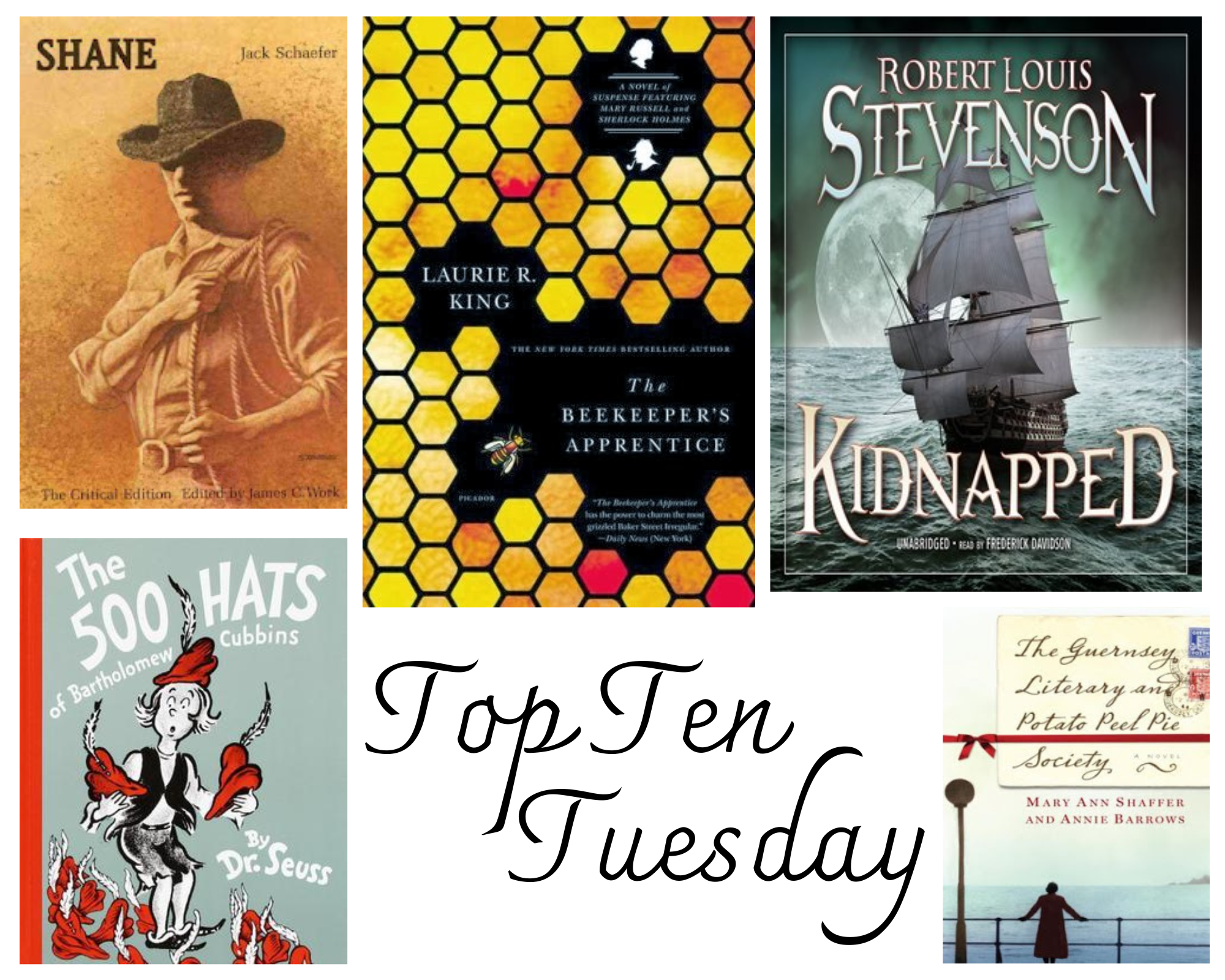
Top Ten Tuesday: It's About Time

This week's prompt from That Artsy Reader Girl for Top Ten Tuesday is "Books Set in Another Time."  I'm using that to talk about my ten favorite historical fiction books.

I think of historical fiction as fiction set during a time before the author's adult life.  For instance, an author born in 1930 who writes about the 1950s isn't writing historical fiction... but if they write about the 1850s, or even the 1930s, then it's historical fiction.  (For another example, Jane Austen's books are not historical fiction because she wrote about the early 1800s while she was living in the early 1800s.)


So!  Here are my top ten favorite works of historical fiction, along with links to my reviews and a little info into when and where they are set:

1. Shane by Jack Schaefer (1889, Wyoming)

2. The Guernsey Literary and Potato Peel Pie Society by Mary Ann Schaffer and Annie Barrows (post-WWII, Great Britain)

3. The Beekeeper's Apprentice by Laurie R. King (1915, Great Britain)

4. The 500 Hats of Bartholomew Cubbins by Dr. Seuss (Medieval England)

5. Kidnapped by Robert Louis Stevenson (1751, Scotland)


6. Speak Easy, Speak Love by McKelle George (1920s, USA)

7. Up from Dust by Heather Kaufman (c. 30 AD, Judea)

8. The Merry Adventures of Robin Hood by Howard Pyle (Medieval England)

9. King of the Wind by Marguerite Henry (1700s Morocco, France, and England)

10. A Flame in the Dark by Sarah Baughman (1500s, Germany)


Have you read any of these?  Any here that surprise you?

Or, did you do a Top Ten Tuesday post this week?  Please share in the comments!

Sunday, February 9, 2025

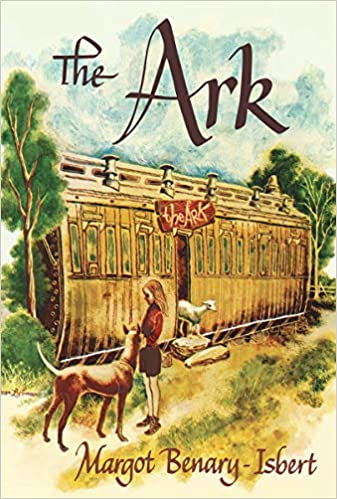
"The Ark" by Margot Benary-Isbert

I read The Ark several times as a teen -- our rural North Carolina library had it and the sequel, Rowan Farm.  I still remember they were both bound in that weird orange hardcover binding that library books so often got rebound into when their original covers wore out.

I actually tried to find this book again every now and then as an adult, because I remembered loving it.  But I didn't remember the author's name, or the name of the sequel.  Do you know how hopeless it is to search the internet for a book called The Ark that is NOT about Noah???  Pretty hopeless.

And then one day, a few months ago, a new acquaintance casually mentioned that Purple House Press had released this book.  I went tingly with hope.  Was this the same book called The Ark that I remembered???  I investigated.  It certainly sounded like the same book!  So, I ordered it, and the sequel.  And then, over the past few weeks, I read The Ark aloud to my kids.  And it is definitely the same book I remember from thirtyish years ago!!!

The Ark is about a mother and her four children in postwar Germany of the late 1940s.  They are refugees from Pomerania (a region of Germany next to Poland) living in West Germany and waiting for their father to be released from a Russian prisoner-of-war camp in Siberia.  Matthias and Margret, the oldest siblings, find work at a farm outside the town where they have been relocated.  They gradually fix up an old train car on the farm for the whole family to live in.  Meanwhile, their mother takes in sewing to help support the family, and younger siblings Andrea and Joey attend school and make friends and have adventures.

This is an amazingly heartwarming and hope-filled book, especially considering it is based on the author's own experiences after WWII.  As soon as I finished reading this book aloud, my kids insisted I begin reading the sequel right away instead of reading something else in between.

Particularly Good Bits:

"Well, what about you, Margret?" Mother asked, taking her daughter's hands in hers.  As she did so, she felt how hard and rough those delicate child's hands had become.  But this did not trouble her; she knew that calloused hands are good for getting a firm grip on life" (p. 163).

The human beings, too, withdrew within the house and within the shell of their own selves.  After the intense activity of summer and hares there followed the time of quiet contemplation, of gathering forces, though within it the stirrings of the next spring were already present (p. 210).

If This was a Movie, I Would Rate It: PG for discussions of death (including a sibling who died during the war), war, and imprisonment that might be too intense for young readers.  No cussing, smut, or on-page violence.


This is my 34th book read and reviewed for my fourth Classics Club list.  It's also the first book finished from my #25for25 list.

Tuesday, May 23, 2023

Top Ten Tuesday: Gimme, Gimme, Gimme

This week's Top Ten Tuesday prompt from That Artsy Reader Girl is "things that make me instantly want to read a book."


I thought it was going to be hard to come up with ten things that I gravitate toward, but it turned out to be really easy!  I discovered I'm actually quite predictable when it comes to what will draw me to a book.  

1. It's a mystery.  Amateur detectives, police detectives, private investigators -- I love them all.  I want to know what happened and whodunnit, and I would prefer not to figure out the solution before the author reveals it, thank you very much.  Favorite authors for my favorite genre include Raymond Chandler, A. Conan Doyle, Rex Stout, Dashiell Hammett, Jan Burke, and Laurie R. King.

2. It's historical fiction.  Give me something set in the past, and I am instantly interested.  Two particular historical settings are always magnets for me, which I'll discuss below, but really just saying "historical fiction" gets me intrigued.  

3. It's by an author I already like.  Yes, I'll try new authors.  I routinely do.  But the name of an author whose other books I know I enjoy is always going to attract me to a book.  I am a creature of habit who likes knowing a bit of what to expect, and I love to read a new book by an old favorite author.

4. It has a "found family" vibe.  So many of my favorite books have "found families" in them, like The Lord of the Rings by J. R. R. Tolkien, The Outsiders by S. E. Hinton, and The Guernsey Literary and Potato Peel Pie Society by Mary Ann Schafer and Annie Barrows.

5. It's about a close friendship.  I am far more attracted to stories that revolve around a friendship than ones that revolve around a romance.  Give me two people who would kill for, die for, or live for each other, but aren't romantically involved, and I will just eat that story up with a spoon.


6. It's a retelling.  I write retellings.  I read retellings.  I love seeing how an author can build a new story on an existing framework.  I love finding the parallels and the shout-outs and the references.  I don't love every retelling I've read, but I definitely will be attracted to a book just from hearing that it's a retelling.

7. It's a western.  This is really a recent development.  Until the last ten years or so, I infinitely preferred my cowboys to be on the screen, not on the page.  I had read maybe three or four adult westerns up until then.  Now, I gobble them up.  Not sure why it took me so long to get into them, but I'm glad to be here now!

8. It's set during WWII.  If the Old West is where my imagination lives, WWII is where it goes on vacation.  You put "1940s" or "WWII" in that cover blurb and you instantly have my attention.  

9. It's a classic.  I have read a lot of classics.  I have a lot more classics yet to read.  These books and stories and characters remained popular decades and even centuries for a reason -- because they have important and enjoyable things to say.  Also, I love how, every time I read a new classic, some reference in some other book or movie will suddenly make sense.  

10. It's got a horse on the cover.  This is a carryover from my horse-obsessed childhood, but it still holds true.  Put a horse on the cover of your book and I will at least pick it up and read the cover blurb.  Basically every time.  Powerful stuff.


This was an incredibly fun post to write!  I hope you enjoyed reading it.   I think I might do something similar over on my other blog, only about what draws me to movies, actually.

Friday, May 20, 2022

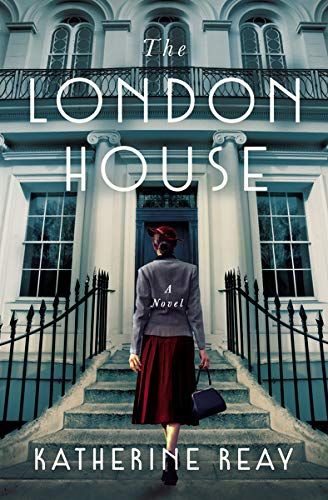
"The London House" by Katherine Reay

This was a difficult book, in some ways.  It contains two unhappy stories intertwined with each other, and I worried for a long time that at least one of them would not be resolved happily.  But I trusted Reay to at least deliver a satisfying ending, even if it was not exactly "happy," and I did not trust in vain.

In the present day, Caroline Payne is contacted by an old college friend, Mat Hammond, who has written an article about her grandmother and great-aunt and their family history during World War II.  Caroline is hurt and angered by the article, and convinced it's not entirely accurate.  Her relationship with her parents is distant, bordering on estranged, but her brother convinces her to go to their home in London and learn more from her mother there.

Caroline convinces Mat to postpone publishing the article until she can learn the truth, and off she goes to learn the real story about her grandmother and her twin sister, who may or may not have run away with a Nazi during the early days of WWII.  

Through diaries and letters, Caroline learns a startling truth about her family history -- a truth that even her grandmother and grandfather didn't really understand.  Along the way, she helps her family heal and begin to grow closer again.  Also, she and Mat tentatively consider resuming the relationship they'd let dissolve back during college.

By the end, everyone is in a much healthier and happier place, but boy, was most of this book rough!  

I'm sorry to see that Katherine Reay has continued to move away from writing explicitly Christian fiction, though.  You can't even call The London House faith-based fiction -- it's simply clean and wholesome, and that's all.  Which is not bad, but not as awesome as I think it could have been.  She talks about absolute truth existing, outside of people's perceptions and decisions and whims, but she never leads the discussion to where that absolute truth comes from.  The closest she gets is quoting C. S. Lewis a bit.  What a missed opportunity.

Particularly Good Bits:

I realized Jason and I shared something in common--we needed people in our lives with vibrancy and color, perhaps because we had somehow and somewhere lost our own (p. 44).

"When something bad happens," she continued, "it's easy to blame someone else, and in some cases maybe it is their fault, but that doesn't matter.  Not in the end.  What does matter is how long we hold on to that hurt or that anger.  We can magnify the pain, making it worse and worse until it devours us, or we can forgive it and get on with life" (p. 137).

I wondered how much my dad had missed, how much I had missed, by focusing on what was absent rather than what was in front of us (p. 152).

I need to forgive Mother and Father for not being who I needed them to be.  That sounds self-absorbed and patronizing as well, but I don't mean it that way.  I simply mean they strive to be the best parents they can--I see that now--and simply because it's not what I wanted does not mean their efforts aren't right and true (p. 236).

It is wrong to believe my perception is the only reality, and a true one at that.  There are absolute truths in this world, Margo, and I am slowly learning I do not determine them (p. 236).

If This was a Movie, I Would Rate It: PG-13 for wartime violence and discussion of an unmarried couple spending the night together (not shown, only discussed).

This has been my 20th book read off my TBR shelves for #TheUnreadShelfProject2022.

Thursday, October 28, 2021

"A Spy on the Home Front" by Alison Hart

My kids love the American Girl books, just like I did as a kid.  I've bought them a lot of the tie-in mysteries over the years, mostly at the second-hand bookstore, but I've never read any of them myself, until now.

A Spy on the Home Front is a fast read with a pretty serious topic: anti-American spying during WWII.  Molly McIntire spends every summer with her grandparents, and she's good friends with Anna Schulz, a girl her age who lives on a nearby farm.  Anna's parents immigrated to America before Anna was ever born, but now the FBI is investigating the family because they came from Germany.  They suspect Anna's older brother is trying to distribute anti-American propaganda, and Molly and Anna uncover evidence that points to someone else entirely.

Mysteries where kids find things adults can't are often kind of contrived, but this one does a good job of showing that kids sometimes are more observant than adults, but not necessarily smarter.  I had fun reading it, even if the ending was more melancholy than I had anticipated.

If This was a Movie, I Would Rate It: PG for discussions of American concentration/containment camps for Japanese-Americans and German-Americans.

This is the third book I read for the #AMonthOfMystery challenge on Instagram.

Wednesday, April 29, 2020

"Wade McClusky and the Battle of Midway" by David Rigby

This was a very cool book, especially since I love the new Midway (2019) movie so much.  This book really helped round out Wade McClusky as portrayed by Luke Evans in the movie and let me understand even better the pivotal part he played in winning the Battle of Midway during WWII.

Although the book title would suggest that this focuses solely on his role in that particular battle, it's actually a full biography of McClusky, going from his boyhood through his early naval career, and continuing on past the war into his retirement and eventual death.  But the bulk of the book does involve that particular battle and all the factors that went into how it played out.

My one quibble with this book is that it got a little repetitive with its insistence that McClusky has been misrepresented and even somewhat slandered in other accounts of the Battle of Midway.  I understand that Rigby was trying to set the record straight and show how heroic and pivotal McClusky's role in that battle was, and I agree it's important that it be understood aright.  But I feel like he belabored the wrongness of other historians and authors more than was necessary, rather than letting the truth speak for him.  There came a point when I would skim any paragraphs that dealt with pointing out the flaws in other accounts of the battle or reports of McClusky's behavior in it because it was kind of the same thing again and again after a while.  It started to feel more like a defense attorney was writing this, or a religious apologetics professor, rather than a historian and biographer.  

But I enjoyed this book overall, and I learned a great deal about Midway and the US Navy's aviation program and presence in WWII as a whole, which was really cool.

If This was a Movie, I Would Rate It: PG for some war-related accounts of violence and danger.  No cussing that I can recall.


Luke Evans really doesn't look anything like the real Wade McClusky, but he did such a marvelous job of portraying his quiet, calm, detail-oriented, attentive, steady leadership.  Though I suppose I might be biased, being an Evans fan already.  If it hadn't been for him talking about this movie on his social media accounts, though, I might never have gone to see the movie at all, which would have been a tragedy!  Because it has become one of my absolute favorite movies ever!

This is my 13th book read for #TheUnreadshelfProject2020.

Sunday, March 22, 2020

"Together at the Table" by Hillary Manton Lodge

I got this from the library not knowing that it was book three in a trilogy.  Oooooooops.  In my defense, the library barcodes and such had totally covered up all but the numeral 3 on the back cover, and that's the only place the cover mentioned it was part of a series, so I thought it was a stand-alone like Jane of Austin

But it was totally okay -- I figured out what was going on with no trouble at all.  Lodge is too good a writer to let new readers who stumble into the series midway be confused. 

And y'all... she is a very good writer indeed.  Within a few pages, I wanted to be friends with restaurateur Juliette D'Alisa, hang out at the Two Blue Doors restaurant she runs with her brother, go on genealogy-tracing adventures with her to Chicago and Europe. 

Juliette goes through a lot of relationship upheaval in this book.  Proposals.  Breakups.  Make-ups.  But none of it was... overwrought.  Or rushed.  Or sappy.  It all unfolded in a way that felt very believable to me.  The central romance was refreshingly realistic.  And there's a wedding in the middle of the book, not at the end, which was awesome!  Also, Juliette has two men in her life in a romantic sense, and neither of them is a jerk.  Or a creep.  Or a "bad boy."  They're both nice guys.  I can't remember the last time I ran into that.  Even in Jane Austen one guy ends up being secretly skanky or an opportunistic fortune hunter or whatever.  Lodge sidesteps all the love-triangle tropes so beautifully, and I applaud her.

All during her relationship changes, Juliette is also dealing with a lot of changes at the restaurant, plus she's trying to solve a mystery about her grandmother's experiences during World War II in France.  You know I also love things that involve WWII, so I really enjoyed that aspect of the story.  It's the one part where I really felt like having read the first two books would have been nice, but not to the point where I wanted to put this down and go find the earlier books and read those before finishing this one. 

Eventually, Juliette's grandmother's own words, via letter, fill in a lot of gaps and answer a lot of questions.  We learn her own story of love lost and love found.  Her story doesn't mirror Juliette's too neatly, and yet they are both stories of "lost love and second helpings" as the title puts it.

Also, Juliette's family is awesome.  She and her sisters are my people.  Their conversations are so much like things my brother and I say, dropping stuff like the Kobayashi Maru in very naturally, and just... can I please hang out with them?

I'm going to have to read the first two books now.  Our library is offering curb-side pick-up for materials to minimize contact, and I think the kids and I are going to have to try that this week.  If I end up loving those two as much as I loved this one, I'll have no choice but to buy the whole set so I can have it on my shelf and hug them as much as I want.  And reread them.

(Mine from my Instagram)

Particularly Good Bits:

I didn't answer.  I couldn't.  There were only questions in my head where answers used to be (p. 58).

Was that what it meant to be a grownup?  To finally realize that your parents weren't invincible, but that they had challenges and struggles of their own? (p. 80).

So often I feel worry is a heavy, wet, wool blanket we wear about our shoulders (p. 255).

If This was a Movie, I Would Rate It: PG-13 for some discussions of sexual matters in dialog, some frank and some veiled, all tasteful and the sorts of things adult sisters would really say to each other, or wives to their husbands.  There are no descriptive sex scenes, and I would consider this a clean book, but some might not.  There is no cussing or scenes of violence, though the WWII parts involve some dangerous situations.

Monday, November 18, 2019

"South by Java Head" by Alistair MacLean

While this won't ever be a favorite MacLean book for me, it was definitely a thrilling ride!  It's got spies (more than you realize), daring rescues, extreme escapes, a cute little kid, several nurses, some treachery, several heroes, and various exotic locations.  Also, terrible storms at sea.  Also, submarines.  Also, various explosions.

Basically, the Japanese are overrunning Singapore during WWII, and a bunch of British soldiers (many of them wounded) need to quick get out of there before they get captured and tortured and killed.  Also, there's a spy who has Very Important Information he needs to get to the Allies.  Also, there are nurses and an orphaned little boy.  They leave, they have many brushes with the enemy, people get captured, people escape, and then the whole thing ends VERY abruptly, with basically no denouement at all.

As always, the make-or-break thing for me with this book is the characters.  While I got fond of several, I never really wanted to be friends with any of them, which is why it's not going on my list of favorite Alistair MacLean books.  But it was still worth reading, and I had fun with it.

Particularly Good Bits:

The wind had dropped away now, the rain fined to a gentle drizzle and a brooding hush lay over the darkened city as it faded swiftly into the gloom of the night (p. 34).

Beyond anger lies fury, the heedless, ungovernable rage of the berserker, and beyond that again, a long, long step beyond the boundary of madness, lies the region of cold and utterly uncaring indifference (p. 266).

If This was a Movie, I Would Rate It:  PG-13 for wartime violence, some bad language, hints at what might happen to the nurses if their enemies captured them, and a few discussions of torture (but none depicted).


This is my thirteenth book read and reviewed for the 2019 Mount TBR Reading Challenge!

Monday, June 24, 2019

"The Selected Letters of Laura Ingalls Wilder" edited by William Anderson

Oh.  My.  Word.

So, my mom picked up this book at the Wall Drug bookstore in Wall, SD, a couple months ago.  She showed it to me when I was visiting her last week, and I ended up reading the whole thing over the course of about three days.  It was fascinating and encouraging and wonderful.

It was fascinating because of how well I feel like I got to know the woman behind the books I've loved basically all my life.  These letters start in 1894 and go 1956, and they are staggeringly varied.  Some are to friends, some to her husband Almanzo, some to her daughter Rose, some to perfect strangers who sent her fan mail.  The ones I liked best were the ones to children who wrote her about her books.

It was encouraging because she struggled so hard with writing By the Shores of Silver Lake, which is my favorite of her books.  I'm struggling with the book I'm writing right now, and knowing that I'm not the first writer to struggle with a book that's a ways into a series is a comfort.

It was wonderful because Laura Ingalls Wilder was such a sweet, tart, friendly, shy, intelligent, obstinate, REAL person, and you get that sense of her from these letters.  I'm so happy I read this book.  I might have to get a copy of my own.

Particularly Good Bits:

As you read my books of long ago I hope you will remember that the things that will give you happiness are the same now as they were then.  Courage and kindness, loyalty, truth and helpfulness are always the same and always needed.  (1950 letter to the Pomona Public Library) (p. 323)

If This was a Movie, I Would Rate It:  PG.  There's a very light smattering of strong language.

Monday, December 10, 2018

"Twenty and Ten" by Claire Huchet Bishop

A few homeschooling mom friends recommended this to me a few years ago when I was teaching my oldest about WWII and trying to figure out how to explain the Holocaust to him because he's very sensitive, and was even more sensitive back then.  Unhappily, I never found a copy before we were done with school for the year.  Happily, I DID find a copy last year sometime, and finally managed to read it myself this fall.  

Even though my son is in 5th grade now, I'm still going to have him read this.  But I think I'll also have my 3rd-grade daughter read it too.  It's a solemn, but hope-filled story.  

When the Nazis occupy France during WWII, twenty French children are sent to the mountains to live with Sister Gabriel, a nun who teaches and cares for them.  They survive quietly there until one day a man arrives and asks if they would be willing to hide ten Jewish orphans who have fled the Nazis.  They agree to take in the ten extra children and share their meager food and clothing.  

At first, it's fun to have more playmates.  But one day, suspicious Nazi soldiers descend on the children while Sister Gabriel is gone.  It's up to those twenty French children to endure interrogation and intimidation... or else their ten new friends will be found and captured.

Based on a true story, this book is definitely serious, and tense in places, but not quite tense enough to be scary.  I'm really glad friends recommended it to me, and I look forward to discussing it with my kids later this year when they're studying WWII.  Courage, kindness, integrity, and ingenuity are all featured here, making a powerful impact in very few words.

If This was a Movie, I Would Rate It: PG for tense and serious subject matter.


This is my 24th book read and reviewed for the Classics Club.


This is my 14th book read and reviewed for the Mount TBR Reading Challenge 2018.


And this is my 10th book read and reviewed for the Old School Kidlit Reading Challenge 2018!  Wahoo, I reached my goal for this too!

Sunday, December 31, 2017

"The Brass Compass" by Ellen Butler

I got to hear Ellen Butler speak at my local library a couple of months ago on the topic of women in the OSS.  That's the Office of Strategic Services, if you don't know, the American intelligence service they created in the early days of WWII, which has since become the CIA.  I watched the Alan Ladd movie O.S.S. (1946) earlier this year and was curious as to how accurate that representation might have been, and I'm always interested by anything to do with WWII anyway.

Butler was knowledgeable and engaging, and I very much enjoyed her presentation.  I even raised my hand to ask if she'd seen Alan Ladd's movie and if it seemed accurate in light of her own research.  (She said she thought it was accurate overall, so yay.)  Butler has even managed to meet and interview some surviving female OSS agents, and her own grandfather served as a cryptographer during WWII.  I found her fascinating.

As for The Brass Compass, it was overall most enjoyable as well.  It follows Lily, a young American who speaks French and German flawlessly.  She joins the OSS because she's bored and purposeless and is soon behind enemy lines, posing as a nanny so she can spy on a high-ranking Nazi officer.  But her cover is eventually exposed, forcing her to flee across Germany in the dead of winter.  She's eventually reunited with the man she loves, an American airman, and goes on to have more spying adventures with and without him.  It's kind of an episodic story, with Lily having various spying escapades, and with the love story threading through all of it.  

If This was a Movie, I Would Rate It:  a soft R for violence and torture, mentions of rape, description of a Nazi death camp, bad language sprinkled throughout (including an f-bomb dropped by a soldier confronted with said death camp), and some non-explicit love scenes.  Really, it's the torture that pushes my rating up from a PG-13.

Tuesday, June 6, 2017

Top Ten Tuesday: In Honor of D-Day


This week's prompt from The Broke and the Bookish is "Top Ten Books From X Genre That I've Recently Added To My TBR List."  Because today is the 73rd anniversary of the D-Day invasion of Normandy, France in 1944, I'm going to list off the Top Ten WWII-Related Books On My TBR List.


Agent Zigzag by Ben Macintyre

American Women and WWII by Doris Weatherford

The Bitter Road to Dachau by Robert L. Wise

Code Name Verity by Elizabeth Wein

Dear Enemy by Jack Cavanaugh


Lipstick and Lies by Margit Leische

Saving Amelie by Cathy Gohlke

Since You Went Away... Letters to a Soldier from His Wife by Margaret Buell Wilder

Warriors of the Forgotten Front by L. Craig Johnson

With Every Letter by Sarah Sundin

I think that's a nice mix of non-fiction and fiction, don't you?  I have about ten more books on my TBR list that deal with WWII, and it was tricky narrowing it down to the ten I most want to read.

I had a great-uncle who hit the beaches at Normandy 73 years ago.  Though he's passed away, I'd like to dedicate this post to him, and to all the other brave soldiers who participated in that extraordinary invasion.  The world is a better place because of them.

Friday, January 20, 2017

What My Kids are Reading #8

Time to talk about the books my kids are reading and having read to them lately :-)  We've found some good stuff at the library lately, and also pulled some things off our own shelves to enjoy.


Sarah (6) and Eggnog (5)

Dewey:  There's a Cat in the Library by Vicki Myron and Bret Witter, illustrated by Steve James -- This is the true story of a kitten who was left in the book drop at the public library in Spencer, Iowa, adopted by the head librarian (Vicki Myron), and proceeded to live in the library!  There are several picture books about him, this being the first.  I've been to Spencer, Iowa -- the Spencer Fair was a big deal when I was a kid, and I got to go to it with my grandparents and a bunch of cousins one year when we were visiting family in Iowa.  So I love that connection :-)


Goldilocks and the Three Dinosaurs by Mo Willems -- We are all major Mo Willems fans here, but we hadn't read this one before!  It's a silly, sly retelling of the Goldilocks story, and now Cowboy and I keep teasing our little girls about filling them up with chocolate pudding so we can eat them :-9

When a Dad Says "I Love You" by Douglas Wood, illustrated by Jennifer A. Bell -- This is a sweet, sweet book about how fathers often tell their kids they love them with actions, rather than words.  But sometimes they use words too.

Lost in the End by Winter Morgan -- A Minecraft chapter book!  My kids are obsessed with Minecraft right now, and Sarah picked this out and is determined to read it All By Herself.  She's doing such a great job of sticking to it, and will probably finish it off by the end of the week.  Her first chapter book read by herself!  I'm so proud :-D


Sam (9)

A Connecticut Yankee in King Arthur's Court by Mark Twain, retold by Lucia Monfried -- Pretty sure he's read this before, but all of a sudden, he's grooving on this funny classic about a man from Twain's day who time-travels back to Arthurian times.  I think our recent viewing of Ivanhoe (1982) prompted him to dig this out again.


The Essential Captain America, Vol. 2 by Stan Lee, Jack Kirby, Jim Steranko, & Friends -- I picked this up at a library book sale a while back, and when Sam was looking for something "new and different" to read, I pulled this off my own shelf for him (it was nestled up next to my 5 volumes of The Essential Wolverine).  He's really loved it, so I've ordered a used copy of volume 1 for him as a surprise.  Sarah really loves Cap, so I suspect she'll be trying these out before long herself.

Jars of Hope:  How One Woman Helped Save 2,500 Children During the Holocaust by Jennifer Roy, illustrated by Meg Owenson -- I got this for him for school, as we're studying WWII in history and I've been trying to find some non-scary ways to discuss the Holocaust with him.  Sam is very tenderhearted and has a vibrant imagination, and was upset by a tiny photo of General Eisenhower inspecting a death camp in a bio we read.  This is a picture book and below his reading level, but the way it focuses on the people who helped save others from the Nazi death camps is really positive and hopeful, and helps showcase the fact that even one person can fight against atrocity.  I think it also really helped him to process the idea of people killing other people just because of who or what they are.  I hope so, anyway!

Aloud to All of Them


I've blogged before about how I just don't really like The Phantom Tollbooth very much.  But Cowboy loves it, and Sam is just the right age to "get" and enjoy the wordplay, so Cowboy has been reading this aloud to all of them!  That's a big treat, as usually it's Mommy who does the reading aloud.  Sam's loving it, Sarah is kind of enjoying it, and Eggnog is barely tolerating it because she doesn't get why Sam is laughing.  So Cowboy will just have to read it aloud to her again in a few years, right?

Friday, December 30, 2016

"Where Treetops Glisten" by Tricia Goyer, Cara Putman, and Sarah Sundin

This is a trio of novellas telling intertwined stories.  The three Turner siblings each find love at Christmastime during World War Two, on three successive Christmases.  

In "White Christmas" by Cara Putman, it's 1942 when college student Abigail Turner meets factory worker Jackson Lucas accidentally.  She offers her father's lawyering services to help save the Lucas farm, and as she and Jackson meet up over and over, they become friends, then fall in love.

In "I'll be Home for Christmas" by Sarah Sundin, it's 1943, and Air Force ace Pete Turner is home on furlough in time for Christmas.  He gets reacquainted with widow Grace Kessler when her little daughter Linnie decides he's the answer to her prayer asking God for a new daddy.  

In "Have Yourself a Merry Little Christmas" by Tricia Goyer, it's 1944, and Meredith "Merry" Turner is working as a nurse in a field hospital in the newly liberated Netherlands when she encounters the man she had loved years previously, but had suspected of being a Nazi spy.

All three stories are sweet and fun, and they were the perfect sort of light reading I like during the busy end of December.  Each one had a nice message of trusting God, with characters growing and learning in believable ways.  If you're a fan of Christian fiction, holiday stories, clean romance stories, or simply the WWII setting, you'll probably get a kick out of these.  I read it as an e-book with my Kindle app, but I wouldn't mind owning a paperback copy.

Particularly Good Bits:

"I guarantee no woman has ever fallen in love with me after one kiss.  It takes at least twenty.  I happen to be quite resistible."  (from "I'll be Home for Christmas")

"The thing about love," Nancy said, more serious now, "is that it's slow to fade.  It's not a bad thing.  Love is meant to last."  (from "Have Yourself a Merry Little Christmas")

If This was a Movie, I Would Rate It:  PG for war-related things like talk about concentration camps, hiding Jewish people to protect them, people being killed, and some surgical and medical situations in the final story especially.  The romances do involve kissing, but nothing more.


This is my third book read and reviewed for the Literary Christmas Challenge hosted by In the Bookcase.