In other words, here's some of the Hamlet-related stuff I've collected over the past 18 years. I thought you might be interested in seeing some of the books and movies I've been talking about during this read-along.
First and foremost, my copies of the play's text:
The one on the very bottom is the one I'm using for the read-along. The teensy one on the top was a gift from my friend Eva recently. The one directly under it, with the sort of greyish cover, is the one I used in college when I both studied and taught this play. Most of these I've bought used over the years -- the only ones I've bought new are the bottom one, the one for college, and one in the middle with a blue stripe that has Jude Law on the cover.
Why on earth do I have 16 copies of the text? (Not counting the Charles and Mary Lamb retelling or the Cliffs Notes, which should have gone in a different photo.) Because each one has interesting notes, commentaries, essays, and so forth, and I love seeing what other people have to say about this play and learning from them. I have not read all of these yet! I like to pull one out every now and then to learn something new. I rarely let myself gorge on Hamlet the way I've been doing this month.
Then here are my illustrated retellings:
The only one I've read all the way through is the Manga version on top, which is gorgeous. Just haven't gotten to the others yet.
Here are some books that are about the play, but don't contain the full text:
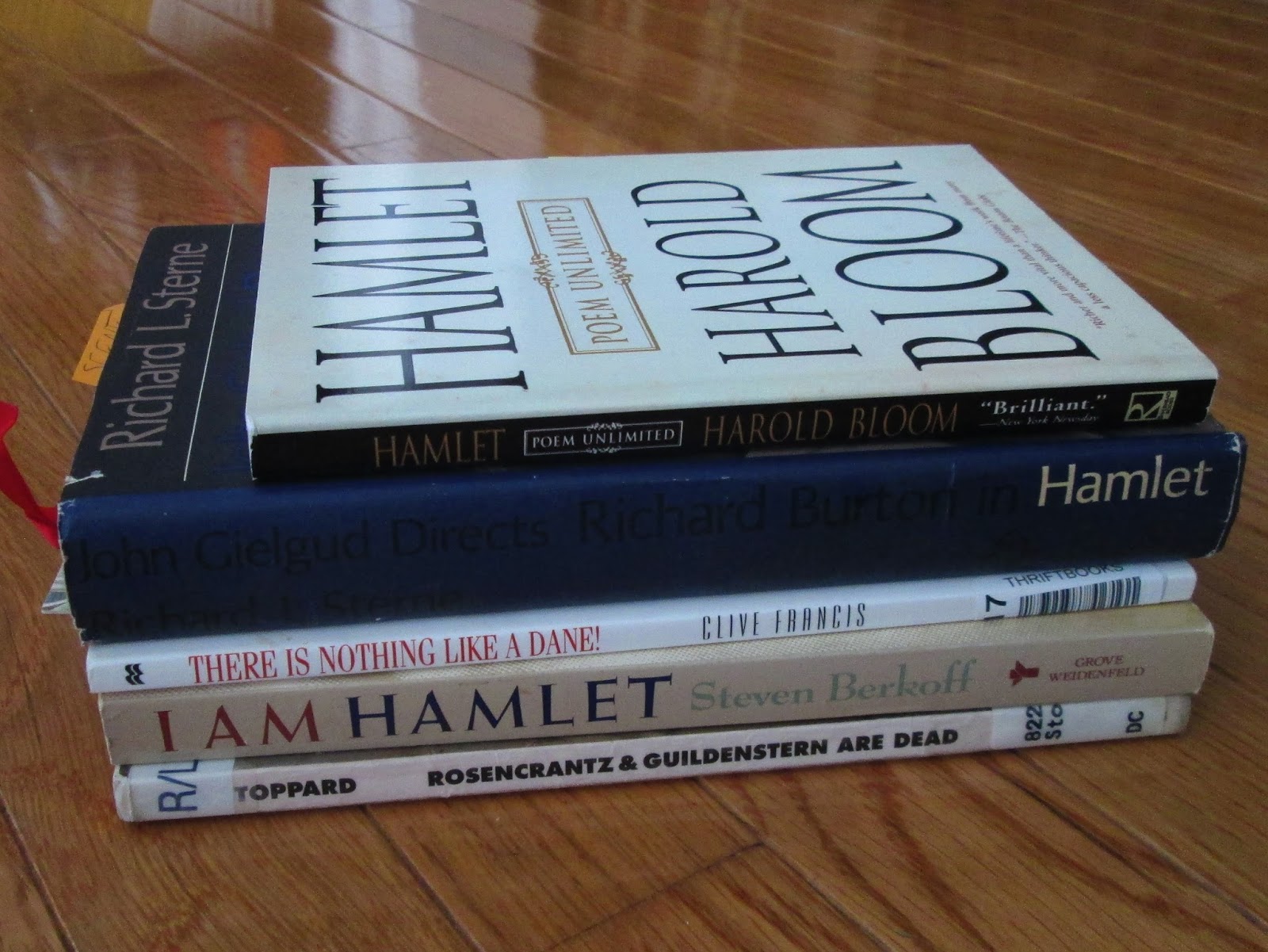
The top two are the ones I've been referencing a lot during the read-along, There is Nothing Like a Dane! is a humorous collection of anecdotes about playing the role on stage, and of course Rosencrantz and Guildenstern are Dead is a retelling in play form. I haven't read I Am Hamlet yet.
See all those sticky notes in the top two books?
Those are marking all the places where they say things I think I might want to share with you during the read-alongs. All the ones I haven't shared already, that is -- I pull them out when I'm finished with them.
And here's what I affectionately call "the doorstop." I bought this on June 26, 1997, after reading several of Shakespeare's plays in a big book from the library and deciding I wanted my own copy. I think I might have bought this while at the beach on a church youth group trip, actually. This is the copy where I first read Hamlet.
And you can tell, by the fact that the binding is broken there and naturally opens straight to this play, that I re-read this copy several times between then and going to college the next year.
In fact... this whole play just comes right out of the book, along with King Lear. That actually happened my senior year of college when I was taking a Shakespeare course and lugging this book around all semester -- we studied Lear and my binding gave up at that point.
Here's something I found tucked inside the back of that book: notes I took the very first time I read the play!
I didn't like having to flip back to the list of characters to remember who all these people with strange names were, so I copied them out and used this as a bookmark. I did that with a bunch of other plays too -- I found those lists as well. I also wrote down a bunch of favorite lines as I read.
Once I got to the "to be or not to be" soliloquy, you can see I just gave up jotting down favorite lines because I had too many -- I just wrote down the scene it was in and the page number and left it at that.
Anyway, here are all the movie versions I own:
I haven't yet watched Hamlet at Elsinore, which stars a young Christopher Plummer and is a recording of him in the role at the yearly Hamlet production in Elsinore itself. Saving that one for a future treat. I've only seen Legend of the Black Scorpion once, but the others I've watched three or more times each. I shelve them in order of production, so they range from Burton's in the '60s to Tennant's in the '00s.
Finally, here are a couple things I have hanging on the walls in my library:
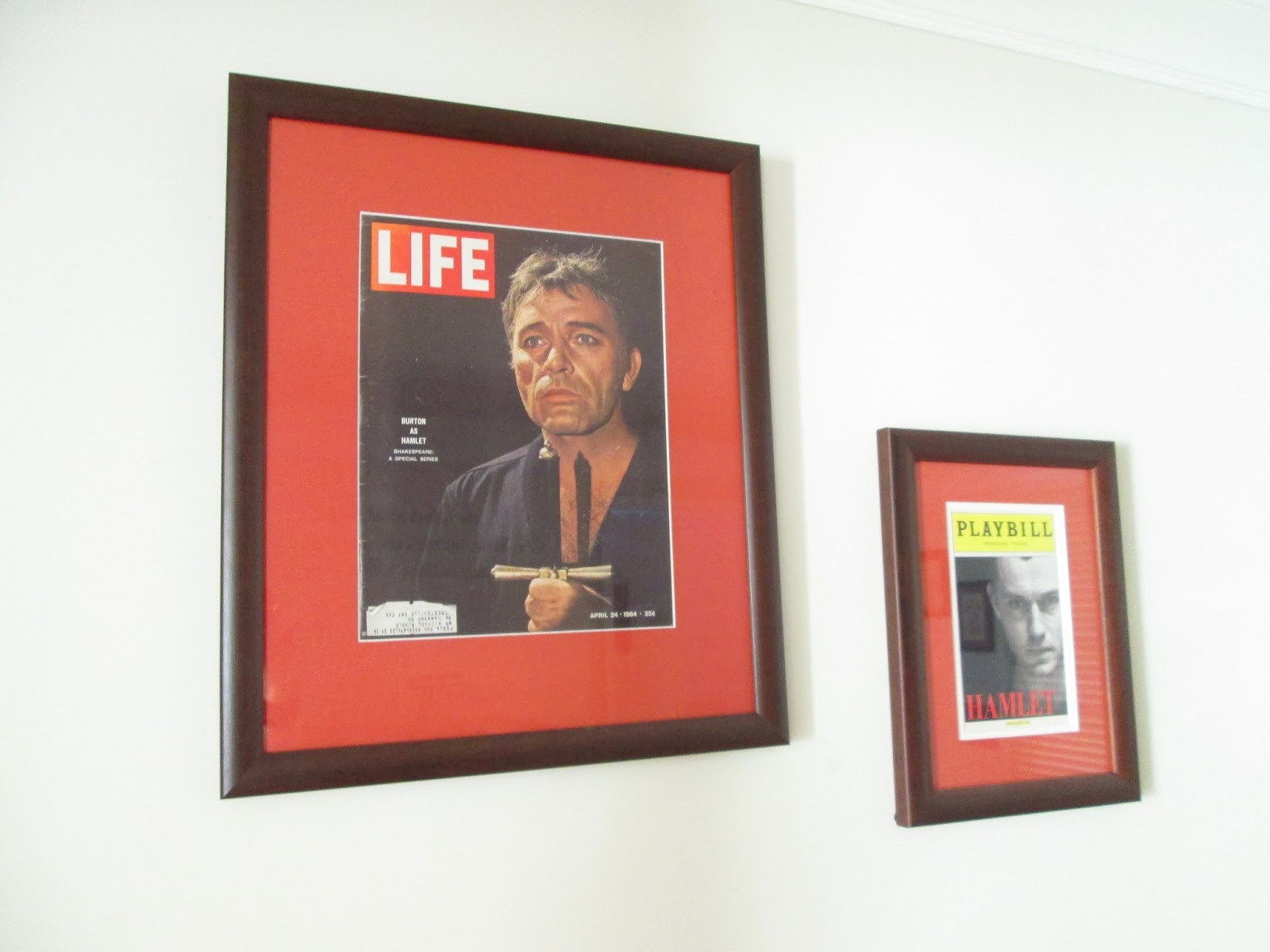
Those are both the full magazines, I didn't rip the covers off them. One is a copy of Life from the '60s with a big interview with Richard Burton in it, and also some articles about Shakespeare in general. The other is my Playbill from when I saw Hamlet performed live. Since Burton and Law are two of my absolute favorite Hamlets, I like having them paired up on my wall this way.
And this is a print of Hamlet from Etsy shop Immortal Longings. In it, reflected, you can kind of see two other prints I have on the opposite wall that are from the same shop, but of Much Ado About Nothing and The Taming of the Shrew instead. (You can see those in this post on my other blog.)
I have a few other Hamlet-related things, but they're mostly just interesting to me, and this post is pretty long as it is, so we'll just quit here.
Pages
- Home
- Who Am I?
- Books I've Written
- Book Reviews -- Fiction
- Book Reviews -- Nonfiction
- Book Reviews -- Manga/Graphic Novels
- Book Reviews -- Books By Series
- Book Reviews -- Christian Fiction
- Christmas Reads
- Clean Reads -- Adults
- Clean Reads -- Teens/YA
- Clean Reads -- Kids
- Classics Club List #5
- Top Ten Lists Year by Year
- My Favorite Novels
Thursday, October 22, 2015
Tuesday, October 20, 2015
Hamlet Read-Along: Act III, Scene 1
We start out with Rosencrantz and Guildenstern reporting that they are really bad at spying and have no idea why Hamlet is acting so oddly. Claudius and Polonius prepare to spy on Hamlet themselves, since R&G failed so utterly. An offhand remark from Polonius prompts Claudius to give us our first real clue at to whether or not he is has committed some great sin. I love the way his aside ends there: "O heavy burden!" (53) Now we know Hamlet's not the only one brooding over a secret.
Then, here it is: the famous "To be or not to be" soliloquy. One of the most famous passages in all of literature, and pretty central to the plot of this play. Of course, it's partly a musing on suicide -- Hamlet's thinking that just dying would be a lot easier than going on with this wretched revenge business. It's also a musing on one of the central themes of the play: action versus playacting. Will Hamlet lose not only "the name of action" (87), but the ability to act as well, or will his playacting at being mad, at not knowing how his father really died -- will that aid him in acting on the Ghost's information?
Some actors play this scene as quite suicidal, others have him more musing academically about death, some start out considering their own death and move on to thinking about life and death, acting and action in a broader sense. Marvelous writing that allows for so many interpretations, don't you think? I dearly love that soliloquy -- I memorized it after the very first time I read this play, and still can recite it nearly perfectly. So beautiful. (EDIT: I don't mean I read it through once and knew it perfectly. I mean after I finished reading the play, I went back and memorized the soliloquy. Took me days.)
I do find it interesting that he says "no traveler returns" (79), because hasn't the Ghost just returned from the dead, in a way? Maybe he means never fully returns.
And then here comes Ophelia, walking around with a book, just like Hamlet was doing a few scenes ago when Polonius accosted him. She's just pretending to read or pray ("orisons" means "prayers," so quite often she's shown reading a prayer book), just as Hamlet was earlier pretending to be mad. And this is generally my least-favorite scene ever. Because Hamlet is pretty cruel here, isn't he? I have a really hard time liking him here. He's very angry when he figures out she's walking there to bait him into talking so her father and his uncle can spy on him, but right from the first, he's denying he ever loved her, denying he gave her gifts or letters or whatever her "tokens" are. And telling her to go to a nunnery, which could mean just a convent, but was also slang for a brothel -- is he telling her he wants her to go shut herself away from the world and be safe, or is he saying she's a worthless whore? Either way, unkind, Hamlet. Very unkind.
He's sending her farther down the path to her own madness, the path I think Polonius first nudged her onto by suggesting that she's to blame for Hamlet's madness. So she's got that guilt riding her, and then Hamlet disavows any love for her and does a lot of yelling and shouting -- who wouldn't be an emotional and mental wreck? But what does she say, after he's berated her? "Heavenly powers, restore him!" (140). Her first reaction is to pray for him, that he can soon be more like himself again. Only after he does some more ranting and yelling does she start to pity herself. Poor, poor Ophelia -- she's the most innocent character in all of this, excepting perhaps Horatio. Of all the characters, she deserves her fate the least.
Off stomps Hamlet, out come Claudius and Polonius, and while Polonius thinks this all still stems from despised love, Claudius disagrees. Neither of them pay much attention at all to poor, weeping Ophelia, which is pretty typical of almost all the characters in this play -- they only pay her any notice if they need her to do something or they have no other choice. Laertes, her brother, is the exception here, and that's part of why I'm so fond of him. Especially when he's played well.
Favorite Lines (Besides the Entire "To Be or Not To Be" Speech):
"...to the noble mind
Rich gifts wax poor when givers prove unkind" (99-100).
"I was the more deceived" (119).
"Oh, what a noble mind is here o'erthrown!" (149).
"There's something in his soul
O'er which his melancholy sits on brood" (163-64).
"Madness in great ones must not unwatched go" (187).
Possible Discussion Questions:
Do you think Hamlet is contemplating committing suicide at this point in the play, or just thinking about it somewhat abstractly?
Why do you think Hamlet told Ophelia to go to a nunnery? Do you think he meant "convent" or "whorehouse" or possibly both?
Hamlet discusses the idea that a little lewdness will overcome a lot of chastity, and that women make monsters out of men by cuckolding them -- do you think he's speaking/thinking of his mother here? Does he maybe think she cuckolded his father? Is he comparing Ophelia to Gertrude, or warning her against such behavior?
Then, here it is: the famous "To be or not to be" soliloquy. One of the most famous passages in all of literature, and pretty central to the plot of this play. Of course, it's partly a musing on suicide -- Hamlet's thinking that just dying would be a lot easier than going on with this wretched revenge business. It's also a musing on one of the central themes of the play: action versus playacting. Will Hamlet lose not only "the name of action" (87), but the ability to act as well, or will his playacting at being mad, at not knowing how his father really died -- will that aid him in acting on the Ghost's information?
Some actors play this scene as quite suicidal, others have him more musing academically about death, some start out considering their own death and move on to thinking about life and death, acting and action in a broader sense. Marvelous writing that allows for so many interpretations, don't you think? I dearly love that soliloquy -- I memorized it after the very first time I read this play, and still can recite it nearly perfectly. So beautiful. (EDIT: I don't mean I read it through once and knew it perfectly. I mean after I finished reading the play, I went back and memorized the soliloquy. Took me days.)
I do find it interesting that he says "no traveler returns" (79), because hasn't the Ghost just returned from the dead, in a way? Maybe he means never fully returns.
And then here comes Ophelia, walking around with a book, just like Hamlet was doing a few scenes ago when Polonius accosted him. She's just pretending to read or pray ("orisons" means "prayers," so quite often she's shown reading a prayer book), just as Hamlet was earlier pretending to be mad. And this is generally my least-favorite scene ever. Because Hamlet is pretty cruel here, isn't he? I have a really hard time liking him here. He's very angry when he figures out she's walking there to bait him into talking so her father and his uncle can spy on him, but right from the first, he's denying he ever loved her, denying he gave her gifts or letters or whatever her "tokens" are. And telling her to go to a nunnery, which could mean just a convent, but was also slang for a brothel -- is he telling her he wants her to go shut herself away from the world and be safe, or is he saying she's a worthless whore? Either way, unkind, Hamlet. Very unkind.
He's sending her farther down the path to her own madness, the path I think Polonius first nudged her onto by suggesting that she's to blame for Hamlet's madness. So she's got that guilt riding her, and then Hamlet disavows any love for her and does a lot of yelling and shouting -- who wouldn't be an emotional and mental wreck? But what does she say, after he's berated her? "Heavenly powers, restore him!" (140). Her first reaction is to pray for him, that he can soon be more like himself again. Only after he does some more ranting and yelling does she start to pity herself. Poor, poor Ophelia -- she's the most innocent character in all of this, excepting perhaps Horatio. Of all the characters, she deserves her fate the least.
Off stomps Hamlet, out come Claudius and Polonius, and while Polonius thinks this all still stems from despised love, Claudius disagrees. Neither of them pay much attention at all to poor, weeping Ophelia, which is pretty typical of almost all the characters in this play -- they only pay her any notice if they need her to do something or they have no other choice. Laertes, her brother, is the exception here, and that's part of why I'm so fond of him. Especially when he's played well.
Favorite Lines (Besides the Entire "To Be or Not To Be" Speech):
"...to the noble mind
Rich gifts wax poor when givers prove unkind" (99-100).
"I was the more deceived" (119).
"Oh, what a noble mind is here o'erthrown!" (149).
"There's something in his soul
O'er which his melancholy sits on brood" (163-64).
"Madness in great ones must not unwatched go" (187).
Possible Discussion Questions:
Do you think Hamlet is contemplating committing suicide at this point in the play, or just thinking about it somewhat abstractly?
Why do you think Hamlet told Ophelia to go to a nunnery? Do you think he meant "convent" or "whorehouse" or possibly both?
Hamlet discusses the idea that a little lewdness will overcome a lot of chastity, and that women make monsters out of men by cuckolding them -- do you think he's speaking/thinking of his mother here? Does he maybe think she cuckolded his father? Is he comparing Ophelia to Gertrude, or warning her against such behavior?
Sunday, October 18, 2015
"The Silmarillion" by J.R.R. Tolkien
I have finally finished this!!! I started it way back in April to participate in the Tolkien Trio Reading Tradition hosted by James at A Tolkienist's Perspective. And yes, it took me six months to read it. I know it's fiction, but most of it read an awful lot like non-fiction. In fact, it reminded me of reading some sections of the Old Testament. Particularly if you've never read the OT before, and you don't know any of the people in the stories or what they're going to do. Then it's lots of strange names and kind of hard to keep everyone straight.
It's also a lot like the OT in that it's a story of creation. It involves angels and fallen angels, under different names, and eventually a kind of flood that changes the form of the earth. Of course, it's a fantasy-based version instead, but you can draw a lot of interesting parallels if you so desire.
I did quite like lots of this -- some of the stories captured me, especially the story of Beren and Luthien, which I at least knew a little about from reading the appendices of The Lord of the Ring. And I felt very sad for Eol, the Dark Elf. I also really enjoyed seeing how everything worked into the story of the One Ring eventually.
Although it took me a long time to read because I kept getting sidetracked by other books, I'm really happy I've read this at last, and I know that the next time I read it, I'll understand it much better and get through it a lot faster.
Particularly Good Bits:
But of bliss and glad life there is little to be said, before it ends; as works fair and wonderful, while still they endure for eyes to see, are their own record, and only when they are in peril or broken for ever do they pass into song (p. 95).
Among the tales of sorrow and of ruin that come down to us from the darkness of those days there are yet some in which amid weeping there is joy and under the shadow of death light that endures (p. 162).
"Many are the strange chances of the world," said Mithrandir, "and help oft shall come from the hands of the weak when the Wise falter" (p. 301).
If This was a Movie, I Would Rate It: PG for some mild violence.
This is my 27th book read and reviewed for The Classics Club.
It's also a lot like the OT in that it's a story of creation. It involves angels and fallen angels, under different names, and eventually a kind of flood that changes the form of the earth. Of course, it's a fantasy-based version instead, but you can draw a lot of interesting parallels if you so desire.
I did quite like lots of this -- some of the stories captured me, especially the story of Beren and Luthien, which I at least knew a little about from reading the appendices of The Lord of the Ring. And I felt very sad for Eol, the Dark Elf. I also really enjoyed seeing how everything worked into the story of the One Ring eventually.
Although it took me a long time to read because I kept getting sidetracked by other books, I'm really happy I've read this at last, and I know that the next time I read it, I'll understand it much better and get through it a lot faster.
Particularly Good Bits:
But of bliss and glad life there is little to be said, before it ends; as works fair and wonderful, while still they endure for eyes to see, are their own record, and only when they are in peril or broken for ever do they pass into song (p. 95).
Among the tales of sorrow and of ruin that come down to us from the darkness of those days there are yet some in which amid weeping there is joy and under the shadow of death light that endures (p. 162).
"Many are the strange chances of the world," said Mithrandir, "and help oft shall come from the hands of the weak when the Wise falter" (p. 301).
If This was a Movie, I Would Rate It: PG for some mild violence.
This is my 27th book read and reviewed for The Classics Club.
Saturday, October 17, 2015
Hamlet Read-Along: Act II, Scene 2 -- Part Two
Picking back up where we left off on Thursday, with line 313, and here comes Polonius to tell Hamlet what he already knows, thanks to Rosencrantz and Guildenstern: a troupe of players has arrived at Elsinore. Hamlet behaves a little off-kilter again when Polonius is there, but mostly he's just being rude and snarky.
Polonius gets another funny bit here, as he drones on and on about all the possible combinations of genres these players like to perform. Shakespeare wrote a lot of plays that combine genres, so I feel like he's almost poking a little fun at himself and his own acting company here, saying they can't help throwing as many things into a play as possible. After all, many of his tragedies are rooted in histories, his history plays often swing tragic or comic, and some of his comedies contain so many tragic elements we call them "problem plays" because they refuse to be neatly categorized.
Okay, anyway, here enters Hamlet's other father-figure: the First Player, also referred to as the Player King. King Hamlet may be Hamlet's physical father, but the First Player seems to me to be his sort of creative father. Mentor, older and wiser friend, guide. Here we learn that Hamlet is not only a devoted fan of theater, but something of an actor himself. Surely anything he has learned from theater about acting has been helping him with his pretending to be mad.
Hamlet asks the First Player for a speech Hamlet heard once and liked -- and considering he's only heard it once, wow, Hamlet remembers a whole bunch of it, doesn't he? There's that fierce intelligence of his again. It's a bit of a play about the sacking of Troy, and I'm going to share this bit of it from Branagh's Hamlet (1996) because I like how the First Player (Charlton Heston) speaks the speech with great passion, but also, they show the scene being acted out by Judi Dench as Hecuba and John Gielgud as Priam. This is the only way I get to include a scene of John Gielgud in Hamlet, even though he's not playing the title role.
Okay, so why does Hamlet ask for this particular speech? What is going on in it? Well, Pyrrhus is the son of Achilles, and he's killing King Priam to avenge his father's death, while Queen Hecuba looks on and mourns. Suddenly you see why this scene might have readily jumped to Hamlet's mind, why he might desire to hear and see it performed. Whether anyone else yet gets the connection between it and what's been happening in Elsinore, we don't know.
Also, there's that ear motif again, did you catch it? The city crashes down around them and "[t]akes prisoner Pyrrhus' ear" (407), which just means catches his attention, but it not only catches his attention, it causes him to do nothing (412). And Hamlet will soon reveal via soliloquy that he's upset with himself because he's been doing nothing about the information he has heard. And during that speech, he'll also toss off the idea of "cleav[ing] the general ear with horrid speech" (489). Once you start looking for them, those ears are everywhere.
The First Player is moved to tears by the scene he's reenacting, and Hamlet thanks him for such a moving performance, then tells Polonius to find them a place to stay and so on. He tells us just how important he thinks actors and plays are: "they are the abstract and brief chronicles of the time. After your death you were better have a bad epitaph than their ill report while you live" (453-56). Of course, Shakespeare, being an actor and a playwright, would probably think actors and plays are important, but Hamlet thinking so as well makes us understand how dedicated he is to plays and playacting. And since this whole play is about the difference between truth and pretending, that's pretty important, I think.
And, hey, check it out! Hamlet is a bit of a playwright himself -- he plans to write up 12-16 lines to add to the play. I find that nifty :-)
So after everyone leaves, we get one of my favorite soliloquies: the "rogue and peasant slave" speech. Hamlet compares himself unfavorably to his friend the First Player -- Hamlet has so many reasons to be angry and sad, but he's been wasting his time pretending to be crazy instead. The First Player, on the other hand, can get himself all worked up over something pretend, a story he's telling. Hamlet wonders if he's a coward, and hasn't killed Claudius because of that -- he's angry with himself, he's just sort of brainstorming here about why he hasn't killed Claudius yet. And through that brainstorming, he firms up his new idea of having the players perform a play that resembles the way the Ghost described his murder. If Claudius freaks out about it, Hamlet will know the Ghost was speaking the truth.
Here's Richard Burton's rendition of this speech, just because I feel like including videos in this post.
Polonius gets another funny bit here, as he drones on and on about all the possible combinations of genres these players like to perform. Shakespeare wrote a lot of plays that combine genres, so I feel like he's almost poking a little fun at himself and his own acting company here, saying they can't help throwing as many things into a play as possible. After all, many of his tragedies are rooted in histories, his history plays often swing tragic or comic, and some of his comedies contain so many tragic elements we call them "problem plays" because they refuse to be neatly categorized.
Okay, anyway, here enters Hamlet's other father-figure: the First Player, also referred to as the Player King. King Hamlet may be Hamlet's physical father, but the First Player seems to me to be his sort of creative father. Mentor, older and wiser friend, guide. Here we learn that Hamlet is not only a devoted fan of theater, but something of an actor himself. Surely anything he has learned from theater about acting has been helping him with his pretending to be mad.
Hamlet asks the First Player for a speech Hamlet heard once and liked -- and considering he's only heard it once, wow, Hamlet remembers a whole bunch of it, doesn't he? There's that fierce intelligence of his again. It's a bit of a play about the sacking of Troy, and I'm going to share this bit of it from Branagh's Hamlet (1996) because I like how the First Player (Charlton Heston) speaks the speech with great passion, but also, they show the scene being acted out by Judi Dench as Hecuba and John Gielgud as Priam. This is the only way I get to include a scene of John Gielgud in Hamlet, even though he's not playing the title role.
Also, there's that ear motif again, did you catch it? The city crashes down around them and "[t]akes prisoner Pyrrhus' ear" (407), which just means catches his attention, but it not only catches his attention, it causes him to do nothing (412). And Hamlet will soon reveal via soliloquy that he's upset with himself because he's been doing nothing about the information he has heard. And during that speech, he'll also toss off the idea of "cleav[ing] the general ear with horrid speech" (489). Once you start looking for them, those ears are everywhere.
The First Player is moved to tears by the scene he's reenacting, and Hamlet thanks him for such a moving performance, then tells Polonius to find them a place to stay and so on. He tells us just how important he thinks actors and plays are: "they are the abstract and brief chronicles of the time. After your death you were better have a bad epitaph than their ill report while you live" (453-56). Of course, Shakespeare, being an actor and a playwright, would probably think actors and plays are important, but Hamlet thinking so as well makes us understand how dedicated he is to plays and playacting. And since this whole play is about the difference between truth and pretending, that's pretty important, I think.
And, hey, check it out! Hamlet is a bit of a playwright himself -- he plans to write up 12-16 lines to add to the play. I find that nifty :-)
So after everyone leaves, we get one of my favorite soliloquies: the "rogue and peasant slave" speech. Hamlet compares himself unfavorably to his friend the First Player -- Hamlet has so many reasons to be angry and sad, but he's been wasting his time pretending to be crazy instead. The First Player, on the other hand, can get himself all worked up over something pretend, a story he's telling. Hamlet wonders if he's a coward, and hasn't killed Claudius because of that -- he's angry with himself, he's just sort of brainstorming here about why he hasn't killed Claudius yet. And through that brainstorming, he firms up his new idea of having the players perform a play that resembles the way the Ghost described his murder. If Claudius freaks out about it, Hamlet will know the Ghost was speaking the truth.
Here's Richard Burton's rendition of this speech, just because I feel like including videos in this post.
Regicide is serious business. I don't think Hamlet is a coward -- I think he is very intelligent and cautious, and understands what will very likely happen if he does kill Claudius. Either he'll be killed himself for his crime, or he'll have to flee and live the rest of his life in exile. It's no wonder he's been hesitating, is it? Harold Bloom suggests also that "Hamlet cannot believe that the proper use of his capability and godlike reason is to perform a revenge killing" (Hamlet: Poem Unlimited, p. 70). He has his whole life ahead of him, and the Ghost of his dead father says he's bound to throw that away to avenge this murder -- is that at all fair or right? These can be our Possible Discussion Questions today -- is Hamlet is a coward; why does he wait so long to act; should he even have to do this in the first place?
Favorite Lines:
"Out, out, thou strumpet Fortune!" (423)
"Use every man after his desert, and who shall 'scape whipping?" (468-69)
"Now I am alone" (475).
"...the devil hath power
T' assume a pleasing shape" (525-26).
"The play's the thing
Wherein I'll catch the conscience of the king" (530-31).
Favorite Lines:
"Out, out, thou strumpet Fortune!" (423)
"Use every man after his desert, and who shall 'scape whipping?" (468-69)
"Now I am alone" (475).
"...the devil hath power
T' assume a pleasing shape" (525-26).
"The play's the thing
Wherein I'll catch the conscience of the king" (530-31).
Friday, October 16, 2015
The Hamlets I Have Seen
I've now seen 15 different productions of Hamlet. This is a list of all of them, in chronological order of when they were made, and a few of my thoughts on them. If I've blogged about them more fully elsewhere, I've linked to that post with the production's date.
BTW, when I say "film" or "stage" for them, I mean that either they were made as a film or are a filmed stage production. Not that I've seen all the "stage" versions actually on stage -- I've only seen it performed truly live once.
Have you seen any of these? Have you seen some that aren't on this list? Do you have any favorites? Or any you're eager to see?
1948 (film) -- Laurence Olivier. The one everybody talks about. I've only seen this once, and ought to see it again before I pass judgement on it, but my initial impression was not exactly favorable. I did like Jean Simmons as Ophelia.
1965 (stage) -- Richard Burton. The one with the best "O, Vengeance!" ever. Hume Cronyn is possibly my favorite Polonius, and the cast overall is solid. They play the whole thing in modern street clothes as if it were a final rehearsal before the costumes arrive, and with minimal scenery and props, which strips the whole production of distractions and makes you focus on the words and acting. And of course, Burton has a wonderful voice, and his performance is excellent. I dearly love this version, and absolutely recommend it.
1969 (film) -- Nicol Williamson. The boring one. I did like how they twisted the nunnery scene to make it playful and cool instead of mean. And Anthony Hopkins is a great Claudius. But overall, skip.
1980 (stage) -- Derek Jacobi. The one where everyone is really nice. Patrick Stewart plays a pretty cheerful Claudius, and Polonius (Eric Porter) is fairly benign. Jacobi is a mournful Hamlet, gentle and pensive and soft-spoken. Worth seeing, especially if you want to see it in Elizabethan costumes.
1990 (film) -- Mel Gibson. The one where people get hung up on the Oedipal interpretation, even though the Jacobi version is not much different. But it's a very accessible production. I like Gibson in the role so much, as he's got lots of practice playing off-balanced characters and does it well. Helena Bonham Carter is a very effective Ophelia, Glenn Close is not too distracting as Gertrude, Alan Bates makes a really menacing Claudius, and Ian Holm is a conniving Polonius that makes you wonder if he can really be the same guy who plays sweet old Bilbo Baggins. I do recommend this version, despite the ick factor.
1990 (stage) -- Kevin Kline. The one I really ought to see again some time. I don't remember it much at all, other than that I didn't like it well enough to buy a copy or see it a second time.
1996 (film) -- Kenneth Branagh. The one with allllllll the famous people in it that is reeeeeeeally long. It uses pretty much the full text, and it's magnificent in scope and scale. Great acting from Branagh as Hamlet, Kate Winslet as Ophelia, and Derek Jacobi as Claudius. And my favorite Horatio ever: Nicholas Farrell. If you're willing to spend four hours on it, see this one.
2000 (film) -- Ethan Hawke. The one where Hamlette finally finds the perfect Laertes in Liev Schreiber. And I really love Julia Stiles as Ophelia. Bill Murray is an excellent Polonius -- might tie with Hume Cronyn as my favorite. Kyle MacLachlan is a nicely menacing Claudius, and Sam Shepherd is a very sympathetic Ghost. And Hawke is a very young, very easy-to-worry-about Hamlet. But I love Liev Schreiber as Laertes, and that's all there is to it. I heartily recommend this one.
2000 (film) -- Campbell Scott. The one set in America in the early 20th century. It's got a good Horatio (John Benjamin Hickey) and awesome costumes. Scott is a pensive and interesting Hamlet. Worth finding if you've seen some of the more well-known adaptations and want to broaden out.
2002 (stage) -- Adrian Lester. The one set in India or somewhere equally Eastern. This one cuts up the text and reassembles it a bit oddly, but it's a nifty production. The sets are really vivid and interesting.
2004 (stage) -- Simon Keenlyside. The opera. Keenlyside is a delightful Hamlet, very sympathetic. It's opera, so the text isn't the same as the play, especially since it's based on the French translation by Alexandre Dumas. It has a totally different ending! And a super-creepy Ghost. If you at all like opera, try it out.
2006 (film) -- Daniel Wu. The Chinese one that's awfully violent. It's actually titled The Banquet, or Legend of the Black Scorpion. It's fascinating if you're really into Hamlet and want a fresh retelling that does not stick to the play or use the text. Or if you like Chinese movies about ninjas and stuff. Otherwise, skip.
2009 (stage) -- David Tennant. The one where Captain Picard and Dr. Who square off. Excellent modernization, and Patrick Stewart plays the scariest, smoothest, slipperiest Claudius ever. I like Peter De Jersey a lot as Horatio, but this is clearly the Tennant/Stewart show, and everyone knows it. I definitely recommend this one.
2009 (stage) -- Jude Law. The one I saw live on Broadway. The one I would love to see again, except the fools who run the theater didn't think to capture it on film. Gugu-Mbatha Raw played Ophelia as timid and innocent. Matt Ryan played Horatio, and he was soooooo good. One of my favorite Horatios. Jude Law was, of course, excellent as Hamlet -- very active and angry and into pacing around barefoot. How I wish they'd filmed it.
2015 (stage) -- Benedict Cumberbatch. The one I didn't see live, but saw as a telecast. Yesterday. Cumberbatch was a very emotional and accessible Hamlet, and Ciaran Hinds was a formidable Claudius. Sian Brooke made a compelling and piteous Ophelia. Everyone else was acceptable, though I was disappointed by Leo Bill's Horatio and his extremely limited stage time.
BTW, when I say "film" or "stage" for them, I mean that either they were made as a film or are a filmed stage production. Not that I've seen all the "stage" versions actually on stage -- I've only seen it performed truly live once.
Have you seen any of these? Have you seen some that aren't on this list? Do you have any favorites? Or any you're eager to see?
1948 (film) -- Laurence Olivier. The one everybody talks about. I've only seen this once, and ought to see it again before I pass judgement on it, but my initial impression was not exactly favorable. I did like Jean Simmons as Ophelia.
1965 (stage) -- Richard Burton. The one with the best "O, Vengeance!" ever. Hume Cronyn is possibly my favorite Polonius, and the cast overall is solid. They play the whole thing in modern street clothes as if it were a final rehearsal before the costumes arrive, and with minimal scenery and props, which strips the whole production of distractions and makes you focus on the words and acting. And of course, Burton has a wonderful voice, and his performance is excellent. I dearly love this version, and absolutely recommend it.
1969 (film) -- Nicol Williamson. The boring one. I did like how they twisted the nunnery scene to make it playful and cool instead of mean. And Anthony Hopkins is a great Claudius. But overall, skip.
1980 (stage) -- Derek Jacobi. The one where everyone is really nice. Patrick Stewart plays a pretty cheerful Claudius, and Polonius (Eric Porter) is fairly benign. Jacobi is a mournful Hamlet, gentle and pensive and soft-spoken. Worth seeing, especially if you want to see it in Elizabethan costumes.
1990 (film) -- Mel Gibson. The one where people get hung up on the Oedipal interpretation, even though the Jacobi version is not much different. But it's a very accessible production. I like Gibson in the role so much, as he's got lots of practice playing off-balanced characters and does it well. Helena Bonham Carter is a very effective Ophelia, Glenn Close is not too distracting as Gertrude, Alan Bates makes a really menacing Claudius, and Ian Holm is a conniving Polonius that makes you wonder if he can really be the same guy who plays sweet old Bilbo Baggins. I do recommend this version, despite the ick factor.
1990 (stage) -- Kevin Kline. The one I really ought to see again some time. I don't remember it much at all, other than that I didn't like it well enough to buy a copy or see it a second time.
1996 (film) -- Kenneth Branagh. The one with allllllll the famous people in it that is reeeeeeeally long. It uses pretty much the full text, and it's magnificent in scope and scale. Great acting from Branagh as Hamlet, Kate Winslet as Ophelia, and Derek Jacobi as Claudius. And my favorite Horatio ever: Nicholas Farrell. If you're willing to spend four hours on it, see this one.
2000 (film) -- Ethan Hawke. The one where Hamlette finally finds the perfect Laertes in Liev Schreiber. And I really love Julia Stiles as Ophelia. Bill Murray is an excellent Polonius -- might tie with Hume Cronyn as my favorite. Kyle MacLachlan is a nicely menacing Claudius, and Sam Shepherd is a very sympathetic Ghost. And Hawke is a very young, very easy-to-worry-about Hamlet. But I love Liev Schreiber as Laertes, and that's all there is to it. I heartily recommend this one.
2000 (film) -- Campbell Scott. The one set in America in the early 20th century. It's got a good Horatio (John Benjamin Hickey) and awesome costumes. Scott is a pensive and interesting Hamlet. Worth finding if you've seen some of the more well-known adaptations and want to broaden out.
2002 (stage) -- Adrian Lester. The one set in India or somewhere equally Eastern. This one cuts up the text and reassembles it a bit oddly, but it's a nifty production. The sets are really vivid and interesting.
2004 (stage) -- Simon Keenlyside. The opera. Keenlyside is a delightful Hamlet, very sympathetic. It's opera, so the text isn't the same as the play, especially since it's based on the French translation by Alexandre Dumas. It has a totally different ending! And a super-creepy Ghost. If you at all like opera, try it out.
2006 (film) -- Daniel Wu. The Chinese one that's awfully violent. It's actually titled The Banquet, or Legend of the Black Scorpion. It's fascinating if you're really into Hamlet and want a fresh retelling that does not stick to the play or use the text. Or if you like Chinese movies about ninjas and stuff. Otherwise, skip.
2009 (stage) -- David Tennant. The one where Captain Picard and Dr. Who square off. Excellent modernization, and Patrick Stewart plays the scariest, smoothest, slipperiest Claudius ever. I like Peter De Jersey a lot as Horatio, but this is clearly the Tennant/Stewart show, and everyone knows it. I definitely recommend this one.
2009 (stage) -- Jude Law. The one I saw live on Broadway. The one I would love to see again, except the fools who run the theater didn't think to capture it on film. Gugu-Mbatha Raw played Ophelia as timid and innocent. Matt Ryan played Horatio, and he was soooooo good. One of my favorite Horatios. Jude Law was, of course, excellent as Hamlet -- very active and angry and into pacing around barefoot. How I wish they'd filmed it.
2015 (stage) -- Benedict Cumberbatch. The one I didn't see live, but saw as a telecast. Yesterday. Cumberbatch was a very emotional and accessible Hamlet, and Ciaran Hinds was a formidable Claudius. Sian Brooke made a compelling and piteous Ophelia. Everyone else was acceptable, though I was disappointed by Leo Bill's Horatio and his extremely limited stage time.
Benedict Cumberbatch as Hamlet
I went to see the live broadcast thingie of Benedict Cumberbatch as Hamlet at a somewhat-nearby movie theater tonight, and I just now finished writing up a long review of it here, on my other blog. I thoroughly enjoyed getting to see it, especially since I was there with the same friend who went to see Hamlet performed live with me six Octobers ago. She's a theatre major, so absolutely right there with me in appreciating live performances, Shakespeare's language, everything. And a wonderful theater-going companion! I wish we lived nearer to each other so we could meet up to see movies together more often. We also got to talking with another attendee after the show ended -- she found out I'm doing this read-along and asked for my blog address, so hi, Patricia! I hope you could read my handwriting and find this.
I'm reeeeeeeeeally tired now and heading to bed. Again, my review of the Cumberbatch version is here, and I hope you enjoy reading my caffeinated thoughts on it!
Thursday, October 15, 2015
Hamlet Read-Along: Act II, Scene 2 -- Part One
I have so much to say about this scene that I am splitting it into two posts. This first post will deal with lines 1-312, ending where it says "Enter Polonius." I'll discuss the rest of the scene in the next post.
And so the spying begins in earnest. We got a taste of it in the previous scene, with Polonius sending Reynaldo to spy on Laertes, but now Claudius is sending Hamlet's friends Rosencrantz and Guildenstern to spy on him and try to find out why he's acting all nutty. And Claudius hasn't even heard about Hamlet accosting Ophelia yet! But already he's worried about Hamlet's "transformation," saying that neither Hamlet's "exterior nor the inward man Resembles that it was" (6-7). He and Gertrude flatter and bribe Guildenstern and Rosencrantz into agreeing to try to tease the truth from Hamlet. Nice friends, huh? And nice parents, too! Yeesh.
Gertrude knows her son well, though. She's convinced his antics stem from "his father's death and our hasty marriage" (57). Claudius should just listen to her and not bother with all these little sneaky tricks. Paranoid much, Claudius?
And then here comes Polonius to suggest another reason for Hamlet's behavior: despised love. Polonius told Ophelia to reject Hamlet, and now Hamlet's acting all odd, so surely that must be the reason! Gertrude thinks that might be true, though she doesn't sound convinced.
Also in here we get the news that hey, guess what? Young Fortinbras was totally planning to try to take over Denmark. Happily, those messengers Claudius sent to Fortinbras' uncle got there just in time to alert him to Fortinbras' schemes, and so now Fortinbras has agreed to attack Poland again. Yay! Warmonger diverted. Though he wants to march through Denmark on his way to Poland... surely there's no harm in that, right? Okay, good, let's get back to the whole Hamlet problem.
So Hamlet sent a love letter to Ophelia, and Polonius decides he needs to critique Hamlet's writing style. Actually, I remember reading once, so long ago that I can't remember anymore where I read it, that the whole "'beautified' is a vile phrase" (110) thing might have been a dig from Shakespeare at one of his fellow playwrights. That playwright had been mocking or denigrating one of Shakespeare's plays, and then written something that had the phrase "beautified" featured prominently in it, so Shakespeare is mocking him back here too. I can't remember anymore at all where I read that, or who the other playwright was, alas, but I thought it was a cool idea.
Look at me, I'm getting as bad at going off on tangents as Polonius. He reads them the letter, he discusses how he's told Ophelia to reject Hamlet, and he and Claudius hatch yet another plan to spy on Hamlet. The poor guy! Spied on from every angle. In fact, Polonius kind of tries to sound him out here himself, asking him about what he's reading and so on. Hamlet warns him to keep an eye on Ophelia, and then he says "Conception is a blessing, but, as your daughter may conceive -- friend, look to 't" (181-82). I think there are two possible meanings here, but maybe you can think of others? Hamlet loves his double entendres and word play, so I think either he's saying, "Watch out because your daughter might get pregnant" or "Watch your daughter so she doesn't start thinking about things she shouldn't." Maybe even start realizing what a fool her father is? Polonius seems to take the former view, as he uses the word "pregnant" in line 204, and the phrase "be delivered of" on line 207.
Okay, so then Guildenstern and Rosencrantz enter, and while Hamlet was kinda wild and antic around Polonius, he seems pretty normal with them, though he keeps up the wordplay. They seem to think his whole joke about Fortune's private parts to be pretty normal for him. But Hamlet seems to have suspected their appearance from the first, and he gets them to admit that Claudius and Gertrude have sent them to watch him because he's acting oddly. He gives them some reasons for it, and falls to musing about the worthlessness of the world and people.
Depending on whether your copy follows a Quarto or a Folio edition, you might be missing a chunk or two of the scene -- my copy has them at the back of the book, and I can flip to them there. (For an explanation of the whole "Folio vs. Quarto" thing, this page explains it pretty well.) The first is the part where Hamlet calls Denmark a prison, which I find really important. As John Gielgud says, "[a]ll the people in the play are shut up in this castle... There is this curious feeling... that they are all really locked in the castle, in a miasma of corruption and sensuality" (John Gielgud Directs Richard Burton in Hamlet p. 17). Hamlet can't leave -- Claudius has as much as told him he's under house arrest -- and Hamlet doesn't know who's listening in on him, who's watching him. These old friends of his are being used against him, and soon Ophelia will be -- and of course, we the audience are also in a way spying on him. Hamlet as a play, and Hamlet as a character, are all consumed with acting, pretending, playing -- they demand an audience, and we fill that role for the play, while many of the other characters, especially Horatio, fill it for Hamlet.
With all the spying going on, I start feeling sort of claustrophobic and worried. To quote Gielgud again, "They're bad, shallow people, the people in this play. All except Hamlet, Horatio, the Gravedigger, and the Player King. They all have a zestful superficiality which should create a feeling of corruption" (JGDRBIH p. 91). Elsinore is not a pleasant place to be at this point.
And here come more people to fill up this castle! Rosencrantz calls them "the tragedians of the city," and it's understood that this is supposed to be the King's Men, Shakespeare's own company. The second part my edition is "missing" is where R&G tell Hamlet that there's a company of child actors that is really popular right now, and so this troupe of tragedians is travelling around to find audiences. When Shakespeare wrote this, there really was such a troupe of child thespians who were very fashionable and caused a big stir in London's theater world -- your edition probably has notes about this too. Just another instance of Shakespeare inserting the real world into his play -- the line "Hercules and his load too" is supposed to refer to the Globe Theater too, as Hercules holding up the earth was the sort of logo of the Globe.
Hamlet's super happy that his favorite acting troupe has arrived, and that's where we're going to stop right now. I hope to post the next part tomorrow -- right now, I need to go get ready to head to the movie theater and see the telecast of Benedict Cumberbatch's performance in... Hamlet! More about that tomorrow too :-D
Favorite Lines:
"...brevity is the soul of wit
And tediousness the limbs and outward flourishes" (90-91).
"That he is mad, 'tis true. Tis true, 'tis pity,
And pity 'tis 'tis true" (97-98).
"To be honest, as this world goes, is to be one man picked out of ten thousand" (175-76).
"Words, words, words" (189). (I very much wanted to use that line as the title for this blog when I created it, but it and many variations of it were already taken.)
"Though this be madness, yet there is method in't" (201-02).
"Beggar that I am, I am even poor in thanks; but I thank you" (236-37).
"...there is nothing either good or bad but thinking makes it so" (244-45).
"A dream itself is but a shadow" (253).
"What a piece of work is man: how noble in reason, how infinite in faculties; in form and moving how express and admirable; in action how line an angel; in apprehension how like a god -- the beauty of the world, the paragon of animals! And yet, to me, what is this quintessence of dust?" (267-72)
"Oh, there has been much throwing about of brains" (323).
Possible Discussion Questions:
What do you think of Hamlet's letter to Ophelia? Does he mean she shouldn't doubt that he loves her, or is he saying she should? "Doubt" could mean "suspect" here, which would make "never doubt I love" (117) mean "never suspect I love." Or it could mean "hesitate to believe," which would mean "never hesitate to believe I love." And Hamlet sent her this letter recently, so did he suspect it would be shown to her father and then Claudius and Gertrude?
And so the spying begins in earnest. We got a taste of it in the previous scene, with Polonius sending Reynaldo to spy on Laertes, but now Claudius is sending Hamlet's friends Rosencrantz and Guildenstern to spy on him and try to find out why he's acting all nutty. And Claudius hasn't even heard about Hamlet accosting Ophelia yet! But already he's worried about Hamlet's "transformation," saying that neither Hamlet's "exterior nor the inward man Resembles that it was" (6-7). He and Gertrude flatter and bribe Guildenstern and Rosencrantz into agreeing to try to tease the truth from Hamlet. Nice friends, huh? And nice parents, too! Yeesh.
Gertrude knows her son well, though. She's convinced his antics stem from "his father's death and our hasty marriage" (57). Claudius should just listen to her and not bother with all these little sneaky tricks. Paranoid much, Claudius?
And then here comes Polonius to suggest another reason for Hamlet's behavior: despised love. Polonius told Ophelia to reject Hamlet, and now Hamlet's acting all odd, so surely that must be the reason! Gertrude thinks that might be true, though she doesn't sound convinced.
Also in here we get the news that hey, guess what? Young Fortinbras was totally planning to try to take over Denmark. Happily, those messengers Claudius sent to Fortinbras' uncle got there just in time to alert him to Fortinbras' schemes, and so now Fortinbras has agreed to attack Poland again. Yay! Warmonger diverted. Though he wants to march through Denmark on his way to Poland... surely there's no harm in that, right? Okay, good, let's get back to the whole Hamlet problem.
So Hamlet sent a love letter to Ophelia, and Polonius decides he needs to critique Hamlet's writing style. Actually, I remember reading once, so long ago that I can't remember anymore where I read it, that the whole "'beautified' is a vile phrase" (110) thing might have been a dig from Shakespeare at one of his fellow playwrights. That playwright had been mocking or denigrating one of Shakespeare's plays, and then written something that had the phrase "beautified" featured prominently in it, so Shakespeare is mocking him back here too. I can't remember anymore at all where I read that, or who the other playwright was, alas, but I thought it was a cool idea.
Look at me, I'm getting as bad at going off on tangents as Polonius. He reads them the letter, he discusses how he's told Ophelia to reject Hamlet, and he and Claudius hatch yet another plan to spy on Hamlet. The poor guy! Spied on from every angle. In fact, Polonius kind of tries to sound him out here himself, asking him about what he's reading and so on. Hamlet warns him to keep an eye on Ophelia, and then he says "Conception is a blessing, but, as your daughter may conceive -- friend, look to 't" (181-82). I think there are two possible meanings here, but maybe you can think of others? Hamlet loves his double entendres and word play, so I think either he's saying, "Watch out because your daughter might get pregnant" or "Watch your daughter so she doesn't start thinking about things she shouldn't." Maybe even start realizing what a fool her father is? Polonius seems to take the former view, as he uses the word "pregnant" in line 204, and the phrase "be delivered of" on line 207.
Okay, so then Guildenstern and Rosencrantz enter, and while Hamlet was kinda wild and antic around Polonius, he seems pretty normal with them, though he keeps up the wordplay. They seem to think his whole joke about Fortune's private parts to be pretty normal for him. But Hamlet seems to have suspected their appearance from the first, and he gets them to admit that Claudius and Gertrude have sent them to watch him because he's acting oddly. He gives them some reasons for it, and falls to musing about the worthlessness of the world and people.
Depending on whether your copy follows a Quarto or a Folio edition, you might be missing a chunk or two of the scene -- my copy has them at the back of the book, and I can flip to them there. (For an explanation of the whole "Folio vs. Quarto" thing, this page explains it pretty well.) The first is the part where Hamlet calls Denmark a prison, which I find really important. As John Gielgud says, "[a]ll the people in the play are shut up in this castle... There is this curious feeling... that they are all really locked in the castle, in a miasma of corruption and sensuality" (John Gielgud Directs Richard Burton in Hamlet p. 17). Hamlet can't leave -- Claudius has as much as told him he's under house arrest -- and Hamlet doesn't know who's listening in on him, who's watching him. These old friends of his are being used against him, and soon Ophelia will be -- and of course, we the audience are also in a way spying on him. Hamlet as a play, and Hamlet as a character, are all consumed with acting, pretending, playing -- they demand an audience, and we fill that role for the play, while many of the other characters, especially Horatio, fill it for Hamlet.
With all the spying going on, I start feeling sort of claustrophobic and worried. To quote Gielgud again, "They're bad, shallow people, the people in this play. All except Hamlet, Horatio, the Gravedigger, and the Player King. They all have a zestful superficiality which should create a feeling of corruption" (JGDRBIH p. 91). Elsinore is not a pleasant place to be at this point.
And here come more people to fill up this castle! Rosencrantz calls them "the tragedians of the city," and it's understood that this is supposed to be the King's Men, Shakespeare's own company. The second part my edition is "missing" is where R&G tell Hamlet that there's a company of child actors that is really popular right now, and so this troupe of tragedians is travelling around to find audiences. When Shakespeare wrote this, there really was such a troupe of child thespians who were very fashionable and caused a big stir in London's theater world -- your edition probably has notes about this too. Just another instance of Shakespeare inserting the real world into his play -- the line "Hercules and his load too" is supposed to refer to the Globe Theater too, as Hercules holding up the earth was the sort of logo of the Globe.
Hamlet's super happy that his favorite acting troupe has arrived, and that's where we're going to stop right now. I hope to post the next part tomorrow -- right now, I need to go get ready to head to the movie theater and see the telecast of Benedict Cumberbatch's performance in... Hamlet! More about that tomorrow too :-D
Favorite Lines:
"...brevity is the soul of wit
And tediousness the limbs and outward flourishes" (90-91).
"That he is mad, 'tis true. Tis true, 'tis pity,
And pity 'tis 'tis true" (97-98).
"To be honest, as this world goes, is to be one man picked out of ten thousand" (175-76).
"Words, words, words" (189). (I very much wanted to use that line as the title for this blog when I created it, but it and many variations of it were already taken.)
"Though this be madness, yet there is method in't" (201-02).
"Beggar that I am, I am even poor in thanks; but I thank you" (236-37).
"...there is nothing either good or bad but thinking makes it so" (244-45).
"A dream itself is but a shadow" (253).
"What a piece of work is man: how noble in reason, how infinite in faculties; in form and moving how express and admirable; in action how line an angel; in apprehension how like a god -- the beauty of the world, the paragon of animals! And yet, to me, what is this quintessence of dust?" (267-72)
"Oh, there has been much throwing about of brains" (323).
Possible Discussion Questions:
What do you think of Hamlet's letter to Ophelia? Does he mean she shouldn't doubt that he loves her, or is he saying she should? "Doubt" could mean "suspect" here, which would make "never doubt I love" (117) mean "never suspect I love." Or it could mean "hesitate to believe," which would mean "never hesitate to believe I love." And Hamlet sent her this letter recently, so did he suspect it would be shown to her father and then Claudius and Gertrude?
Subscribe to:
Posts (Atom)


