Showing posts with label Science Fiction. Show all posts

Wednesday, November 13, 2024

"One Must Die" by Candice Pedraza Yamnitz, Amber Lambda, Sarah Everest, Claire Kohler, Lydia Mae, and C. C. Urie

I'm not sure I've ever read a novel co-written by six people before.  Not an anthology, but a single novel!  It's quite the ambitious endeavor, but I think it worked really well.

It's hard to describe One Must Die succinctly.  As the cover says, it's a steampunk murder mystery.  Set in a mansion floating above earth that's filled with robots.  And hidden keys.  And secret passageways.  And, somewhere, a treasure vault.

A whole bunch of strangers are invited to try solving a mystery and finding the treasure in the mansion... and then it turns out they're not all strangers after all.  Someone must die before anyone can claim the treasure, and there's a time limit, too.  You have to find the correct key to open the vault, and you have to find the vault.  Lots of treachery and trickery ensues.

This book is kind of like if you put The Westing Game and Clue and Murder on the Orient Express and Sky Captain and the World of Tomorrow in a blender.  It's a fast-paced ride, but never gets too scary or too bloody or too intense.  I'll be handing this off to my tween and teens to read now that I've finished it.

Particularly Good Bits: Dread seemed to settle over the large dining room like spider threads, wrapping us too tightly for any chance of escape (p. 50).

If This was a Movie, I Would Rate It: PG-10 for violence, some romantic interludes (all tasteful), and talk about illegitimate children.

Friday, February 16, 2024

"Kling Klang Gloria" by Jenni Sauer

I think this may be Sauer's best book yet.  Certainly, it is her most complex book yet.  Kling Klang Gloria is a follow-up to Rook di Goo, meaning it is book two of the War on Taras series.  It reads fine as a stand-alone, but you are going to enjoy the last section more if you have already read Rook di Goo.  And, since that last section is my favorite part of the book, overall, I definitely do recommend you read the first book first.

And now you're like, um, Hamlette?  Jenni Sauer has like five other Evraft books out too?  Which you have also reviewed?  How is this book two?

I'm so glad you asked!  This is book two because it is the second book in the War on Taras series, which takes place in the Evraft Galaxy.  The other books take place there too, and they sometimes involve characters who were in these books.  And that's about as much explaining as I can do.  I suggest visiting Sauer's website or connecting with her on social media to learn more.  Or just read the books and figure it out!  That's what I did ;-)

Anyway, Kling Klang Gloria starts out as a Sleeping Beauty retelling of sorts, then morphs into a King Thrushbeard retelling.  Princess Zariya wakes up from a cryogenic sleep and discovers her planet, Taras, has been overrun by their enemies.  The palace where she grew up has been leveled and the capitol city razed.  What's left of the Tarisian population is scavenging for survival and avoiding the occupying troops as much as they can.

Zariya is welcomed back by the only remaining royal guard, Thrush, who has faithfully waited all these years for her to awaken.  Together, they set off across the planet, looking for safety and purpose, basically.  Slowly, Zariya learns what happened to her planet and her people, and she slowly picks up clues as to Thrush's past, too.  Woven throughout the book are flashbacks to how and why Zariya was frozen and what her life was like beforehand.

Zariya was viewed as a spoiled and nonsensical girl all her life, treated as if she did not have a mind or will of her own and should just be a pretty puppet.  The only person who ever understood her was a boy named Arian, her only friend, but the two drifted apart as they grew up, leaving Zariya bereft and confused more than once as Arian stepped farther and farther away from her.  Zariya loves to fix things with her hands and has a genius for mechanical things, but struggles to understand social expectations and emotional cues, which makes me assume she is meant to be somewhere on the autism spectrum.  Maybe?  

Thrush starts out didactic and gruff, but mellows as he starts to trust Zariya and protect her because he wants to, not because it's his duty.  The two grow close and begin taking hesitant steps toward a romantic relationship, but this is more a coming-of-age story than a love story.  Their romance is sweet and very slow-burn, and I liked it a lot.

Particularly Good Bits:

Funny, that living scared her more than dying did.  But she had gone to so much trouble to survive, that was exactly what she intended to do (p. 18).

People were minefields of emotions and social constructs Ziya had never learned to read no matter how hard she tried (p. 267).

They weren't perfect.  Neither of them.  But maybe they could be imperfect together (p. 395).

If This was a Movie, I Would Rate It: PG-13 for some intense situations, violence, fake marriage as a cover story that involves Zariya and Thrush sharing a bed (innocuously) multiple times, and some mentions of menstruation and tampons that might not be something younger readers would appreciate/understand.  There's no cussing, no smut, and no gore, but there are brief mentions of someone having been tortured and several instances of hand-to-hand combat and other acts of violence.


This is my 6th book read from my TBR shelves for the 2024 Mount TBR Reading Challenge.

Friday, August 18, 2023

"The Witch at the Edge of the Woods" by Jenni Sauer

What a beautiful, big story wrapped up in a tiny novella!  I read nearly all of this book while at my daughters' gymnastics practice, and I kept getting tears in my eyes, refusing to cry, and then sneezing from the held-back tears.  By the end of the book, I'm pretty sure the other parents nearby thought either I had the plague or really bad allergies.  Oops!

Eva Behnam lives in a cottage at the edge of the woods.  She's not exactly a witch, she simply is from another race and world than the one where she lives now, and that Elassi heritage means she has powers that the people around her don't.  So, they label her a witch.

At the beginning of the book, Eva is reeling from the worst sort of breakup, the kind where you discover the person you loved was only pretending to love you, but actually using you for some purpose of their own.  By nature a healer, Eva is discovering that your own hurts are often the hardest to heal.  But, by reaching out to those around her and helping them heal, she finds the rest and balm she needs herself.

This book is a celebration of kindness, helpfulness, friendship, patience, and perseverance.  Although it hasn't eclipsed A Little Beside You as my favorite book by Jenni Sauer, I think it may be her most beautiful book yet, inside and out.  If there was ever such a thing as cottage-core sci-fi, this is it.

Particularly Good Bits:

"My mother always said in every situation, you have two options: to either help or to hinder.  There's nowhere in the middle to rest.  And I'd rather help" (p. 50).

...the thing she hated most about friendship was allowing her friends to make choices she knew were the wrong ones (p. 71).

"You are not alone.  And you don't have to ever apologize for hurting" (p. 83).

If This was a Movie, I Would Rate It: PG-13 for difficult topics including infant loss/miscarraige, spousal abuse and child abuse (mental, physical, and emotional), and attempted marital rape (very obliquely referenced).  No cussing or smut, but some physical violence.

This has been my 44th book read from my TBR shelves for #TheUnreadShelfProject2023.

Tuesday, April 4, 2023

Top Ten Tuesday: Indie State of Mind

I love that this week's Top Ten Tuesday prompt from That Artsy Reader Girl focuses on Indie/Small Press/Self-Published Books!  As an author who has published both with the small press and self-publishing models, I am excited to see those get a chance to shine this week.

Although, technically, any press that is not affiliated with one of the "big five" (Penguin Random House, Macmillan, Harper Collins, Simon and Schuster, and Hachette Book Group) is considered to be "independently published," I am focusing mainly on self-published books here, with a couple of very small press exceptions.


Here are my favorites:

The Beautiful Ones by Emily Hayse -- book two in the fantasy western Knights of Tin and Lead trilogy, which retells the King Arthur legend

A Little Beside You by Jenni Sauer -- a "Snow White and Rose Red" retelling with a scifi setting and lots of cozy vibes

These War-Torn Hands by Emily Hayse -- book one in the fantasy western Knights of Tin and Lead trilogy, which retells the King Arthur legend

Emmazel by Kendra E. Ardnek -- a fantasy story that weaves the fairy tale "Rapunzel" with the Jane Austen novel Emma

In the Glorious Fields by Emily Hayse -- book three in the fantasy western Knights of Tin and Lead trilogy, which retells the King Arthur legend


Isabella's Daughter by Charity Bishop -- the last book in the Tudor Throne series of historical fiction revolving around Britain's Tudor royalty

Song of the Valley by Britt Howard -- a sweet, heartwarming Christian romance set in modern-day Montana

Land of Hills and Valleys by Elisabeth Grace Foley -- coming-of-age historical fiction set in Wyoming during the Great Depression

Laertes by Carly Stevens -- a dark academia retelling of Shakespeare's Hamlet set in 1920s Europe

The Goblin and the Dancer by Allison Tebo -- a retelling of the fairy tale "The Steadfast Tin Soldier" changed up so that the jack-in-the-box character is not a villain


Have you read any of these?  Do you seek out indie books and authors, or read them if they happen to cross your path?

Friday, May 13, 2022

"Rook di Goo" by Jenni Sauer

As much as I loved Rook di Goo the first time I read it... I loved it even more this second time through.  The first time, it was my introduction to Jenni Sauer.  Now, I've read three more of her books.  The first time, I didn't know if I could trust her to give me a happy ending.  This time, I had the joy of already knowing the ending, and being able to trace how she set it up.  The first time, I didn't know I would become an actual Gibbs fan when I read Yesterday or Long Ago, and I found him kind of meh in this one; this time, I found him endearing.

Although A Little Beside You remains my favorite Sauer book, this one really is a close second.  El's journey from disillusioned military deserter to fierce and loyal team member is just... beautiful.  It is.  The fact that this is also a Cinderella retelling is secondary for me, because El's story is so much more interesting than that.  Yes, the Cinderella elements are there, but they're... not the point, you know?

The point is that broken people have worth and purpose.  That hurting people can find healing.  Joy and friendship and love are not reserved for the whole and healthy.  And I LOVE that message.  Fiercely.  It's exactly what God offers to us when he says, "Come to Me, all you who are weary and heavy-laden, and I will give you rest."  And when the Isaiah says, "A bruised reed, He will not break, and a smoldering wick, He will not extinguish."  And the Psalmist, when he says, "A broken and a contrite heart, O God, You will not despise."  There's so much depth of truth to this book, bearing out Biblical truths even though it's set in an imaginary sci-fi world and the words 'God' and 'Bible' and 'Jesus' don't appear.

Anyway, totally love this book. So much.


Particularly Good Bits:

Cyrene was advertised as a melting pot, but most knew it to be a dumping ground (p. 2).

"Ginger says I have an eye for seeing lost things, and I guess you could say that's true" (p. 73).

She would die down here, suffocating in her own cowardice because she was too afraid of standing up for what was right and facing the consequences.  And the worst part was she wasn't sure which fate was worse (p. 130).

Tulle and lace, wrapping every woman in the room up like a package (p. 217).

Hadn't her ancestors been willing to die for what was right?  Hadn't they thought fighting oppression more important than preserving their own lives?  Hadn't they laid down their lives for truth and justice to prevail?  Revolutions weren't fought by people who played it safe (p. 345).


If This was a Movie, I Would Rate It: PG-13 for violence and trauma regarding remembered  acts of war.  No cussing, no smut, no other questionable content.

Monday, April 25, 2022

"Fluff with a Side of Treason, Vol. 1" by Jenni Sauer

I love the way Sauer describes her stories in this collection, as fanfiction for her Evraft books.  Yes, fanfiction.  Even though they're written by the author.  She does not intend for these stories to be taken as canon, but just to be fun stories using familiar characters where she can explore whatever themes interest her.  Such a fun concept!

I actually loved all the stories -- not a single dud here!  Still, these were my particular favorites:

+ "First Date" -- I loved seeing Will Garrick and his future adopted daughter Rinity meet, and I love how kind he is to her and her mom right from the start.

+ "Happy Cavarden, Gibbs" -- This is basically a Christmas story, and anything with gift-giving and wishes granted is almost guaranteed to make me happy.

+ "Wedding Night" -- A fluffy and snuggly story with lots of surprises and upended expectations.  So sweet!

+ "Glitter" -- It's a completely improbable little story, and yet it totally works!  

Yup, this little collection enchanted me.  AND it made me realize I need to reread Rook di Goo, so I think I'll be diving back into that book soon!

Particularly Good Bits:

"Who... doesn't want ice cream?  It's a universal food.  There's never a time when a sane person doesn't want ice cream.  What's wrong with you?" ("Bad Day," p. 59).


"Which one of you is responsible?"

Trapp snorted.  "Us?  Responsible?  How can you ask that with a straight face?  I've never been responsible a day in my life" ("Trapp Jr.," p. 97).


She wasn't afraid because she didn't have to do it all alone anymore.  For the first time in her life, she had people who were worth living for ("Captured," p. 138).

If This was a Movie, I Would Rate It: PG-13 -- there's no bad language or smut, but some of the stories do contain violence or memories of violence, and there are some other things that readers probably need a bit of maturity to handle, like talk about a miscarriage.

This is my 15th book read from my TBR shelves for #TheUnreadShelfProject2022.

Wednesday, January 12, 2022

"A Little Beside You" by Jenni Sauer

Well, I have a new favorite Jenni Sauer book.  And a new favorite Jenni Sauer hero, heroine, and sidekick.  Make space in my heart, everyone from the previous books, because Bender and Cori and Meg get a lot of room there now.  Especially Bender.  My goodness, Bender.

Bender, Bender, Bender, Bender, BENDER!

Bender is a literal hitman for a gang/mafia group called the Bears, as in, he hits people very effectively when his bosses tell him to.  He's a hulking giant with the kind of massive fists and grim glower that scare people without him even having to touch them.  His favorite pastimes include knitting, stargazing, and drinking tea with friends.  And if that last sentence seems to contrast very irrationally with the one before it, then you may be discovering why I love Bender.  Gentle giants are some of my favorite characters, every time.  And a guy who breaks other people for pay, but yearns to leave that life because he hates it -- you're basically describing a hot fudge brownie sundae to me, folks.  Give me a spoon so I can eat him up.

And then there's Cori.  She learned how to treat wounds and injuries from her father, how to help people without regard for how they got their injuries, and how to stand up for herself and her sister.  But what she needs to learn is how to let someone else stand up for her too.  Enter Bender.  They each spend most of the book vying for the chance to care for the other person, which is so delightful, it makes me bouncy.

Plus, there's Meg.  Cori's little sister who has never yet met a problem that tea, baked goods, and an understanding smile won't alleviate.  But she's not so naive that she thinks those will solve every problem -- she realistically knows they will help, but they aren't a magic potion that will fix everything.  I might like Meg even better than Cori, even though she's not the focus of the book.  

I suspect (and very much hope) Sauer will write us a book about Meg one of these days because her Evraft books intersect in such delightful ways.  Like how this one hooks up to Yesterday or Long Ago to explain how Bender got tickets to a ball for his sister Amya!  I love how the Evraft books each stand on their own, so they can be read in any order, but they flesh each other out a little here and there too.  I probably love that because I've been doing exactly the same thing with my Once Upon a Western books ;-)

A Little Beside You is a retelling of "Snow White and Rose Red," which is a fairy tale I haven't read for decades, so I didn't do a lot of dot-connecting between the book and that story.  But I'm sure there are a lot of connections I just wasn't aware of!  Sauer always spins fairy tales in such a cool way with her books.

Particularly Good Bits:

He told himself he didn't care what people thought; it was a badge of honor he wore, an armor to protect himself (p. 7).  (AKA the moment I grabbed Bender and wrote my name on the bottom of his boot so people would know he was mine.)

Hot water cascaded over her and she let it wash the blood and the memories away together (p. 12).

Bender strongly suspected she'd have happiness no matter what, because it seemed that was just the sort of person she was.  Like sunshine wrapped in a human (p. 86).

"If you wanted to move halfway across the galaxy, I'd pack my things today" (p. 302).

If This was a Movie, I Would Rate It:  PG-13 for physical violence, injuries, blood, etc.  What Bender gets paid to do is ugly, and Sauer doesn't hide that.

This is my first book read off my TBR shelves for #TheUnreadShelfProjecto2022!

Tuesday, June 22, 2021

"Wait Until Tomorrow" by Jenni Sauer

The Steadfast Tin Soldier and Rapunzel are two of my favorite fairy tales.  So a novella by Jenni Sauer that melds the two, set in the same universe as Rook di Goo and Yesterday or Long Ago?  Totally my jam.

Rue is what would have been called a "taxi dancer" a hundred years ago, here on earth.  She works at a disreputable dance hall, paid to dance with the men who frequent it.  Rue is an orphan, alone in the big city, exactly the sort of helpless young woman that others prey on.  She doesn't like being pawed at by an endless stream of bad dancers, but it's better than working Upstairs.  Just what the Upstairs girls do is never specified, but it doesn't have to be.

When Rue is attacked in the alley behind the dance hall, Inspector "Robbie" Robrecht investigates the crime, but he seems more interested in talking to Rue than in the hopeless impossibility of finding an unknown assailant in a city full of strangers.  Gently, gradually, Robbie and Rue get to know each other.  But when Rue's employer decides to give her to the dance hall's bouncer instead of moving her Upstairs, Rue runs.  And Robbie follows, hampered by his prosthetic leg, but faithful and determined.

I love that I can trust Sauer to deliver a happy, hopeful ending.  Although the original Steadfast Tin Soldier ends with fire and death, the author finds a logical way to subvert those that leaves me with a satisfied smile.

Particularly Good Bits:

He was too good for the galaxy, and that meant he was galaxies too good for her (p. 43).

If This was a Movie, I Would Rate It: PG for inexplicit mentions of men's hands roving over a woman, a frightening attack, lots of chasing and danger, and a pretty scary ending.  Nothing actually objectionable, but not really something for elementary school kids either.

This is my 29th book read off my TBR shelves for #TheUnreadShelfProject2021.

Tuesday, April 13, 2021

"Yesterday or Long Ago" by Jenni Sauer

This book made me so happy :-)  It is the perfect sort of springtime book, where even when serious things happen, you have the solid sense that everything will work out just fine.  It's basically a gender-flipped Aladdin retelling, but it's also just it's own sweet thing, and I loved it.

My favorite thing about Yesterday or Long Ago is how it revolves around a friendship between two young women, Rinity and Amya, who are completely loyal to each other.  So often, female friendships in fiction get used to set up tension when they both like the same guy, or one of them gets more successful at her job than the other and jealousy breaks up their friendship.  But none of those sorts of clichés happen here -- hooray!  Instead, Rinity and Amya are kind, considerate, and truthful with each other.  Sure, they do disagree at times, but "will they stay friends?" is not a plot point at all, and I loved that.

Another thing I loved was how Rinity used storytelling to calm herself down, to get herself through stressful situations, and even to explain herself to others.  I identify strongly with that habit.  Also, Amya sews, and so do I, so that was a fun connection for me too.

Both girls fall in love with men far above their social station, and trying to figure out how to tell the men the truth about where they come from is the biggest problem they have for a while.  But then Rinity gets tangled up with a shady man who claims to know who her real father was, something she's always longed to know, and everything gets pretty worrisome for a while... but, like I said, you always have a sense that things will end well, which makes the darker parts not too dark.

(My photo from my Instagram account.)


This is not exactly a sequel to Sauer's debut novel Rook di Goo, but instead takes some side characters from that book and has them be love interests, antagonists, and secondary characters here.  The two books take place in a shared universe, but can be read independently.  So it's a little bit like how characters from one of my Once Upon a Western books will pop up in later books and stories too.  I like interrelated stories like that :-)

I received an advance copy of this book from the publisher and was in no way obligated to review it.

This book will be released on May 12.  If you want to know how and where to pre-order it (and receive some pre-order swag!), please check out the author's blog for that info.  Even though I got to read an ARC, I'm ordering a physical copy myself because I know I'll want to reread it, and I want it on my shelf.

You can add it to your to-read shelf on Goodreads right here.

Particularly Good Bits:

She fought to keep her words a hiss, keenly aware that they were in the Library and the books wouldn't like it if she yelled (ch. 4).

She couldn't just keep reading books and pretend reality didn't exist (ch. 15). 

She pushed that hope away, though she knew that wasn't how hope worked.  It was a pesky thing that had a habit of sticking around far longer than she wished and refused to be killed no matter how hard you tried.  It was tenacious as ivy and twice as stubborn (ch. 27).

She wasn't a girl in a storybook.  People often assumed she didn't, but she did know the difference between reality and stories (ch. 29).

If This was a Movie, I Would Rate It: PG for some perilous moments and lots of kissing.  But sweet and innocent kissing, nothing racy.  No bad language; very mild violence and peril.

This is my 16th book read from my TBR for #TheUnreadShelfProject2021.

Tuesday, August 25, 2020

"Rook di Goo" by Jenni Sauer


Do you like stories that revolve around "found families" at all?  That's one of my favorite storytelling devices, or themes, or what have you.  And Rook di Goo has one.  A delightful found family that the main character stumbles into and is embraced by.  Eventually.

Cadet Elisandra Elis has deserted.  She's run from her military duties, overwhelmed by things she's done under orders.  Haunted by them, even.  She winds up on a rustbucket of a ship captained by someone more important than he seems, and together with her new friends/family, she ends up saving a lot of lives.

And, it's a Cinderella retelling, too.  Plus, one of the best explorations of anxiety and PTSD I've read.  No easy fixes or platitudes or "just think happy thoughts" nonsense here, but instead the sensitive and realistic treatment of what it's like to live with a mind broken around the edges.  Astonishingly good, really.

You probably have gathered that I don't read a lot of sci-fi. I like to watch sci-fi, you understand.  But I don't read it much.  And that's for the same reason that I generally prefer to watch fantasy rather than read it.  I don't like description-heavy writing.  I don't like long passages about what worlds look like or how magic or tech words, or explanations of political and monetary systems.  Worldbuilding doesn't interest me greatly, so when I can just see things on a screen instead of having to read about them, I'm happier.

BUT.  I do like some sci-fi, just like I enjoy some fantasy.  And I enjoy them for the same reason I enjoy other books -- if they have characters I care about.  And if a sci-fi or fantasy book can give me characters I love and show me their world through the eyes of those characters instead of just telling me about them, then I will very likely dig that book.

And Rook di Goo does exactly that.  It first gives me a handful of characters to care about, then slowly unfolds the world they live in by showing it to me through their eyes and as they interact with it.  I dug it so much.


(Mine from Instagram)

Particularly Good Bits:

She wasn't sure if she should be flattered or annoyed that he seemed to think she always had some sort of master plan in her head.  She usually did, if she was being honest, but they took work to come up with, and the assumption made her feel a little taken for granted (p. 99).

"Surrender is not the same as compliance," the man said, crossing his arms and looking sullen (p. 118).

If you couldn't feel at home where you always had, then were was home supposed to be? (p. 216)

If This was a Movie, I Would Rate It: a soft PG-13 for violence.  No cussing, no racy scenes, and no gore, but quite a lot of remembered violence and some in-story too, including violence that results in the death of children.

This is my 31st book read for #TheUnreadShelfProject2020.

Sunday, June 7, 2020

"Five Seasons of Angel" edited by Glenn Yeffeth

I don't talk about it much on this blog because this is my book blog, not my movies/writing/life blog, but Angel (1999-2004) is my second-favorite TV show of all time.  This spin-off of Buffy the Vampire Slayer (1997-2003) follows vampire-with-a-soul Angel (David Boreanaz) to Los Angeles as he seeks to make amends for all the harm he had inflicted on others before being cursed with a soul.  It's kind of a supernatural film noir series, especially for the first couple of seasons.

Angel debuted my sophomore year of college, and my roommates insisted I watch the premier episode with them.  I thought it was okay.  Okay enough that I watched the next few with them too, and by episode three, I was hooked for good.  I started watching Buffy with them too, and became a fan of it as well, though not as devotedly.

This book is a collection of essays in which, as the subtitle says, Science Fiction and Fantasy Writers Discuss Their Favorite Vampire.  Which is a bit misleading, because several of the essays don't focus on Angel himself at all, so maybe it should say Favorite Vampire Show instead?  But that's just quibbling.  This book, as a whole, delighted me.  Considering I've watched this whole series through twice, once in its initial run and once via DVD, and rewatched many episodes many more times than that, I thought I knew the series and Angel's story arc in it pretty well.  But, in fact, this book taught me some things about the show, pointing out nuances I hadn't noticed, and was generally as informative as it was enjoyable.

My favorite essays were:

  • "Angelus Populi" by Don DeBrandt
  • "That Angel Doesn't Live Here Anymore" by Laura Resnick
  • "A World Without Love: The Failure of Family in Angel" by Jean Lorrah
  • "It's Not Easy being Green and Nonjudgmental" by Abbie Bernstein
  • "Why We Love Lindsey" by Michelle Sagara West
  • "The Good Vampire: Angel and Spike" by Peter S. Beagle
  • "Victim Triumphant" by Jacqueline Lichtenberg
  • "Death Becomes Him: Blondie Bear 5.0" by Nancy Holder
  • "True Shanshu" by Laura Anne Gilman
  • "There's My Boy..." by Joy Davidson

Um, yes, that's like half the essays.  There were SO MANY excellent ones! If you're a fan of this series, definitely find yourself a copy of this book.


Particularly Good Bits:

Sometimes, when reality is too grim, fantasy is all we have (p. 4, "Angelus Populi" by Don DeBrandt).

It's all about pain.  Ridicule is a way to get rid of your own by forcing it upon someone else (p. 6, "Angelus Populi" by Don DeBrandt).

If we look at the opening credits of every Angel episode, we see a graphic representation of Angel's eternal isolation.  Yes, there are some changing shots of Angel interacting with the cast of each season, but the end of the montage never changes.  our final image of Angel remains that dark silhouette walking away from us into the night. Angel alone (p. 62, "A World Without Love: The Failure of Family in Angel" by Jean Lorrah).


Lorne's not stupid -- he understands the advantages of being a good fighter -- but he sees it as just another quality, like an ability to read auras: nice if you have it, but nothing wrong with you if you don't (p. 71, "It's Not Easy being Green and Nonjudgmental" by Abbie Bernstein).

Angel reveals that life's victims -- not heroes, but people just like us -- are all that stand between us and annihilation (p. 137, "Victim Triumphant" by Jacqueline Lichtenberg).

In [Cordelia's] humanity, we see the best points of the Angelverse: not the strong defending the weak, but the weak learning how to be strong (p. 185, "True Shanshu" by Laura Anne Gilman).

If This was a Movie, I Would Rate It: R for frank discussions of sexual situations and themes and some bad language.  Not a book kids are going to want to read anyway.

This is my 19th book read and reviewed for #theunreadshelfproject2020 :-)

Monday, October 29, 2018

"Fahrenheit 451" by Ray Bradbury

Every time I read something by Ray Bradbury, I think, "Why don't I read more Ray Bradbury?"  I really need to remedy that and just... read more of his stuff.  I mean, I've read 3 of his novels and 2 collections of short stories, but I know he wrote a lot more than that.  Vanessa Rasanen has me convinced I need to try Something Wicked This Way Comes, so that's going on my TBR list.

I love this book.  I loved it the first time I read it, between freshman and sophomore years of college.  I've loved it every time I've reread it, and this is probably the fifth time I've read it.  It's fantastic.  The storytelling, the writing, the plot, the imagery, the characters, just everything.  I don't generally enjoy dystopian fiction, but this book hits so many of my buttons that I can't help but love it.  Loner protagonist?  Deep discussions about the value of books?  Characters who stand up against oppression?  Burning buildings?  People living on the fringes of society?  Check and check and check again. 

(From my Instagram)

If you don't know about this book, it's about a future society where everyone is obsessed with interactive television shows and spends their days and nights listening to music piped into their heads through little earbuds called seashells, and if that sounds eerily like today's society... yeah.  Bradbury wrote this in the 1950s, and wow, our world right now resembles his a lot.  Except that in this book, firemen set fires.  Specifically, they burn books.  All books, all the time.  Doesn't matter what they are, they must be burned. 

One fireman, Guy Montag, meets up with a quirky and unusual girl one evening, and her perspective on life changes his worldview forever.  Instead of burning books, he tries reading one, and... I don't want to spoil the book, so let's just say nothing is ever the same for him again.  It's fabulous, and everyone should read it, okay?  It has so much to say about the power of words.

I had the great pleasure of attending a reading given by the late, great Ray Bradbury when I was in college.  I brought along my copy of Fahrenheit, 451, which he signed for me.  I treasure it.


If This was a Movie, I Would Rate It:  a hard PG-13 for bad language, scary moments, violence, and discussion of things like suicide.


This is my 23rd book read and reviewed for my second go-round with the Classics Club and my 3rd for the Reams of Rereads event.

Thursday, November 9, 2017

"Flashes of Splashes" by Elizabeth McCleary

Sometimes when I get really busy in Real Life, I don't have time to sink my teeth into a novel, so I grab an anthology of short stories because I know I can read individual stories here and there, as I have time.  If you like doing that too, and you're looking at your calendar for the next couple of months and thinking you're going to be awfully busy... then this might be the book for you.

Flashes of Splashes is a collection of flash-fiction stories, which means they're all VERY short, only a couple of pages each.  They all involve water in some way.  Thirty-one very different stories (well, two of them actually tell the same story from different sides) about water.  Many of them are speculative fiction -- fantasy or sci-fi.  Some of them are totally grounded in reality.  Most of them have a surprise twist at the end that makes you see the story in a new light.

My six favorites were:

~ "B is for Bubbles" -- it made me chuckle

~ "G is for Gulf" -- I loved the ending

~ "V is for Vortex" -- it surprised me

~ "Z is for Zawn" -- it's about pirates!

~ "Dancer" -- so sweet

~ "Water" -- I loved the twist at the end

If This was a Movie, I Would Rate It:  PG for a few mild curse words.  I will probably marker over them and then let my 10-year-old read this if he wants to.

Thursday, May 11, 2017

"I, Robot" by Isaac Asimov

I'm quite sure I've read this before, back in my twenties, but the only story I remembered at all was "Robbie."  That makes sense, though, as it has a Cinderella thing going on, and I love Cinderella.

I, Robot is a collection of 9 short stories concerning robots, written by Isaac Asimov and originally published as short stories from 1940 to 1950, according to Wikipedia.  They're strung together with a loose framing device of a narrator interviewing Dr. Susan Calvin about the early days of robotics.  I got this from the library because I was having my niece read "Robbie" for her ninth grade lit course and I needed to reread it myself so we could discuss it.  And I decided to just reread the whole thing because I really couldn't remember it.

My favorite story is still "Robbie," about a robotic nanny devoted to its childish charge, so much so that the girl's mother becomes jealous and demands the robot be removed from the household.  

I also really liked "Liar," in which a robot who can read minds obeys the First Law of Robotics (no robot can cause harm to a human, or allow harm to come to them by inaction) in a creative and disastrous way.

In fact, I noticed that my enjoyment of the stories in this collection was directly related to the amount of human emotion involved.  The more the story involved humans emotionally engaged with each other or robots in some way, the more it interested me.  And the stories that were more science-oriented, I just read through without much real enthusiasm.  They were interesting, but they didn't grab me.  I'm pretty intrigued by this insight into my reading, as I hadn't realized before that the emotional engagement of characters mattered that much to me -- I'm going to have to ponder this!

If This was a Movie, I Would Rate It:  PG for some mild bad language and suspenseful situations.


This is my fourth book read and reviewed for Adventure of Reading Challenge, and my ninth for my second go-round with the Classics Club.


Thursday, March 9, 2017

"Rogue One" by Alexander Freed

I had basically given up reading movie novelizations until I read this book.  In fact, I initially had zero interest in reading this because I'd tried reading the novelization of The Force Awakens last year and hated it so virulently that I'd sworn off reading movie-into-book stuff.

The trouble is that, when I watch a movie, especially when I watch it over and over like I did Rogue One, I write it in my head as I watch.  I will absolutely have an internal voice-over of sorts going on that narrates bits of the action, fills in what people are thinking and feeling, and generally novelizes it for me.  One of the hazards of being a writer I guess.  Also, it really bugs me when a writer feels the need to improve a movie's dialog by changing it a ton.  If they want to add more, fine, but also give me the dialog that is in the movie the way it's said in the movie.  I absolutely do not want to spend my time thinking, "But that's not what they said!"

Actually, it was a movie novelization that made me realize, when I was 18, that I was actually getting to be a good writer.  I read the book version of The Mask of Zorro (1998) on the plane ride home for Christmas from college, and I kept objecting to the way it was written and wanting to improve it.  That was the first time I ever read a book and thought, "I could have written this better."  (And before I sound too arrogant, let me add that I've only thought that maybe a dozen times in the 18 years since.  This is a rare and generally irksome occurrence, and usually one I get with children's books.)

However, DKoren read this and loved it, for the most part.  She assured me that, while she also couldn't make it past the first chapter or two of The Force Awakens, she inhaled this book in a single day.  So I got it from the library and gave it a try.

You may have noticed that it has been listed in my sidebar as something I'm reading for weeks.  Maybe a month.  That's not because I was dragging my feet about reading it, or having trouble getting into it.  Quite the opposite!  I have enjoyed this book so much, I have read it just a scene or two at a time, so as to savor it and prolong my enjoyment.  And also because reading it was almost like watching the film.  Since it's gone from theaters now, this was the best way I could find to maintain the joy I got from watching the movie over and over.  In fact, I bought my own copy, which arrived yesterday.  I know I'll be reading it over and over in the years to come.  Especially the first scene in chapter 13.

Am I perfectly happy with this book?  No.  There are a few things I would have written differently.  I interpreted a few character reactions to events in ways this author did not.  But for the most part, I found it a wholly satisfying experience.  There were a couple of times where Freed even used the exact word to describe something that I had picked for it while watching, which tickled me.


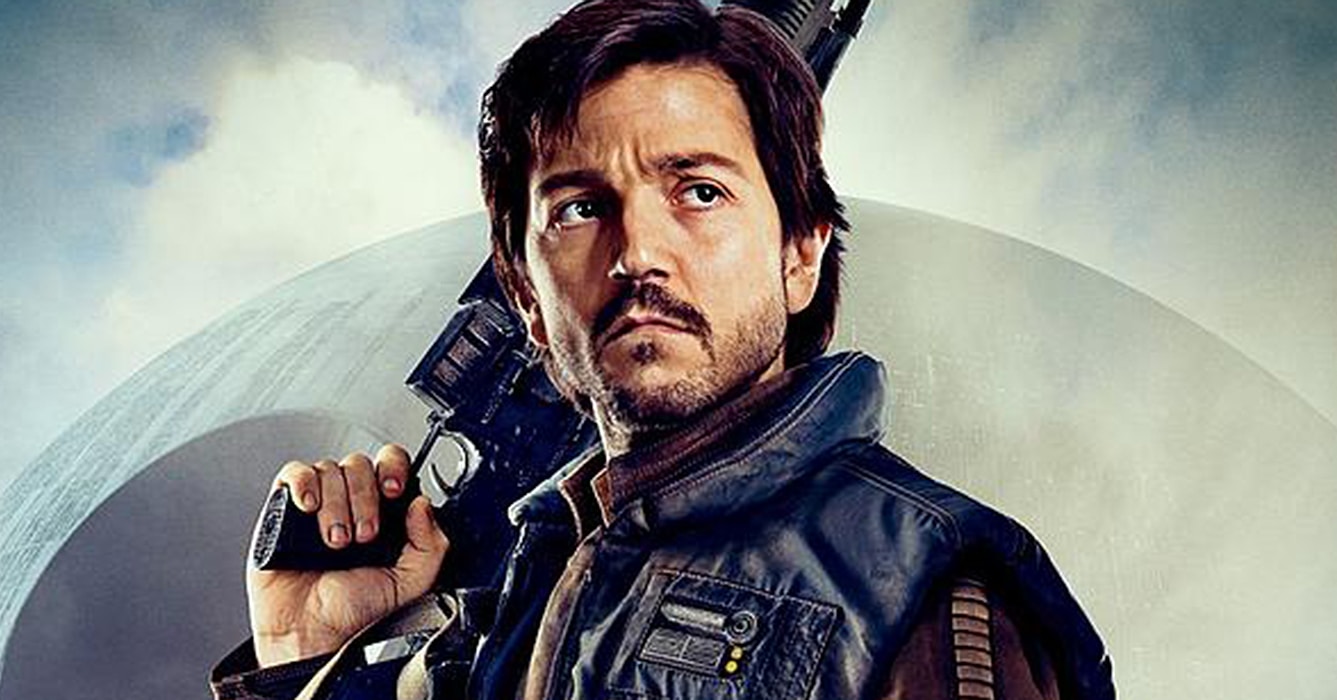
If you read my other blog, you know I fell in love with Cassian Andor (Diego Luna) the first time I saw Rogue One.  Obviously, that meant the characterization of Cassian was going to be make-or-break for this novel.  I approved if it.  In fact, all the characterizations were awesome, and some of them even made me like a character better than I do in the movie.  Especially Lyra Erso (Jessica Prescott will be happy to hear this) -- I still object to her behavior, but I understand her choices a little better now.  Similarly, I don't find General Draven quite so horrid as I did before.  He's still a black-handed bossypants, but I get where he's coming from now.

The only thing I truly disliked about this book, to be honest, was the fact that it does have some bad language.  Not a lot, but one of the things I love about the film is that it has zero bad language.  I wish the book had been the same.

Particularly Good Bits:

The tragedy of K-2SO's existence was this:  The skills he most cherished were skills his rebel masters disdained; and the skills he considered crude and trivial were skills his masters were helpless to learn (p. 144).

He was tired of crimes he never answered for (p. 153).

Steam spilled from the iris, and as Krennic's eyes adjusted he heard a new sound:  a hollow, metallic rasp that resonated in the chamber; the desperate, hungry breathing of a creature that should not have been alive (p. 189).

Dozens of vessels winked into existence against the shroud of space, filling the void as if some mythological deity had upturned a bottle of fresh stars over the heaves (p. 252).

It was, in a sense, a delaying tactic, but delay defeat long enough, and a triumph  might eventually find its way home (p. 265).

Was this hope?  Facing fear after fear, for oneself and for friends and for the galaxy, all out of some desperate need to accomplish the impossible?  (p. 271).

If This was a Movie, I Would Rate It:  PG-13 for violence and language.

Wednesday, July 22, 2015

"Fortunately, the Milk" by Neil Gaiman

I got Fortunately, the Milk from the library because it kept popping up on reading lists that also included A Snicker of Magic, and since Sam and I both adored that book, I thought we should give this a whirl.  I've never read one of Gaiman's books before, but I've wanted to for a while because I liked his story in A Study in Sherlock, and also, he lives in Wisconsin part of the time, and I used to live in Wisconsin, so that made me interested in him too.

Fortunately, the Milk is a tall tale told by a father who went out to get milk for breakfast and took an incredibly long time to get back, so he told his kids a fantastic story about time-travelling dinosaurs and pirates and wumpires and other funny things that kept him from getting back right away.  The book is chock full of silly illustrations by Skottie Young, which I found almost as funny as the book.  

Sam liked it pretty well too, though he only read it once, which means he didn't love it.  I liked it enough to plan on seeking out more of Gaiman's books.

If This Was a Movie, I Would Rate It:  PG for some mildly worrisome moments involving danger from volcanoes, wumpires, and pirates, etc.

Friday, July 11, 2014

"Shades of Grey" by Jasper Fforde

Some of you, having read the book title at the head of this post, may have been horribly aghast that someone whose blog you read would ever read That Book.  But then you looked at the author name, and then you saw the book cover image, and by now you've realized that I did not read That Book.  I read this book, an off-beat, speculative fiction kind of novel that defies easy description.

Shades of Grey takes place several centuries in the future, in a strange world few but Fforde could have imagined.  There are flocks of killer swans.  Everyone is terrified of the dark, because very few people can see in it.  Making new spoons is illegal.  And all of society is ordered according to a hierarchy of how much of what color you can see.  People can only see one color, or no color at all, and how much color you can see determines how important you are.

Some kind of cataclysmic event (referred to as The Something That Happened, and never explained in the book) is responsible for changing an advanced version of our world into this strange new one.  Weirdness and mysteries abound, and Eddie Russett, a young Red too curious for his own good, slowly figures some of them out.  He also falls in love with a violent Grey named Jane and gets eaten by a tree. 

By this point, you already know whether or not you'd like this book -- those last two paragraphs have made you either intrigued or annoyed.  So I'm not gong to make any recommendations here.  This was not my favorite Jasper Fforde book, but it wasn't my least-favorite either.  Fforde is clearly making a statement about the arbitrary hierarchies of today's world and the way we treat nonconformists, and probably several other points that I was too dizzied by his wackiness to catch.  In the end, I felt like it was too silly to be a serious novel, and too serious to be a silly novel.  Still, it was a fun read.

Particularly Good Bits:

I didn't set out to discover a truth.  I was actually sent to the Outer Fringes to conduct a chair census and learn some humility.  But the truth inevitably found me, as important truths often do, like a lost thought in need of a mind (p. 1).

I returned home, made sure Jane wasn't in the house, carefully filed the telegram in my valise and then hid under the bed for half an hour before making my way down to the sports fields (p. 254).

If This was a Movie, I Would Rate It:  PG-13 for adult dialog and situations (sex is always called "you know," but you know what "you know" stands for).

This is my ninth book read and reviewed for the I Love Library Books challenge.

Friday, April 11, 2014

"The Strange Case of Dr. Jekyll and Mr. Hyde" by Robert Louis Stevenson

Wow.  I'd never read this before, and it was not what I was expecting!  I mean, I knew the basic story (nice Dr. Jekyll creates a potion that turns him into evil Mr. Hyde), but I had no idea how introspective and philosophical it would get about human nature.

Yes.  I'm thirty-three, I've been reading classics since I was a little kid, and I'd never read this novella.  In fact, until a few years ago, I thought it was written by H. G. Wells!  Which is probably why I thought it would be both more sci-fi and more scary than it is.  This is not a scary book.  Well, not today.  I do like imagining what it must have been like to read this when it was first published.  When you didn't know the basic story, and you got to that reveal where Hyde turns into Jekyll before another character's eyes -- how freaky was that?

We're kind of used to the idea now.  The normal, nice, helpful guy with the rage monster inside him.  I've long thought that the whole idea of the Incredible Hulk draws heavily on this story.  Like Dr. Jekyll, Dr. Bruce Banner delves too greedily and too deep into the mysteries of science and medicine.  By so doing, he unleashes a beast from within his own self.  Like Mr. Hyde, the Hulk acts mostly from his primitive instinct to protect himself.  Now, unlike Dr. Jekyll, Dr. Banner can choose to unleash his inner Hulk.  And unlike Dr. Banner and his freak gamma ray accident, Dr. Jekyll chose to transform himself into the loathesome Mr. Hyde.  He enjoyed it, he deliberately transformed over and over -- at first.  And unlike Mr. Hyde, the Hulk isn't a homicidal maniac.  But both Dr. Banner and Dr. Jekyll had that monster within themselves all along.  Dr. Banner is always angry.  Dr. Jekyll has always enjoyed indulging in secret pleasures and vices. 

In fact, that's what I find the most interesting about this book:  the way it explores the idea of original sin.  If you're not familiar with the term, it's the Christian concept that all humans have inherited a sinful nature from their parents.  The Bible says, "Surely I am sinful from birth, sinful from the time my mother conceived me" (Psalm 51:5).  We all are capable of evil -- we all sin every day.  Maybe we can hide it, maybe we can fool ourselves into thinking it doesn't matter.  But it's there.  Dr. Jekyll created an elixir that could distill his evil nature, make his "better self" disappear while his "worse self" came to the foreground.  But that worse self had always been there, it had merely been disguised.

Particularly Good Bits:

The inhabitants were all doing well, it seemed, and all emulously hoping to do better still, and laying out the surplus of their gains in coquetry, so that the shop fronts stood along that thoroughfare with an air of invitation, like rows of smiling saleswomen (p. 8).

"If he be Mr. Hyde," he had thought, "I shall be Mr. Seek" (p. 19).

It was a wild, cold seasonable night of March, with a pale moon, lying on her back as though the wind had tilted her, and a flying wrack of the most diaphanous and lawny texture (p. 48).

If This was a Movie, I Would Rate It:  PG for oblique descriptions of sinful behavior and for mildly scary imagery.

This is my seventh book read and reviewed for The Classics Club and my fourth for the Mount TBR Challenge.

Saturday, November 24, 2012

"The Age of Miracles" by Karen Thompson Walker


Entertainment Weekly made this book sound poignant and intriguing, so I got it from the library.  They were right, but it seems I'm not at all in the mood for poignant these days.  Remember how This Side of Paradise depressed me?  So did The Age of Miracles.  Not as much, but it still planted a big cloud of gloom over my head for the few days it took me to read it.  If that sounds like a non-recommendation, it's not -- this book is original and lovely, it just was not at all what I wanted (or needed) to be reading right now.  Back before it took a lot of prayer, coffee, and chocolate to get me through the day in a cheerful fashion, I bet I'd have liked this book a lot more.

The Age of Miracles begins on the day that middle-schooler Julia and her parents learn, along with the rest of the world, that the earth's rotation is slowing down.  Known as The Slowing, this phenomenon at first doesn't seem to change things much -- days are a few minutes longer, at first.  Before long, though, those extra minutes are extra hours.  The government decides to stick with a twenty-four hour day, so that everyone can be on the same page about when things like school and work should happen.  Only not everyone likes that idea -- the "real timers" follow the sun's schedule instead, staying awake during the daylight and sleeping in the dark, even though those days stretch longer and longer. 

In the midst of all the global upheaval, Julia is also experiencing the ordinary upheaval of adolescence.  She likes a boy.  She doesn't understand her parents.  She wants to need to wear a bra.  She loses her best friend.  She tries to connect with her grandfather.  Life may be slowing down, but for her it is also speeding up.

Walker juggles the balance between global disruption and personal angst pretty deftly.  Neither one ever seems to be more important than the other.  And her concept of what would happen to the world feels very real -- animals and plants can't adapt, humans struggle to find solutions to problems like energy and food sources, and people argue and come to blows over changes they can't control.  In fact, the thing that gloomed me out is how real it felt -- I would sometimes look out my window and remind myself that the world wasn't actually slowing down and my life wasn't being disarranged, that was just in the novel.

If you like end-of-the-world-is-near books, or coming-of-age books, you'd probably dig this.  Me, I'm heading for the solace of yet another cheerful murder mystery.  I have three small children -- there's plenty of angst and strife in my real life, and I don't need more, even if it is fictional.

Particularly Good Bits:

Carlotta's long gray hair swung near her waist, a ghost, I suspected, of its younger and sexier self.

(Originally posted on Hamlette's Soliloquy on Aug. 20, 2012.)