Showing posts with label #DickensDecember. Show all posts

Wednesday, December 24, 2025

"The Cricket on the Hearth" by Charles Dickens

I can't believe I'd never read this before!  Somehow, I thought it was about a literal cricket sitting on a hearth, telling us stories about the people he's met and things he's experienced.  It is not about that AT ALL.  

I mean, there's a cricket in the story that does chirp near a hearth.  But it's not a talking or sentient cricket.  It's kind of a symbol of contentment and coziness in your own home and among your own family members.  I'm so glad this was one pick for this year's #DickensDecember readings over on Instagram, because I absolutely delighted in this book.

This book is actually about a sweet and cheerful young wife, her older and devoted husband, and some of their friends.  A shadow of suspicion falls over their happy home for a while, and I devoured the last couple chapters of this book in great worry over what was going to happen.

SPOILERS IN THIS PARAGRAPH.  One of the things I liked best were some cool parallels to the Biblical account of Mary and Joseph.  A young and sweet wife, an older husband who suddenly suspects things are not right with his marriage, his plan for a quiet and private separation, and a sudden revelation of unknown facts that makes everything okay again.

I am not always the biggest fan of Charles Dickens, but this is going on my list (with A Christmas Carol and A Tale of Two Cities) of Dickens books I truly and thoroughly enjoy!

Particularly Good Bits:

But let us be genteel, or die! (p. 74)  (I am guessing that Amy March's line "Let us be elegant, or die" in Little Women by Louisa May Alcott is an allusion to this line, since the March sisters are such fans of Dickens.)

If This was a Movie, I Would Rate It: PG for some allusions to suspected marital unfaithfulness.  No cussing, smut, or violence.

This has been my 47th book read and reviewed for my fourth Classics Club list.

Friday, December 16, 2022

"The Snow Storm: A Christmas Story" by Catherine Gore

Although parts of this had that overblown purple prose too many Victorian authors were fond of, the story was a lovely one, and I especially enjoyed the last few chapters.

The story concerns a small British village next to a large estate.  The estate was purchased by some newly rich people and utterly renovated by them quite recently.  They plan to have a fancy Christmas party there and have invited a lot of friends from London to make merry there with them.

The renovations involved turning an old man out of the farm which his family had tenanted for generations, and he is slowly sinking toward death with the grief of this.  But he has a very cheerful and competent niece (?) who is taking care of him now and has made his poor cottage into a snug home.

The London friends get stuck in a blizzard on their way to the estate and must take shelter where they can.  Naturally, some of them stop at this cottage of the poor, dispossessed old man.  Also naturally, a stranger also stops there who turns out not to be a stranger at all, because this is Victorian Literature and Everyone Must Be Connected Somehow.

Happily, I read enough Victorian books to be cool with that ;-)  I did enjoy the book a lot, though I freely admit to having skimmed some of the more purple parts.

Particularly Good Bits:

The poor were sanguine.  The poor are usually sanguine.  It is one of the few luxuries in which they can indulte.

...she had laughed her way through the labours of life;--guiltless of an unkind word or unfair action:--comprising her moral law in "do as you would be done by;" and her philosophy in "put your shoulder to the wheel; tomorrow's a handier help than yesterday."

If Dinah's whole life, in short, had been one of unmixed prosperity, it could scarcely have left her more thankful, or more thoroughly content.

However cheerless the prospects of the family, the sunshine of her buoyant spirits rendered them light.

If This was a Movie, I Would Rate It: G.  Nothing objectionable here.


This is my third book read for the Literary Christmas Reading Challenge, my 59th book read from my TBR shelves for #TheUnreadShelfProject2022, and my sixth for my fourth Classics Club list.
Thursday, December 1, 2022

"The Christmas Hirelings" by M. E. Braddon

This sweet little novella is like the epitome of Victorian Christmas fiction: filled with the knowledge that life can be fleeting and people can be cruel... but they don't need to be.

An aging aristocrat, his good friend, and his niece are all set to spend a very boring Christmas together at the aristocrat's country manor.  Then his friend suggests they "hire" some children to liven up their festivities, and after some consideration, they decide to do exactly this.  The friend departs for a while and returns with three siblings who are genteel, enthusiastic, and intelligent, and who fill the manor house with all the joy and brightness it was missing.

The smallest child is precocious in both intellect and attitude, and she captures the aristocrat's attention and eventually claims his heart (in a grandfatherly sort of way, never fear)... and then calamity strikes.  And, because this is Victorian literature, you can never be too sure that everything will turn out fine because some Victorian authors will just randomly kill off children just to make you cry, so I finished the last couple chapters of this novella with a lot of trepidation.  But I liked it a lot, by the very end.

Particularly Good Bits:

"Christmas can hardly be made too much of where there are children in question."

"They are small, but they are people."

Each of the children discovered a glittering new coin, and in Moppet's portion there were two sixpences.  The stout and serious butler helping the pudding on the carving-table by the light of a single candle was suspected of treasonable practices.

"People who are unhappy don't like anything.  Unhappiness is disliking."

"My life was barren, but it was peaceful.  What more did I want?"

If This was a Movie, I Would Rate It: G.  Clean and innocent and sweet.


I read this as part of the #DickensDecember2022 group challenge on Instagram, and it's also my first book read for the Literary Christmas Reading Challenge this year.  It's also my sixth book read for my fourth Classics Club list AND my 56th book read off my TBR shelves for #TheUnreadShelfProject2022.  Whew!

Sunday, December 19, 2021

"Christmas at Thompson Hall and Other Christmas Stories" by Anthony Trollope

I got this book because the first story, "A Christmas at Thompson Hall," was one of the selections for the  #DickensDecember2021 reading group this year.  And I went ahead and read the whole thing because... Christmas!  I'm not sure that I've read anything by Trollope before, but I really want to read something else of his now because he has a very engaging and conversational style, and I like that.

Anyway, here's what I thought of each story in this collection:

+ "Christmas at Thompson Hall" was hilarious.  I was laughing and laughing aloud over this story.  So much so that my kids asked me what was so funny, so I tried to summarize it, but it's so ridiculously complicated that I only confused them.  They'll just have to read it themselves.  It all revolves around a woman who is dragging her husband back home to England to have Christmas with her family.  And then he catches a cold, and she tries to get mustard to make a mustard plaster for him, and Victorian hijinks ensue.  I really don't want to explain more than that because it would spoil the fun for anyone who hasn't read it yet, but wants to.

+ "Christmas Day at Kirkby Cottage" was kind of a let-down after the bouncing fun of the previous story. Young lovers have an argument about the importance of Christmas and then make up.

+ "The Mistletoe Bough" is about a girl who thinks she shouldn't marry the man she loves because she thinks she's being a better person by denying herself happiness.  If that sounds like a downer to you, well, that's because it is.  It ends happily, at least.

+ "The Two Generals" was interesting because I haven't read any other stories about the American Civil War written by an Englishman.  His perspective of what people on either side of the conflict might be thinking was very interesting, and pretty even-handed.  The story is about two brothers from Kentucky who each become generals during the war... but one in the Union Army and one in the Confederate.  And they both love the same girl.  And they both sneak home for Christmas, and conflict ensues.

+ "Not If I Know It" revolves around a verbal misunderstanding between two friends, one of whom takes terrible offense to the way the other answers a request.  They spend Christmas glaring and grumbling, and it's just kind of a grumpy story all around.

So, clearly, "Christmas at Thompson Hall" was my favorite, and I really liked "The Two Generals" too, but I doubt I'll reread the other three stories.  Still, the first was so funny that I'll keep my copy just to reread it for laughs some future Christmas.

If This was a Movie, I Would Rate It: G.  Clean and unobjectionable stories.  But you may never look at mustard pots the same way again, or handkerchiefs, or hotel corridors.

This is my 33rd book read and reviewed for my third Classics Club list and my 50th for #TheUnreadShelfProject2021!!!

Monday, December 13, 2021

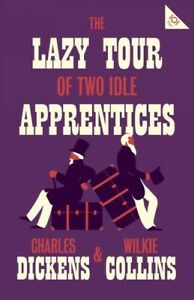
"The Lazy Tour of Two Idle Apprentices" by Charles Dickens and Wilkie Collins

I think the best thing I can say about this book is that... I've read it, so now I never have to wonder if I ought to read it.

Charles Dickens and Wilkie Collins went on a trip around the northwest part of England together, and they wrote up a fictionalized version of their trip to include in Dickens's magazine Household Words.  And it's both nonsensical and dull, which is kind of hard to make work, but they do.  The most interesting part, for me, was the beginning where they go hiking up a mountain and one of them sprains his ankle.  That was humorous and lively, and reminded me a lot of going hiking with my kids.  Someone is always lagging behind, someone is always whining, and so on.

There are two ghost stories included in their adventures, one kind of weird and one downright creepy.  I'm not a big fan of ghost stories, but I know the Victorians were, so I guess those were supposed to add some thrills?

Anyway.  If you are a fan of Dickens or Collins (or both), you might find this interesting just because they did collaborate on it, but I will be selling my copy to the used bookstore forthwith.

If This was a Movie, I Would Rate It: PG for those ghost stories, which were too creepy for young kids.


This is my 32nd book read and reviewed for my third Classics Club list and my 49th off my TBR shelves for #TheUnreadShelfProject2021.  

Tuesday, December 15, 2020

"A House to Let" by Charles Dickens, Elizabeth Gaskell, Adelaide Anne Proctor, and Wilkie Collins


Well, this was an interesting premise for a novella, anyway.  Charles Dickens and his writer friends Wilkie Collins, Elizabeth Gaskell, and Adelaide Anne Proctor all got together to write a book in several pieces that got stitched together later with a narrative framework.

It begins with "Over the Way," co-authored by Dickens and Collins, which tells of an elderly woman who moves to London and becomes fascinated by the house across the street from her new home.  It's up for rent, or "to let," and she thinks it contains a mystery, so she asks her butler and an old friend to both find out the history of the house.

Elizabeth Gaskell picks up the story with "The Manchester Marriage," which is part of the house's history, all about a widow who remarries a kind man, but inadvertently causes heartache.

Charles Dickens adds to the house's history with "Going into Society," about sideshow performers who turned the house into an attraction for a time (think The Greatest Showman).  One of them tries buying his way into society, but discovers that society only wanted to be friends with his money, not him.

Adelaide Anne Proctor continues the list of unhappy happenings with a series of narrative poems called "Three Evenings in the House" about a woman who continually gives up her own chances at happiness to help her brother.

Proctor's other contribution, "Trottle's Report," brings in the current history of the house and the mysterious goings on there.  Another tragedy is in the works, but perhaps it can be averted!

Dickens and Collins end the whole story together with "Let at Last," which does at least have a happy ending, so the whole thing ends on a good note.

Having different authors for the different bits gives them the flavor of being stories told to the characters by very different people, which worked very well for this sort of story -- better than I expected it to, in fact!  I liked "Going into Society" best, I think, because it didn't end totally sadly, but more in a realistically melancholy sort of way.

If This was a Movie, I Would Rate It: PG for some sadness, deaths, and child abuse of the sort you commonly find in Dickens.

Several of the stories-within-the-story take place around Christmas, as does the main narrative that frames them, so this is technically a Christmas story, and thus it is my 2nd book read for the Literary Christmas reading link-up hosted by In the Bookcase.  It's also the 11th for my 3rd Classics Club list and my 49th for #TheUnreadShelfProject2020.

Monday, November 25, 2019

"Nutcracker and Mouse King" by ETA Hoffmann AND "The Tale of the Nutcracker" by Alexandre Dumas

I'm reviewing these together because The Tale of the Nutcracker is Alexandre Dumas' French translation of the German story Nutcracker and Mouse King by E.T.A. Hoffmann.  And the edition I read has them both together, translated into English by Joachim Neugroschel.

I'd never read either of these before -- my knowledge of the Nutcracker story comes from the ballet by Mikhail Baryshnikov that we watched on PBS every winter when I was a kid, and which I now watch on DVD with my own kids.  It was interesting to see the differences not only between these two versions of the story, but between them and the ballet!


E.T.A. Hoffman's is the original, and it has this very bold, brash feel to it.  And it's kinda dark.  Very German-winter-near-the-old-and-scary-forest sort of vibe.  It's all about a little girl named Marie who has a somewhat creepy godfather, Herr Drosselmeier, as well as a bratty brother named Fritz and a snobby sister named Luise.  They get a huge number of fabulous presents for Christmas, including a mechanical castle made by Drosselmeier, who is a Chief Justice, but seems to spend most of his time making fantastical toys and fixing clocks.  He also gives the family a very ugly nutcracker. 

Marie loves the Nutcracker.  She stays up late playing with him, gets attacked by lots of mice led by a seven-headed Mouse King, the Nutcracker and all of Fritz's toy soldiers come to life and have a battle with the mice, and Marie gets injured in the fray, but saves Nutcracker from the ravages of the Mouse King by throwing her shoe at him.  She faints from blood loss, and has to spend a week in bed recovering.

While she's stuck in bed, Herr Drosselmeier comes to visit.  No one in her family believes Marie's story of how she hurt her arm, but Drosselmeier seems to.  He tells her a long story about a princess named Pirlipat, some wicked mice, and a brave young man who tried to save the princess from the mice, only to get turned into a nutcracker.  Marie is convinced this story is about her new Nutcracker, especially when she gets visited by the Mouse King for several nights running.  Mouse King demands she sacrifice all her candies and cookies and marzipan treats to him, or else he'll gnaw on Nutcracker.  Marie tearfully complies, until all her goodies are gone.  But then Nutcracker comes back to life, defeats the Mouse King once and for all, and takes Marie on a journey to the Land of Sweets, which he rules.

After seeing many delightful things there, Marie falls asleep, and wakes up back at home in bed.  Her whole family laughs at her when she tells them about her journey.  But then Herr Drossellmeier returns, with his handsome nephew who has just returned from a long journey, and who obviously is the Nutcracker released from the enchantment for good.

Marie, though only 7, accepts this nephew's offer of marriage.  One year later, they get married, and live happily ever after in the Land of Sweets.

Um, yes.  Child bride and all that.  Hmmmmmmmm.  It's a weird, wacky story, obviously not meant to be taken seriously, so I guess we're just supposed to shrug and be cool with it.

Alexandre Dumas' translation is fairly similar, but he takes out a lot of the scary or weird parts, or tames them down.  Yes, the same Alexandre Dumas who wrote The Count of Monte Cristo and The Three Musketeers tried to make a more-child-friendly version of the story when he translated it.  Which amuses me.  Basically the same things happen, except the mice are way less icky and the whole thing has a more sparkly, bright feel.

I definitely preferred Dumas' version because it was more whimsical, yet a little less nonsensical.

Overall, the story reminded me of a blend of The Wizard of Oz, the Chronicles of Narnia, and Alice in Wonderland, plus the game Candy Land.


You know how, in the ballet, about half the time is taken up with the girl and the prince watching his subjects dance while in his magical kingdom?  That's like one paragraph in this story.  Which also cracks me up.

One thing I like better about both of these than the ballet (at least the Baryshnikov version, which is the only one I've seen) is that they make it clear that the Nutcracker really DOES come to life, and the girl DOES get to marry him and live happily ever after.  I don't always hate the "it was all a dream" kind of ending, as it does work for some stories, but I've never liked its use in the ballet.  So I shall imagine the ballet ends this way from now on.

If This was a Movie, I Would Rate It: PG for some scary/creepy stuff involving mice gnawing on, or threatening to gnaw on, people.


This is my first entry into the Literary Christmas challenge and my 38th for my second go-'round with the Classics Club.