Another short scene! Don't these make you feel productive? "What did you do today?" "Read a scene from Hamlet." No one needs to know it was only a page and a half long!
Rosencrantz and Guildenstern accost Hamlet and try to get him to tell them where he's hidden Polonius' body. Hamlet resumes his antic ways, verbally sparring with them, playing with words, and not being at all cooperative. He ends with "Hide fox, and all after," whereon most productions have him run away and them chase him, like grown men playing tag.
Remember in the post for Act III, Scene 2 that I mentioned I'd just learned that "thing" and "nothing" were used in Shakespeare's day as euphemism's for men and women's "naughty bits" (to toss in a Monty Python euphemism). As soon as I learned that, I immediately thought of the end of this scene, when Hamlet says, "The King is a thing" (24). I don't know enough about slang in Shakespeare's day to know if this is true or not, and this is totally my own reading/idea here, but might Hamlet be using the word "thing" here the same way we would say "jerk," or several other less-savory modern euphemisms that people today use to describe people who are being jerks? And then saying he's "of nothing" would seem to be a reference to Claudius' seduction of Gertrude to secure the throne, perhaps? I don't know, it just makes this passage make more sense in a way, because "the King is a thing" is so random and pointless otherwise, and Hamlet's words, wild and whirling though they may be, are rarely pointless.
Favorite Lines:
"A knavish speech sleeps in a foolish ear" (20).
Possible Discussion Questions:
Do you think Rosencrantz really didn't understand Hamlet calling him a sponge, or is he just angry and frustrated with this antic, deadly prince?
Can you think of a different reading of "the king is a thing" that also makes sense? Or is Hamlet just being super-random in his feigned madness there?
Pages
- Home
- Who Am I?
- Books I've Written
- Book Reviews -- Fiction
- Book Reviews -- Nonfiction
- Book Reviews -- Manga/Graphic Novels
- Book Reviews -- Books By Series
- Book Reviews -- Christian Fiction
- Christmas Reads
- Clean Reads -- Adults
- Clean Reads -- Teens/YA
- Clean Reads -- Kids
- Classics Club List #5
- Top Ten Lists Year by Year
- My Favorite Novels
Wednesday, November 11, 2015
Tuesday, November 10, 2015
"The Bourne Identity" by Robert Ludlum
"Cain is for Charlie, and Delta is for Cain."Every time I read this book, that phrase gets stuck in my head and cycles around and around for weeks. Not in an annoying way, but more in a "Here's how I can instantly get sucked back into the world of this amazing character whenever I feel like it" way.
This is the third time I've read this book, and I must admit I was a little hesitant going in because I went through a phase where I read like ten of Ludlum's books and then got tired of him and haven't touched one since. That was 9 or 10 years ago, and that was when I read this twice, and each of Ludlum's sequels (Supremacy and Ultimatum) once. Those are really good too, and I would like to reread them at some point, but it's the original that I love. And I do still love it! Yay!
There are also 9 sequels written by some other guy after Ludlum's death, but I refuse to read those because by the end of The Bourne Ultimatum, this poor character has been through so much that I want him to be able to live in peace, not keep getting sucked into one deadly situation after another. And this is a little odd for me, since usually once I love a character, I want to spend more and more and more and more time with them -- that's why I love Sherlock Holmes pastiches and so on. But nope, not for Jason Bourne. Let him be at peace.
Now, I also love the Jason Bourne movies that star Matt Damon. But they have very little to do with these books besides the idea of a trained assassin with amnesia who starts out the story riddled with bullets and floating in the ocean. Watching them is what got me to read this book in the first place, and I love both dearly, but they are quite different. Quite.
![]() |
| Matt Damon as Jason Bourne |
I have a great fondness for stories about amnesia. I think it's because I myself treasure my past and my memories -- I rely on them to inform so many of my daily decisions, small and large, trivial and important. The idea of having all that erased, of having nothing at all to rely on in that way... it terrifies and fascinates me.
Which brings me to describing the plot of this book, I guess. Only I don't want to describe too much, so consider this relatively spoiler-free. As spoiler-free as I can make it while still giving you some idea of what it's like, at any rate.
It all begins with a man on a ship in the middle of a storm. He gets shot by person or persons unnamed, falls in the water, and is left to die. Except he doesn't die, he gets found by fishermen and taken to a drunken English doctor who patches up his body. But what the doctor can't patch up is the man's mind -- he's got amnesia and remembers nothing at first of his previous life. Images and words trigger fragments of memories for him, and from that he pieces together clues that lead him to believe that his name is Jason Bourne, and that he's a ruthless assassin.
Then there's Marie St. Jacques, a Canadian financial analyst who was in the wrong place at the wrong time and whom Bourne takes hostage to escape people trying to kill him. Through lots of twists and turns, they wind up falling in love. She's a great character -- she's fiercely intelligent, stubborn, brave, clever (not the same as being intelligent, you know!), resourceful, and morally strong. I really love her way more than Marie in either of the movie versions.
Um, yes, I said either of the movie versions. Besides the Matt Damon version from 2002 that I mentioned already, there's also a TV movie from 1988 starring Richard Chamberlain. I didn't realize the 1988 existed for a long, long time, but once I found out about it, I had to find and watch it, and I'm so glad I did! In fact, I bought a copy.
![]() |
| Richard Chamberlain as Jason Bourne |
The TV version follows the book's plot very closely, and the book's characterization too. At first I wasn't sure if I could buy Chamberlain as Bourne because I'm so used to him in costume dramas like The Count of Monte Cristo (1975), but he absolutely nailed my perceptions of the book's character and made me hungry to re-read it. I'll review the 1988 version on my Soliloquy blog after I've had a chance to see it a second time, but I really did want to mention it here because if I didn't know it existed, very likely lots of other people didn't either.
Okay, so back to the book. It's got lots of action, lots of suspense, and many, many plot twists. So many wonderful plot twists that feel absolutely right and real as they happen, but that I couldn't see coming beforehand. The very best kind of twists. Also, it has some slam-bang character development -- we see Marie St. Jacques turn from a lonely, hardened career woman into a fiery, determined champion. We see a man who has no idea who he is begin to learn who he once was while also figuring out who he is now. As he learns more and more layers about his past, so many of them frightening and horrible, he fights to hang onto what he's grown into in the present, and it's beautiful and aching and... I love this guy, okay? The last three lines of this book both give me cold chills and make me want to cry at the same time.
Particularly Good Bits:
The day was being born, and so was he (p. 34).
"The easiest thing in the world is to convince yourself that you're right" (p. 371).
He was going mad! Blurred images from the past converged with the terrible reality of the present, driving him insane. The doors of his mind opened and closed, crashing open, crashing shut; light streaming out one moment, darkness the next (p. 424).
...all around him objects too painful to look at; he knew them and did not know them. They were fragments of dreams -- but solid, to be touched, to be felt, to be used -- not ephemeral at all (p. 517).
He was being pulled to another room high up in the brownstone, a room that held both the comfort of solitude and the frustration of loneliness (p. 519).
If This was a Movie, I Would Rate It: A very regretful R, for lots of bad language (including many instances of taking God's name in vain), a non-explicit rape, several non-explicit love scenes, and lots of violence.
Monday, November 9, 2015
Hamlet Read-Along: Act IV, Scene 1
Most of the scenes in Act IV are pretty short, and I intend/hope to buzz through them a little more quickly. I'd hoped to finish this play off by Thanksgiving, and while I'm not sure that's feasible anymore, I'd still like to finish it before the second week of December. We shall see!
So this is a short scene where Claudius asks Gertrude what she learned from Hamlet, and we learn something very important: Gertrude is going to protect her son. She tells Claudius he is "[m]ad as the sea and wind when both contend Which is the mightier" (7-8). She blames his murder of Polonius on his madness, too.
Claudius mostly focuses on himself here -- he might have been the one killed instead of Polonius! He's going to get blamed for letting a madman run around Elsinore stabbing people! Oh dear! Time for some damage control! He's going to send Hamlet to England as quickly as possible, while figuring out a way to keep the people of Denmark from demanding he have Hamlet stand trial for the crime without getting in trouble himself.
See? Nice and short.
Favorite Lines:
"Oh, come away!
My soul is full of discord and dismay" (45).
Possible Discussion Questions:
Do you think Gertrude is lying to Claudius like Hamlet asked her to, or might she think Hamlet is mad for real?
So this is a short scene where Claudius asks Gertrude what she learned from Hamlet, and we learn something very important: Gertrude is going to protect her son. She tells Claudius he is "[m]ad as the sea and wind when both contend Which is the mightier" (7-8). She blames his murder of Polonius on his madness, too.
Claudius mostly focuses on himself here -- he might have been the one killed instead of Polonius! He's going to get blamed for letting a madman run around Elsinore stabbing people! Oh dear! Time for some damage control! He's going to send Hamlet to England as quickly as possible, while figuring out a way to keep the people of Denmark from demanding he have Hamlet stand trial for the crime without getting in trouble himself.
See? Nice and short.
Favorite Lines:
"Oh, come away!
My soul is full of discord and dismay" (45).
Possible Discussion Questions:
Do you think Gertrude is lying to Claudius like Hamlet asked her to, or might she think Hamlet is mad for real?
Friday, November 6, 2015
Guest Post about "Persuasion" by Jane Austen
Wednesday, November 4, 2015
Hamlet Read-Along: Act III, Scene 4
Clearly, I just don't have the wherewithal to do read-along posts regularly while visiting my parents this time. I promise that next week, I'll get back to my more usual posting schedule.
So here we are in Act III, Scene 4, and things have started going downhill fast, haven't they? I mean, first Hamlet gets very sarcastic and disrespectful with his mom, and then he goes and kills Polonius. Accidentally, as it were -- he thought the person hiding behind there was surely Claudius, and that he'd found exactly what he'd wished for in the previous scene: a chance to kill Claudius while he was sinning. But nope, it was that "wretched, rash, intruding fool" (31).
I really like the line "I took thee for thy better" (32) because you can understand it two ways: either "I mistook you for your better" or "I killed you in place of your better." Love passages with multiple meanings like that.
Finally, Hamlet convinces Gertrude that Claudius killed his father and that she did wrong to marry her dead husband's brother. Like the Ghost, Hamlet spends a lot more time talking about the latter issue than the former, and while some read this as indicating he has an Oedipus-like desire for his mother, I think it more reflects the Ghost's accusations as well as the moral code of the time and culture in which Shakespeare wrote this. Killing someone was bad, but fairly commonplace. Marrying your in-law, though, was seen as icky. And so often, our human nature reacts more strongly to "icky" than "bad." Anyway, I'm not saying the more Freudian interpretation is totally invalid, I just don't see it as the only valid one.
Did you catch that "ears" theme cropping up again? Gertrude says, "Oh, speak to me no more! These words like daggers enter in my ears" (94-95). I really think Shakespeare deliberately had Claudius poison King Hamlet by pouring the poison in his ear -- it's not how you usually poison someone, after all. And here again -- words like daggers, ears the place where you are vulnerable. Hearing things, Shakespeare seems to say, can be just as dangerous as doing them. I'm always reminded of a Bible passage, the part in James where it says "no human being can tame the tongue. It is a restless evil, full of deadly poison" (James 3:8). I wonder if Shakespeare had that passage in mind while writing Hamlet.
Anyway, the Ghost pops up again! This time inside the castle. And here we have an enduring question: Why Doesn't Gertrude See It? Horatio and Marcellus and Barnardo could see it. Does Gertrude truly not see it? Or is she only pretending not to see it because she doesn't want to? That's our Possible Discussion Question for today.
Hamlet promises the Ghost to get on with the revenging business, then adjures Gertrude to quit sleeping with Claudius and to absolutely not tell him that Hamlet isn't actually mad, just pretending. Then off he goes, pulling Polonius' body out behind him. He clearly suspects that the whole "send Hamlet to England" idea is a trap, and tells Gertrude he doesn't trust Rosencrantz and Guildenstern a bit. Poor Hamlet -- he basically can't trust anyone but Horatio anymore. Even Ophelia was helping her father and Claudius spy on him. Hamlet, Hamlet, get out while the getting is good!
One last thing: pay attention to this idea of someone being "hoist with his own petard" (207), or destroyed by the violence or trap they intended for someone else. It's going to come up again.
Favorite Lines:
"O Hamlet, speak no more!
Thou turn'st my very eyes into my soul" (88-89).
"This is the very coinage of your brain" (137).
"My pulse as yours doth temperately keep time
And makes as healthful music. It is not madness
That I have uttered" (140-42).
"O Hamlet, thou hast cleft my heart in twain" (156).
"Assume a virtue if you have it not" (160).
"I must be cruel only to be kind" (178).
"Indeed this counselor
Is now most still, most secret, and most grave
Who was in life a most foolish, prating knave" (213-15).
So here we are in Act III, Scene 4, and things have started going downhill fast, haven't they? I mean, first Hamlet gets very sarcastic and disrespectful with his mom, and then he goes and kills Polonius. Accidentally, as it were -- he thought the person hiding behind there was surely Claudius, and that he'd found exactly what he'd wished for in the previous scene: a chance to kill Claudius while he was sinning. But nope, it was that "wretched, rash, intruding fool" (31).
I really like the line "I took thee for thy better" (32) because you can understand it two ways: either "I mistook you for your better" or "I killed you in place of your better." Love passages with multiple meanings like that.
Finally, Hamlet convinces Gertrude that Claudius killed his father and that she did wrong to marry her dead husband's brother. Like the Ghost, Hamlet spends a lot more time talking about the latter issue than the former, and while some read this as indicating he has an Oedipus-like desire for his mother, I think it more reflects the Ghost's accusations as well as the moral code of the time and culture in which Shakespeare wrote this. Killing someone was bad, but fairly commonplace. Marrying your in-law, though, was seen as icky. And so often, our human nature reacts more strongly to "icky" than "bad." Anyway, I'm not saying the more Freudian interpretation is totally invalid, I just don't see it as the only valid one.
Did you catch that "ears" theme cropping up again? Gertrude says, "Oh, speak to me no more! These words like daggers enter in my ears" (94-95). I really think Shakespeare deliberately had Claudius poison King Hamlet by pouring the poison in his ear -- it's not how you usually poison someone, after all. And here again -- words like daggers, ears the place where you are vulnerable. Hearing things, Shakespeare seems to say, can be just as dangerous as doing them. I'm always reminded of a Bible passage, the part in James where it says "no human being can tame the tongue. It is a restless evil, full of deadly poison" (James 3:8). I wonder if Shakespeare had that passage in mind while writing Hamlet.
Anyway, the Ghost pops up again! This time inside the castle. And here we have an enduring question: Why Doesn't Gertrude See It? Horatio and Marcellus and Barnardo could see it. Does Gertrude truly not see it? Or is she only pretending not to see it because she doesn't want to? That's our Possible Discussion Question for today.
Hamlet promises the Ghost to get on with the revenging business, then adjures Gertrude to quit sleeping with Claudius and to absolutely not tell him that Hamlet isn't actually mad, just pretending. Then off he goes, pulling Polonius' body out behind him. He clearly suspects that the whole "send Hamlet to England" idea is a trap, and tells Gertrude he doesn't trust Rosencrantz and Guildenstern a bit. Poor Hamlet -- he basically can't trust anyone but Horatio anymore. Even Ophelia was helping her father and Claudius spy on him. Hamlet, Hamlet, get out while the getting is good!
One last thing: pay attention to this idea of someone being "hoist with his own petard" (207), or destroyed by the violence or trap they intended for someone else. It's going to come up again.
Favorite Lines:
"O Hamlet, speak no more!
Thou turn'st my very eyes into my soul" (88-89).
"This is the very coinage of your brain" (137).
"My pulse as yours doth temperately keep time
And makes as healthful music. It is not madness
That I have uttered" (140-42).
"O Hamlet, thou hast cleft my heart in twain" (156).
"Assume a virtue if you have it not" (160).
"I must be cruel only to be kind" (178).
"Indeed this counselor
Is now most still, most secret, and most grave
Who was in life a most foolish, prating knave" (213-15).
Tuesday, November 3, 2015
"The Sense and Sensibility Screenplay & Diaries" by Emma Thompson
First, a confession: I didn't read the screenplay half of this book, only the diaries. I must admit that I'm not a huge fan of reading screenplays unless they're for something I dearly love, so I skipped that. But Emma Thompson's filming diary is delightful, and I read it all this afternoon. And so I have this impromptu addition to my Jane Austen Week celebratory posts :-)
My goodness, I want to be friends with Emma Thompson and hang out with her all the time. She is an amazing blend of intelligence, humor, and capability -- or at least, that's how she comes across in this collection of her random thoughts while filming Sense and Sensibility (1995), which she not only starred in, but wrote the screenplay for. (And she won the Oscar for Best Screenplay, too!) If you're not particularly interested in how movies get made, you might not be too keen on this book, but I found it fascinating, hilarious, and informative. So many insights into the story and characters, so many incisive and wry comments about modern life as an actor, so many random and chuckle-inducing anecdotes.
However, a sprinkling of bad language and some casual mentions of sexual matters prevents me from universally recommending this book. Alas. I wish it was cleaner, because it's lovely overall.
Particularly Good Bits:
I seem finally to have stopped worrying about Elinor, and age. She seems now to be perfectly normal -- about twenty-five, a witty control freak. I like her but I can see how she would drive you mad. She's just the sort of person you'd want to get drunk just to make her giggling and silly (p. 253).
Sense and Sensibility is about love and money. Perhaps its main question is, can love survive without money? A pithy question. Romantic codes teach us that love conquers all. Elinor disagrees. You need a decent amount of money. It's a difficult thing to accept. It cries out against all our cherished ideals. But interesting that our 'western' romantic symbols cost a great deal. Roses, diamonds... (p. 255).
Elinor and Edward seem both to belong to the eighteenth century, the age of Augustan reason. They are firm, balanced, judgemental, drily humorous, far more Alexander Pope than Walter Scott. Marianne shoots toward the middle of the nineteenth century, embracing each romantic ideal like a new lover. The turn of a century always seems to produce a Janus-like generation, some clinging to old systems, some welcoming a new age. Always a powerful time (p. 265).
If This was a Movie, I Would Rate It: a disappointing R for language and suggestive material, as well as drinking and smoking.
My goodness, I want to be friends with Emma Thompson and hang out with her all the time. She is an amazing blend of intelligence, humor, and capability -- or at least, that's how she comes across in this collection of her random thoughts while filming Sense and Sensibility (1995), which she not only starred in, but wrote the screenplay for. (And she won the Oscar for Best Screenplay, too!) If you're not particularly interested in how movies get made, you might not be too keen on this book, but I found it fascinating, hilarious, and informative. So many insights into the story and characters, so many incisive and wry comments about modern life as an actor, so many random and chuckle-inducing anecdotes.
However, a sprinkling of bad language and some casual mentions of sexual matters prevents me from universally recommending this book. Alas. I wish it was cleaner, because it's lovely overall.
Particularly Good Bits:
I seem finally to have stopped worrying about Elinor, and age. She seems now to be perfectly normal -- about twenty-five, a witty control freak. I like her but I can see how she would drive you mad. She's just the sort of person you'd want to get drunk just to make her giggling and silly (p. 253).
Sense and Sensibility is about love and money. Perhaps its main question is, can love survive without money? A pithy question. Romantic codes teach us that love conquers all. Elinor disagrees. You need a decent amount of money. It's a difficult thing to accept. It cries out against all our cherished ideals. But interesting that our 'western' romantic symbols cost a great deal. Roses, diamonds... (p. 255).
Elinor and Edward seem both to belong to the eighteenth century, the age of Augustan reason. They are firm, balanced, judgemental, drily humorous, far more Alexander Pope than Walter Scott. Marianne shoots toward the middle of the nineteenth century, embracing each romantic ideal like a new lover. The turn of a century always seems to produce a Janus-like generation, some clinging to old systems, some welcoming a new age. Always a powerful time (p. 265).
If This was a Movie, I Would Rate It: a disappointing R for language and suggestive material, as well as drinking and smoking.
Sunday, November 1, 2015
Jane Austen Week Tag
Jane Austen Week on Wonderland Creek is here! Naomi Bennet has oodles of spiffy games and other Austenian delights coming all week long, so if you're at all a fan of Jane Austen novels or movies, trot on over there and join the fun!
Here are my answers to the initial party tag. I'll be participating in other ways later this week, too, but I'm doing this for starters :-)
The Questions:
1. On a scale of 1 to 10, how much of a Jane Austen fan do you consider yourself?
Hmm. Probably an 8. I really enjoy her books and many movies based on them, and I love learning about the history of her era, and about Jane Austen herself. I consider myself an Austenite, not a Janeite, just because "Janeite" seems to be used by people who are more interested in the romantic aspects of her novels, whereas I enjoy them more for her writing style and the characters as a whole. Which doesn't mean I don't enjoy the romances too, but they're not what primarily draws me to her books -- they're more like the whipped cream on top of the hot chocolate.
2. If "they" would make a new Jane Austen Movie, and you would be able to be cast in it, which Jane Austen character would you most like to play?
Mrs. Croft from Persuasion. She is such a joy -- helpful, kind, intelligent, enthusiastic, warm... I am exceedingly fond of her. Also, she and Admiral Croft have one of the best marriages we see in Austen, and I like to think my own marriage is rather like theirs.
3. Is there any felicity in the world superior to a walk?
Well, I prefer reading and writing novels to taking walks, and also watching movies. I only really enjoy walks if I have a destination -- if it's walking just for the sake of walking, I'm not really a fan.
4. Who's your favourite Jane Austen 'villain'? (As in 'villain' meaning 'the bad guy.')
No, no, see, I don't have favorite villains! I don't like villains! There are only degrees of how much I dislike them!
Wait, is Frank Churchill considered a villain? I don't find him villainous, but I know a lot of people think he's awful. If so, then I choose him, because I think he's silly and vain and thoughtless, but not awful. I know, I know, I'm weaseling here.
5. What/Who introduced you to Jane Austen?
My mom. She rented the 1995 Sense and Sensibility when it came to video and we watched it together. I thought it was okay. Then she gave me four of Austen's novels for my 16th birthday, and then my friends and I rented the Gwyneth Paltrow 1996 Emma and I loved that.
6. Did you love/enjoy Jane Austen immediately, or has there been a time when you hated (um, prejudged) it?
Oh, hah, I kind of answered that a little above. I never hated Jane Austen's stories, but until the Gwyneth Paltrow Emma, I didn't really enjoy them much. And until Persuasion, I didn't love any of her novels.
![]() |
| (This is only here because I was looking for images of someone gasping, and this made me laugh aloud.) |
7. Who, in your opinion, is the funniest Jane Austen character?
Probably Mr. Woodhouse. I feel too sorry for Miss Bates to find her truly hilarious, though she does make me laugh. But Mr. Woodhouse is like an extreme version of my own germophobic father, and he amuses me greatly.
8. Do you quote Jane Austen randomly in public?
Of course.
9. Are children allowed to eat cake on weddings?
On weddings? Surely you mean at weddings? This must be one of those Europe vs. America things? Anyway, yes, I encourage children to eat cake at weddings because otherwise I will eat it, and I don't need more cake.
10. What is your reaction when you hear that an aquaintance (e.g. A lady at Church) of yours loves Jane Austen?
Oh, good! Someone I can have Intelligent Conversations with. Let's go out for coffee!
11. Who writes better letters, Mr Darcy or Captain Wentworth? (If you forgot what the letters were, shame on you, instead tell me if you prefer Strawberries to Chocolate or not.)
Captain Frederick Wentworth. Mr. Darcy writes nicely, but he has never curled my toes with unutterable joy the way Captain Wentworth has.
(And may the record show that I like strawberries dipped in chocolate, but I don't know if I could choose between the two.)
12. Which Jane Austen heroine do you relate the least to?
Fanny Price. I really don't understand or relate to her at all.
13. What's your favourite Jane Austen house (from one of the movies)?
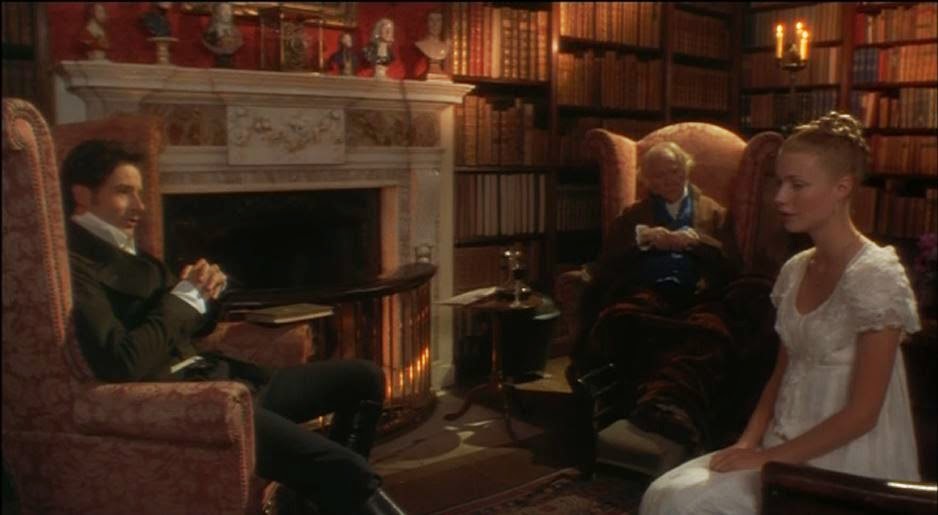
Hartfield from Emma (1996). I went into raptures about it here. I would LOVE to live there.
| (I could live very happily in this library alone, much less the rest of the estate.) |
14. What's your favourite Jane Austen dress (from one of the movies)?
Ummmmm. Probably Emma's peachy ensemble here:
15. Can you turn off lit candles with your fingers?
Yes. I often do. It helps if you lick your fingers first, by the way.
Subscribe to:
Posts (Atom)