Is it me, or have the chapters suddenly gotten way longer? Hmm.
So the fellowship sets out at last, and I start to feel that the story is truly getting started.
A lot happens here, and yet I don't have a lot to say. The bit on Caradhras is very exciting. I spend a lot of time there being impressed by Boromir. He's the one who suggests bringing wood. He's the one who worries that the snow will be "the death of the halflings" (p. 283). He's the one who suggests creating a path back down through the snow for the others to follow. And then he suggests carrying the hobbits through the path. So the last few pages of this chapter in my copy are full of little smiley faces in the margins, and the occasional heart. And sometimes a heart with a smiley face inside it if I'm particularly pleased.
Favorite Lines:
"Books ought to have good endings" (p. 266).
Health and hope grew strong in them, and they were content with each good day as it came, taking pleasure in every meal, and in every word and song (p. 267).
"May the stars shine upon your faces!" (p. 274).
Possible Discussion Questions:
Why is Aragorn is so against going to Moria? I kind of can't remember. Has he been there before?

Book reviews by a Christian writer/wife/mother
Saturday, November 30, 2013

Monday, November 25, 2013
Boromir
(Warning! This contains spoilers about events farther on in The Lord of the Rings. If you're unfamiliar with the whole story, save this to read later.)

Boromir
by Hamlette
It is no secret that Boromir is my favorite character in The Lord of the Rings. I must admit that I was initially drawn to him because he is played by Sean Bean in the movies. In fact, Sean Bean was the whole reason I let my college friends and boyfriend talk me into going to see The Fellowship of the Ring (2001). I had never read the books and knew nothing about the story. I'd read The Hobbit in high school and not cared for it, so I had no interest in Tolkien's other works. But if Sean Bean was in the movie, I'd give it a try.

By the time I'd finished that first movie, I was a firm Boromir fan. And not just because Sean Bean played him, but because he's precisely the sort of character that draws me. He's courageous, he's kind, and, let's face it, he's got really broad shoulders (thanks not just to Sean Bean's own lovely physique, but also to a very good costume). And he's got some moral ambiguity going on, which makes him a lot more interesting to me than straight-arrow Aragorn, Legolas, Gimli, Frodo, Sam, Gandalf, Eomer, and so on.

But it takes more than courage and broad shoulders to make me truly love a character the way I love Boromir. I think, more than anything, what draws me to him is his humanity. He's loyal to his homeland. He doesn't trust strangers. He's conflicted, trying to do what he believes is right for Gondor as well as all of Middle Earth. Trouble is, he's also very, very proud, and he thinks that he knows what's best.
Yes, pride is Boromir's great downfall. In fact, when we first meet him at the Council of Elrond, Tolkien describes him as "proud and stern of glance" (p. 234). He's well-known throughout Middle Earth as a mighty and powerful warrior. Aragorn himself calls him "a valiant man" (p. 269). Being known far and wide for your deeds of derring-do is not exactly conducive to humility, especially when you're Gondor's Captain-General and next in line to be Steward of Gondor.
It is this pride in his own strength that proves to be Boromir's undoing. At the Council of Elrond, he says, "Valour needs first strength, and then a weapon" (p. 260). He believes he has this strength, of course. He's the mighty and valiant Boromir, winner of battles and doer of great deeds! Elrond cautions him that the ring's own strength "is too great for anyone to wield at will, save only those who have already a great power of their own" (p. 261). I think that Boromir believes he has great power, and thinks he can bend the ring to his will.

And so, of course, Boromir stretches out his hand to take the ring, by force if necessary. His pride in his own strength is too great for him to realize that the ring wishes only to use him for its own purposes. He tells Frodo that "true-hearted Men, they will not be corrupted" (p. 389), not realizing that he has already been corrupted by his desire for more and more power.
But he does not get the ring. And when he realizes what he has done, that his great pride has led to an even greater fall, he weeps. He cries out, "A madness took me, but it has passed" (p. 390), seeing clearly at last what a terrible thing he has tried to do. And he repents of his fall, giving up life itself to make amends for his actions. He dies defending Merry and Pippin, two of what he called "the little folk" and took such care of throughout his time with them.

Aragorn finds him "pierced with many black-feathered arrows" (p. 404), surrounded by the Orcs he has killed. And there Aragorn absolves him of his sins, telling him he has not failed, but conquered. I think here that Aragorn is speaking of more than the dead Orcs that Boromir slew. He means that Boromir has conquered his own self, for he realized that trying to take the ring was wrong and repented of it.
Some people think Boromir is a villain. But I think he may be the most realistic character in the whole trilogy -- flawed and faulty, but ultimately heroic. I think he's a closer representation of us than any of the other characters. We too trust to our own strength, take pride in our own abilities, and stumble often as a result. May we also follow Boromir's example by first recognizing when we have done wrong, repenting of it, and then working to fix whatever we may have damaged when we stumbled.

Sunday, November 24, 2013
LOTR Read-Along: The Council of Elrond (FOTR Ch. 14)

Man, this is a long chapter with a lot in it. Where to start?
With Boromir, of course. Here he is at last, my beloved Boromir, this "tall man with a fair and noble face, dark-haired and grey-eyed, proud and stern of glance" (p. 234). There's a little smiley heart in the margins of my book here. I'm not going to say a lot more about him here, as I'm going to do a whole character post about him myself. So for now I'll just point out that he had traveled for a hundred and ten days, all alone, making his way from Minas Tirith to Rivendell. I wish I knew what sorts of adventures he had on the way. That's a long time to be out in the wilderness.

Also, it sounds in this like it was Boromir's idea that he come to Rivendell instead of Farmir, not Denethor's idea. He says "since the way was full of doubt and danger, I took the journey upon myself" (p. 240), which sounds very nice of him. And full of pride, which is his besetting sin, but still, nice of him to spare Faramir all that doubt and danger.
I find it interesting that Bilbo, who was hired by Thorin to be a burglar, ends up being called a thief. Here, Sauron's messenger is quoted as calling Bilbo a thief while talking to Dain, and didn't Gollum call him that too? Hmm.
Elrond is old! His memory "reaches back even to the Elder Days" (p. 237). Holy cow.
Fun factoid about Radagast the Brown: he's "a master of shapes and changes of hue" (p. 251). Wouldn't it be cool if they did something with this in the next Hobbit movie?
Saruman reminds me mightily of Hitler. His voice is his greatest weapon -- here, Gandalf says he was "lulled by the words of Saruman the Wise" (p. 244), and later on he'll tell his companions to beware of Saruman's voice. Also, Saruman says that his "high and ultimate purpose" is "Knowledge, Rule, Order" (p. 253). Doesn't that sound kind of Nazi-esque?
Okay, I'll say one last thing about Boromir. I love how he stands up for Rohan here. Gandalf and Aragorn discuss whether Rohan might be sending a tribute of horses to Sauron. Boromir says, "It is a lie that comes from the Enemy. I know the Men of Rohan, true and valiant, our allies" (p. 255-56). I love him especially much there.
Favorite Lines:
"'The time of my thought is my own to spend,' answered Dain" (p. 235).
"The might of Elrond is in wisdom not in weapons, it is said" (p. 239).
"If simple folk are free from care and fear, simple they will be, and we must be secret to keep them so" (p. 242).
"And he that breaks a thing to find out what it is has left the path of wisdom" (p. 252).
"May your beer be laid under an enchantment of surpassing excellence for seven years!" (p. 257).
"...only a small part is played in great deeds by any hero (p. 263).
"This is the hour of the Shire-folk, when they arise from their quiet fields to shake the towers and counsels of the Great" (p. 264).
Possible Discussion Questions: I'm always struck by the fact that Aragorn attends Elrond's council "clad in his old travel-worn clothes again" (p.233). Why do you suppose he does that? Is he trying to keep a low profile and not draw attention to himself? Trying to impress on people the fact that he's good at the whole wandering-around-and-being-brave thing? Boromir "looked again at Aragorn, and doubt was in his eyes" (p. 241), so clearly he didn't think Aragorn looks particularly kingly. But why?
Elrond says that "The road must be trod, but it will be very hard. And neither strength nor wisdom will carry us far upon it" (p. 262). Do you think this is a foreshadowing of what will happen with Boromir (strong) and Gandalf (wise)?
Friday, November 22, 2013
"The Valley of Fear" by A. Conan Doyle

The mystery of the first half is a sort of locked-room mystery involving the murder of a well-liked American living in Britain. Parts of it reminded me a lot of Laura by Vera Caspary, and others made me think of an earlier Holmes story, "The Golden Pince-Nez." The flashback is all about who wanted to murder that man and why, and it deals with a bunch of murderous members of a band of "freemen" who terrorized a coal mining community in America.
While only the first half involves Sherlock Holmes, the second half is a good adventure story, with some interesting characters and lots of action. So it's not by any means onerous to read.
Particularly Good Bits:
Mediocrity knows nothing higher than itself; but talent instantly recognizes genius (p. 238).
"It is, I admit, mere imagination; but how often is imagination the mother of truth?" (p. 274).
If This was a Movie, I Would Rate It: PG for violence.
Tuesday, November 19, 2013
LOTR Read-Along: Many Meetings (FOTR Ch. 13)

This may be one of my favorite chapters. I love peaceful Rivendell, and would love to spend some time resting there myself.
And I find the relationship between Bilbo and Aragorn so sweet. How Aragorn, with all the things requiring his attention and time, still willingly pauses to help Bilbo compose a song. And this is not the first time he's done so.
Random note -- Gandalf's eyes are described as "dark," and not as grey! But Elrond's eyes "were grey as a clear evening," while Arwen has "bright eyes, grey as a cloudless night" (p. 221).
Did you notice that Frodo has now twice been found lying on his face with a broken sword under him? Gandalf says that's how he was found after the flood passed, and back when Frodo was stabbed on Weathertop, that's exactly how his friends found him then too.
Favorite Lines:
Frodo lay down again. He felt too comfortable and peaceful to argue, and in any case he did not think he would get the better of an argument (p. 213).
"There are many powers in the world, for good or for evil. Some are greater than I am. Against some I have not yet been measured. But my time is coming" (p. 214).
Frodo was now safe in the Last Homely House east of the Sea. That house was, as Bilbo had long ago reported, 'a perfect house, whether you like food or sleep or story-telling or singing, or just sitting and thinking best, or a pleasant mixture of them all'. Merely to be there was a cure for weariness, fear, and sadness (p. 219).
Possible Discussion Questions:
Do you think there's any significance in Frodo being found twice lying on his face on top of a broken sword? Also, Bilbo says, "Don't adventures ever have an end?" (p. 226) Do you think they do, or do they just lead on to more adventures?
Monday, November 18, 2013
My Bookshelves
Emily over at Classics and Beyond participated in a really fun link-up hosted by a blog called Modern Mrs. Darcy. Basically, it's time to show off our bookshelves and talk a little about where and how we store, organize, and curate our book collections. So here are mine.
I keep a lot of my books in a room of our house we call the library. It contains a love seat, a piano, and four-and-a-half book cases.


We also have two book cases in our dining room, though the top shelf on each doesn't have books on it. This is where I teach my kids, so there are a bunch of school books and random supplies and general clutter here. Five of these shelves are full of my husband's books.

And there are three kid-sized cases in the living room.

And I have twelve boxes of books in the basement with no homes yet. I may have too many books. Nah.
Here are close-ups of some of the more interesting shelves.
Yeah, these are almost all about Hamlet. And no, I haven't read all of them. I intend to, but haven't had the chance yet.

These are all Shakespeare, books about writing, and poetry.


Here's my fiction collection. It's mostly organized alphabetically by author's last name, and then multiple books by the same author are alphabetical by title. Unless there's a series, then the series is in order. If I have a bunch of books about an author or character, those come after the originals. So all my Jane Austen-involved books are together, my Sherlock Holmes, etc.


And the bottom shelf and half the shelf above are all books I haven't read yet, starting after the Wolverine collections. Well, I've actually read the Elsie Dinsmore books, but I haven't gotten around to toting them downstairs to put in the boxes of young-adult books I have no room for right now.

And here are my history books. The top shelf is all WWII and the bottom is the rest of history, plus a few random books that don't have another home yet.

I keep my cookbooks in the dining room too, on a little corner shelf that was my great-grandfather's. I didn't actually realize it was that old until recently, so now I'm treating it a little better than I used to, hee. Anyway, my cookbooks are on one shelf, and then the bottom shelf is the middle-grade fiction my son getting into.

So that's pretty much all my bookshelves. I'm glad I got to participate in this link-up, as I love to talk about books! :-D
I keep a lot of my books in a room of our house we call the library. It contains a love seat, a piano, and four-and-a-half book cases.


We also have two book cases in our dining room, though the top shelf on each doesn't have books on it. This is where I teach my kids, so there are a bunch of school books and random supplies and general clutter here. Five of these shelves are full of my husband's books.

And there are three kid-sized cases in the living room.

And I have twelve boxes of books in the basement with no homes yet. I may have too many books. Nah.
Here are close-ups of some of the more interesting shelves.
Yeah, these are almost all about Hamlet. And no, I haven't read all of them. I intend to, but haven't had the chance yet.


These all have to do with movies and TV shows. There are some biographies and autobiographies, books about specific shows, general Hollywood stuff.

Here's my fiction collection. It's mostly organized alphabetically by author's last name, and then multiple books by the same author are alphabetical by title. Unless there's a series, then the series is in order. If I have a bunch of books about an author or character, those come after the originals. So all my Jane Austen-involved books are together, my Sherlock Holmes, etc.


And the bottom shelf and half the shelf above are all books I haven't read yet, starting after the Wolverine collections. Well, I've actually read the Elsie Dinsmore books, but I haven't gotten around to toting them downstairs to put in the boxes of young-adult books I have no room for right now.

And here are my history books. The top shelf is all WWII and the bottom is the rest of history, plus a few random books that don't have another home yet.

I keep my cookbooks in the dining room too, on a little corner shelf that was my great-grandfather's. I didn't actually realize it was that old until recently, so now I'm treating it a little better than I used to, hee. Anyway, my cookbooks are on one shelf, and then the bottom shelf is the middle-grade fiction my son getting into.

So that's pretty much all my bookshelves. I'm glad I got to participate in this link-up, as I love to talk about books! :-D
Saturday, November 16, 2013
"Riders of the Purple Sage" by Zane Grey
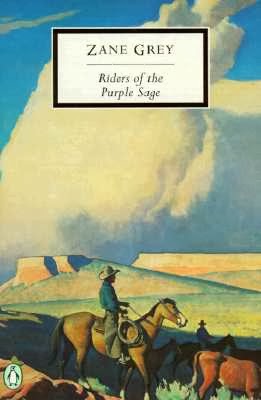 I thought I had read this before, but now I don't think I ever had. Which is silly, because it's one of the most famous western books. I'm glad I finally got to it!
Jane Withersteen is a wealthy Mormon woman whose expansive ranch is the biggest spread anywhere near the Utah town of Cottonwoods. She refuses to stop seeing a "gentile" named Bern Venters and marry a Mormon, and the leaders of the town decide to punish her and Venters for this. Into the fray steps a stranger named Lassiter whose reputation as a Mormon-hater and -killer is known throughout Utah. He saves Venters' life, then champions Jane Withersteen through everything her enemies can devise as they try to force her into submission.
This is not exactly an anti-Mormon book -- while the antagonists are all Mormons and use their religion as the reason behind their actions, Jane Withersteen is also a Mormon and relies on her faith to see her through. I don't know a great deal about Mormonism, just what I learned in catechism class years ago, and what I've picked up here and there since then. So I don't know how accurate any of this is to the history of Utah and such. But Mormonism is a big part of the book, and mostly it's not shown in a good light, but as an excuse to basically be thieves and murderers. Just so you know.
This book hit a lot of sweet spots for me: secret identities, vengeance and avengers, lonesome heroes, spirited heroines, love that crosses boundaries, and (of course) cowboys and the Old West. It also has some spectacular descriptions -- Grey creates a vivid world that's almost too fantastic to believe, full of vibrant colors and amazing landscapes. Nothing is dull or flat or ordinary here -- even the landscape is epic.
I think I could be good friend with Jane Withersteen. At the very beginning of the book, the narrator tells us that she "wished only to go on doing good and being happy" (p. 4). That reminds me a lot of me. She's also stubborn and secretive, but kind and generous. I like her a lot.
And Lassiter -- my goodness, he's precisely the sort of hero I love. A loner with a mission of vengeance, dressed all in black, with a lightning draw and a deadly aim, but with "a quaint grace and courtesy that came to him in rare moments" (p. 245). Yum, yum, yum.
So yeah, very glad I picked this up at the library and have now read it at long last. I suspect this will become one I reread now and then.
First Sentence:
A sharp clip-clop of iron-shod hoofs deadened and died away, and clouds of yellow dust drifted from under the cottonwoods out over the sage (p. 3).
Particularly Good Bits:
Venters looked out upon the beautiful valley -- beautiful now as never before -- mystic in its transparent, luminous gloom, weird in the quivering, golden haze of lightning. The dark spruces were tipped with glimmering lights; the aspens bent low in the winds, as waves in a tempest at sea; the forest of oaks tossed wildly and shone with gleams of fire (p. 157-158).
So, with his passion to kill still keen and unabated, Venters lived out that ride, and drank a rider's sage-sweet cup of wildness to the dregs (p. 203).
If This was a Movie, I Would Rate It: PG-13 for violence and some language.
Subscribe to:
Posts (Atom)